
TL;DR:
- Creative professionals can protect their mental space and creative energy by establishing clear, respectful boundaries grounded in personal sovereignty. Implementing behavioral scripts, contractual limits, and systemic workflows reduces scope creep and emotional exhaustion while fostering healthier client relationships. Structural safeguards are essential for sustainable creativity, shifting boundaries from reliance on willpower to felt safety within the work environment.
Creative professionals boundary setting is the practice of establishing clear, respectful limits that protect emotional health and creative capacity while sustaining professional relationships. A boundary is an expression of personal sovereignty that clarifies what you will do or allow, without severing connection or issuing ultimatums. For artists, writers, designers, and other creative workers, this distinction matters enormously. Without defined limits, scope creep, emotional exhaustion, and chronic overcommitment quietly erode the very conditions that make creative work possible. This guide integrates 2026 therapy guidance, DBT-based behavioral frameworks, and creator-specific workflow systems to give you practical tools you can use immediately.
What are healthy boundaries for creative professionals?
A healthy boundary is not a wall. 2026 therapy guidance defines boundaries as collaborative limits framed in personal sovereignty, not punishments or ultimatums. This means a boundary describes your behavior, not a demand you place on someone else. "I don't take revision requests after the final approval email" is a boundary. "You need to stop asking for changes" is a demand. The first is sustainable. The second creates conflict.

For creative workers, healthy limits serve a specific function: they preserve the psychological conditions that creativity requires. Deep work, emotional availability, and imaginative risk-taking all depend on a nervous system that feels safe. When your time and energy are constantly available to others without structure, that safety disappears.
Healthy limits for creative workers share three qualities:
- They are behavioral. They describe what you will do, not what others must do.
- They include follow-through. A limit without a planned response is a wish. DBT boundary work defines boundaries as specific behavioral limits with clear follow-through plans.
- They are communicated with kindness. Boundaries require kindness to hold effectively. Without it, the limit becomes a weapon rather than a protection.
One technique worth practicing is the 75/25 Somatic Boundary. You stay 75% grounded in your own body and felt sense while giving 25% of your attention to the other person. This prevents the nervous system flooding that makes creatives either over-explain their limits or abandon them entirely under social pressure.
Pro Tip: Before any client call where you expect pushback, spend two minutes doing slow exhale breathing to anchor your nervous system. You will hold your limits more clearly when your body is not in threat mode.
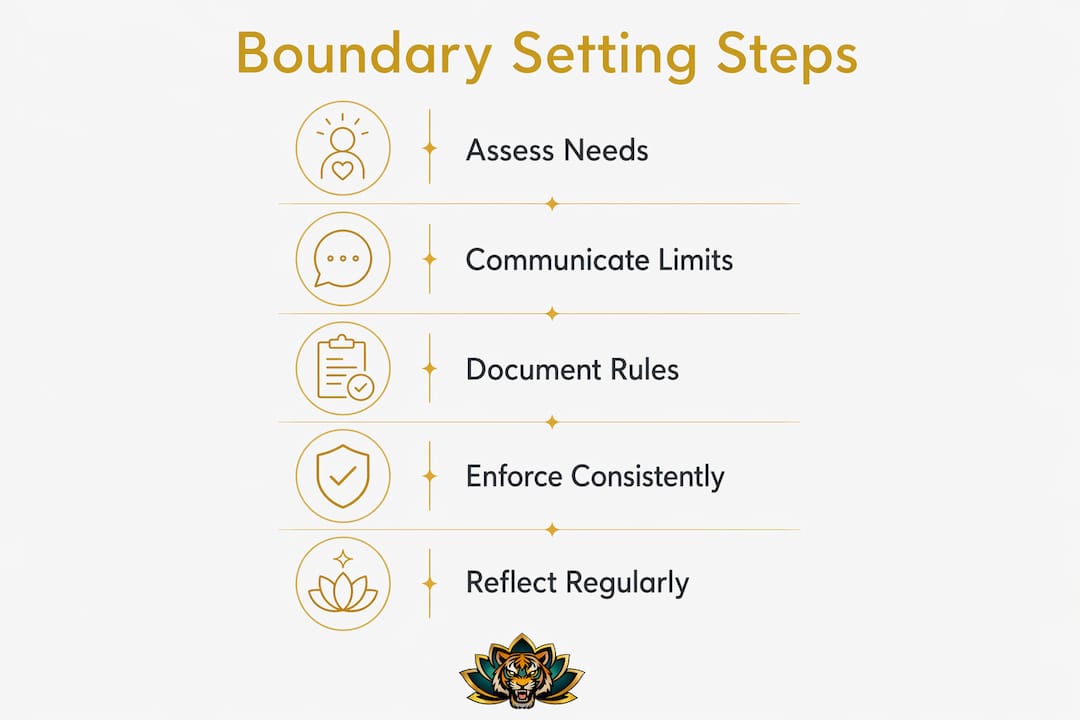
How to set clear limits as a creative professional
The most reliable method for setting limits comes from DBT-inspired behavioral scripting. Boundary scripts combined with rehearsal and distress tolerance skills increase success rates in complex interpersonal situations. The process has four steps.
-
Identify the specific behavior that crossed your limit. Not the feeling, not the pattern. The specific incident. "The client sent revision requests at 11 p.m. on a Sunday" is specific. "The client is disrespectful" is not.
-
Write one behavioral sentence that describes your limit. Use first-person language. "I respond to project messages between 9 a.m. and 5 p.m. on weekdays." This sentence should be so clear that a stranger reading it would know exactly what you mean.
-
Plan your follow-through before the conversation happens. What will you do if the limit is crossed again? "If I receive messages outside those hours, I will respond the next business day without explanation." The follow-through must be within your control and realistic to execute.
-
Check your vulnerability factors before communicating. Are you hungry, sleep-deprived, or already emotionally activated? Cognitive reappraisal mediates burnout risk, which means your emotional state at the moment of communication directly affects how the limit lands. Delay the conversation if you are not regulated.
Here are two scripts you can adapt immediately:
For a new client: "My standard practice is to include two rounds of revisions in the project fee. Additional rounds are billed at my hourly rate. I'll include this in the contract so we're both clear from the start."
For an existing client pushing scope: "I want to make sure we deliver the best result for you. This request falls outside our original scope, so I'll send a change order before we proceed."
Pro Tip: Write your limit scripts in advance and read them aloud at least twice before using them. The boundary blueprint approach works because rehearsal removes the emotional charge from the words. You stop improvising under pressure.
The discomfort you feel when setting a limit is not evidence that you are doing something wrong. It is evidence that you are doing something new. Expect it, name it internally, and proceed anyway.
How to embed limits into creative workflows and client contracts
The most effective "no" for creatives is built into systems and contracts, reducing reliance on emotional verbal refusals. 2026 creator guidance recommends clear scope of work, revision limits, response windows, and change-order policies as the primary tools for reducing scope creep and burnout. When the limit is procedural, it stops being personal.
Every client contract should define four things:
- Deliverables with acceptance criteria. What does "done" look like? Vague deliverables invite endless revision requests.
- Revision rounds. State the number explicitly. Two rounds is standard for most design and writing projects.
- Response timeframes. "I respond to project messages within one business day" sets expectations before resentment builds.
- No-contact periods. Weekends, evenings, and vacation dates belong in the contract, not in a reactive boundary conversation after the fact.
The change-order process deserves special attention. Freelance change-order best practices require signed contract addenda that map requests to scope and link delivery milestones with billing. In practice, this means you pause changed work, send a written change order, and resume only after written approval. Scope changes treated as controlled system inputs protect your cashflow and prevent the slow resentment that destroys client relationships.
| Without workflow limits | With workflow limits |
|---|---|
| Scope creep handled emotionally, case by case | Scope changes trigger a formal change-order process |
| Response times undefined, leading to 24/7 availability pressure | Response windows stated in contract, expectations set upfront |
| Revision requests unlimited and often unpaid | Revision rounds capped; additional rounds billed at hourly rate |
| Burnout addressed reactively after exhaustion | Burnout prevented through calendar buffers and no-contact clauses |
Creative professionals benefit from buffer systems that prevent others from defining their time. Time-blocking your deep work hours on your calendar before client meetings get scheduled is not a luxury. It is a structural limit that protects the work itself. Treat those blocks as client appointments you cannot cancel.
Negotiation is a boundary skill, not a conflict. Reframing it that way changes how you enter those conversations. You are not being difficult. You are protecting the quality and timeline of the work the client hired you to produce.
What are the common challenges in creative boundary setting?
Fear of damaging relationships is the most common reason creative professionals abandon their limits mid-conversation. Communication style is the key variable in maintaining rapport when setting limits. The presence of a boundary itself rarely causes rupture. How it is delivered almost always does.
The practical barriers creative workers face most often include:
- Guilt after saying no. This is especially common for creatives who have built their identity around being generous, available, and accommodating. Guilt is not a signal that you were wrong. It is a signal that you are changing a pattern. Explore setting limits without guilt as a skill you build over time, not a feeling you eliminate.
- Repeated last-minute demands. A client who consistently sends urgent requests outside agreed hours is not disorganized. They have learned that urgency gets results. The pattern changes only when the follow-through changes.
- Scope creep disguised as relationship maintenance. "Can you just quickly..." is the most common entry point for unpaid work. Recognize it as a scope change, not a favor.
- Internal pressure to prove worth through overdelivery. Many creative professionals, particularly women, have been conditioned to equate overwork with professionalism. Self-leadership as a creative woman begins with separating your value from your output volume.
When a client pushes back on a limit you have set, the most effective response is calm repetition. You do not need to justify, elaborate, or apologize. State the limit once, acknowledge their concern briefly, and restate the limit.
"I understand this feels urgent. My response window is the next business day. I'll be in touch then."
Knowing when to escalate matters too. If a client repeatedly violates agreed terms after you have communicated your limits clearly, the next step is a formal written notice referencing the contract. If violations continue, pausing work is a legitimate professional response, not an overreaction.
Self-compassion after a difficult boundary conversation is not optional. You will sometimes handle these moments imperfectly. Repair is possible. What matters is that you return to the limit, not that you executed it flawlessly the first time.
Key takeaways
Creative professionals who embed limits into contracts, communication scripts, and daily workflows protect their creative capacity far more effectively than those who rely on willpower alone.
| Point | Details |
|---|---|
| Boundaries as sovereignty | A limit describes your behavior, not a demand on others, preserving both self-respect and connection. |
| DBT scripting method | Write one specific behavioral sentence per limit and plan follow-through before any conversation happens. |
| Contracts over conversations | Scope of work, revision rounds, and response windows in writing reduce emotional labor and scope creep. |
| Change-order process | Pause changed work, send written approval requests, and resume only after sign-off to protect cashflow. |
| Communication style | Kindness and calm repetition hold limits more effectively than justification or apology. |
Why I think most creatives are solving the wrong boundary problem
Most of the creatives I work with arrive believing their boundary problem is a communication problem. They think if they could just find the right words, the client would respect their time, the collaborator would stop overstepping, and the guilt would finally lift. So they rehearse scripts and read articles like this one, and then the next difficult conversation arrives and everything dissolves.
The real problem is almost never the words. It is the absence of environmental safety. Boundaries shift from willpower to felt safety when the conditions around you create a moat of protection for your creative work. That means your calendar, your contract, your intake process, and your physical workspace all need to carry the weight that you have been asking your nervous system to carry alone.
I have watched talented writers take on clients who disrespect their time, not because they lack assertiveness, but because their intake process never filtered for fit. I have seen designers burn out not from overwork but from the chronic low-grade stress of never knowing when a client might call. The fix was structural, not verbal.
The other misconception I encounter constantly is that setting a limit means the relationship is in trouble. It usually means the opposite. Clients who respect clearly stated limits tend to be the ones who stay longest and refer most generously. The ones who push back hardest on reasonable limits are often telling you something important about what the relationship will cost you long-term.
Start small. Pick one limit you have been avoiding and build the system around it before you have the conversation. The words will come more easily when the structure already exists.
— RachelMHarrison
Ready to build limits that actually hold?
Understanding the theory of creative professional self-care is one thing. Applying it when a client is pressuring you at 9 p.m. on a Friday is another. Rachel-m-harrison offers trauma-informed, one-on-one coaching specifically designed for women and creative professionals who want to move from reactive boundary-setting to grounded, confident self-leadership.
The Sanctuary Symbolic Integration Method™ helps you identify the emotional patterns underneath your boundary struggles, regulate your nervous system, and build the structural and relational limits that protect your creative work long-term. If you are ready to stop white-knuckling your limits and start living inside them, book a session to explore what personalized support looks like for you.
FAQ
What is boundary setting for creative professionals?
Creative professionals boundary setting is the practice of defining clear behavioral limits around time, scope, communication, and emotional labor to protect creative capacity and professional relationships. These limits are grounded in personal sovereignty rather than conflict or punishment.
How do I set limits with clients without damaging the relationship?
Communication style determines rapport, not the limit itself. Use calm, specific language, state the limit once, and avoid over-explaining. Kindness and consistency together hold limits more effectively than any single conversation.
What should a creative professional include in a client contract for boundary protection?
A contract should specify deliverables with acceptance criteria, the number of revision rounds included, response timeframes, no-contact periods, and a formal change-order process for scope additions. These procedural limits reduce the need for emotional verbal refusals.
Why do creatives struggle with setting limits even when they know they should?
The barrier is usually structural, not verbal. Without intake processes, calendar systems, and contract language that filter for fit and define expectations, creatives rely on willpower alone. Boundary enforcement improves when environmental safety replaces moment-to-moment self-regulation as the primary mechanism.
How does DBT help with creative work-life balance?
DBT boundary work provides a seven-step worksheet method that teaches you to phrase limits behaviorally, plan realistic follow-through, and use distress tolerance skills during difficult conversations. This makes limits easier to maintain because they are framed as contingencies rather than emotional reactions.