TL;DR:
- A self-leadership workflow provides a structured, measurable system for women and creatives to build emotional clarity during life transitions. It emphasizes daily micro-actions, reframing thoughts, nurturing natural rewards, and reflecting to foster lasting growth beyond reliance on willpower. Implementing this intentional process with self-compassion and proper materials can transform disorientation into meaningful, sustainable change.
Life transitions have a way of stripping away the familiar, leaving you standing in the middle of your own story with no clear map forward. For women and creative professionals, this disorientation can feel especially heavy because so much of your identity is woven into how you create, connect, and contribute. A structured self-leadership workflow gives you something willpower alone never can: a repeatable, measurable process for building emotional clarity from the inside out.
Table of Contents
- What is a self-leadership workflow and why does it matter?
- What you need before you begin
- Step-by-step self-leadership workflow: The 4-module process
- Measuring progress and navigating setbacks
- Why workflow matters more than willpower: Our perspective
- Ready to design your self-leadership journey?
- Frequently asked questions
Key Takeaways
| Point | Details |
|---|---|
| Structure outperforms willpower | Building a self-leadership workflow provides dependable clarity compared to trying harder alone. |
| Four-module process works | Behavior, thought, reward, and consolidation modules create a proven cycle for growth and happiness. |
| Daily tracking builds awareness | Monitoring emotions and behaviors each day helps measure real progress, not just feelings. |
| Support matters | A trauma-informed, supportive context maximizes safety and success during transitions. |
What is a self-leadership workflow and why does it matter?
A self-leadership workflow is not a to-do list dressed up in motivational language. It is a deliberately designed system that guides how you think, act, and respond to your inner world every single day. Where unstructured coaching might rely on open-ended conversations and qualitative reflection, a workflow creates observable checkpoints so you can actually see yourself changing over time.
Why does this matter so much during transitions? Because emotional uncertainty has a way of making everything feel equally urgent and equally impossible. When you have no structure, your nervous system stays in a low-grade state of alert, scanning for threats instead of moving toward growth. A workflow interrupts that pattern by giving your mind something concrete to follow.
Research supports this idea strongly. Self-leadership interventions can be structured into modules that mix behavior-focused strategies, thought pattern strategies, natural rewards, and consolidation, with evidence measured through longitudinal assessments using daily sampling of flow and happiness. In practical terms, this means that structured self-leadership produces results you can actually feel and track, not just hope for.
Here is what a well-designed workflow typically addresses:
- Behavioral patterns: The micro-actions you take (or avoid) each morning
- Thought patterns: The inner scripts that either open or close your sense of possibility
- Natural rewards: The everyday moments that genuinely energize you
- Consolidation: The reflective practices that help you absorb and carry your growth forward
"Structure is not the opposite of freedom. For women navigating emotional complexity, structure is often the very thing that creates space for freedom to exist."
Learning to practice self-leadership for creative women begins with understanding that a workflow is not a cage. It is a container, and containers make growth possible. You can also explore broader wellness self-care steps as you build the foundation for your workflow.
With a clear sense of why workflow is needed, let's see what you need to get started.
What you need before you begin
Starting a self-leadership workflow without preparation is like beginning a long journey without checking your fuel. The most common reason people abandon structured practices early is not lack of motivation. It is a lack of the right conditions. Creating those conditions first is what makes everything else sustainable.

Emotional safety and self-compassion are the true prerequisites here, not productivity tools or cleverly formatted planners. If you approach your inner work from a place of harsh self-judgment, the workflow becomes another arena for failure. You deserve to begin from a gentler premise: that you are already doing something courageous by showing up.
Beyond mindset, you will need a few practical materials:
- A journal or digital document dedicated exclusively to this practice
- A regular check-in time that you protect, even if it is only ten minutes
- A simple self-measurement method like a daily rating scale for mood, clarity, and focus
- A supportive environment, ideally one that is trauma-informed and free from pressure
Research on self-leadership confirms that daily measures of flow and happiness are what make progress assessments meaningful. This does not mean obsessive tracking. It means gently noting how you feel each day so patterns become visible over time.
Choosing your tool is a personal decision. Some women love the tactile experience of pen and paper. Others prefer a simple notes app on their phone. What matters is consistency, not sophistication. You can also build on practical self-management strategies to strengthen your approach.
Here is a simple comparison to help you choose:
| Tool type | Best for | Potential challenge |
|---|---|---|
| Paper journal | Sensory learners, slow reflection | Easy to misplace or skip |
| Notes app | Busy schedules, portability | Screen fatigue |
| Dedicated app | Structured templates, reminders | Learning curve |
| Coaching template | Guided reflection, accountability | Requires external support |
One more foundational piece: working with a clarity coaching for boundaries framework from the start can help you recognize which boundaries inside your own mind need attention before your workflow can truly take root.
Pro Tip: Set a gentle daily reminder on your phone with a kind message, something like "Check in with yourself now." This small prompt can transform self-leadership from an intention into a habit within two to three weeks.
Once you're prepared, it's time to take action, one step at a time.
Step-by-step self-leadership workflow: The 4-module process
This is where the framework becomes real. The four-module model is based on validated self-leadership research, and each module serves a distinct purpose in your growth process. Think of the modules as rooms in your inner sanctuary: each one has its own function, and moving through all four creates a complete experience.
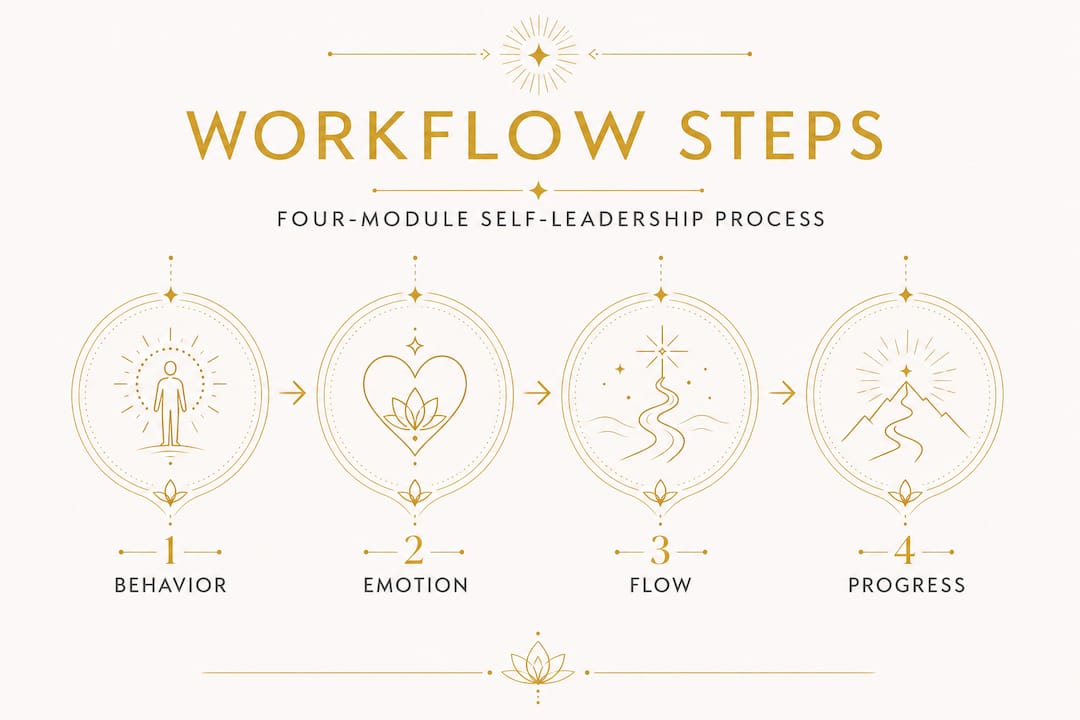
Self-leadership interventions consist of behavior-focused, constructive thought, natural rewards, and consolidation modules, each reinforcing the others in a dynamic, living system rather than a rigid checklist.
Here is how to move through each module intentionally:
-
Behavior-focused module: Set micro-intentions. Every morning, identify one concrete action that aligns with who you are becoming. Not a massive goal. A single, specific micro-action. For a creative professional, this might be writing three sentences in your journal before checking email. For a woman in transition, it might be choosing to take a ten-minute walk before making a significant decision. These micro-actions train your nervous system to associate intention with follow-through.
-
Constructive thought module: Reframe your inner scripts. Notice the story you are telling yourself about your capabilities, your worth, and your direction. When you catch a limiting script, pause and ask: "Is this true right now, or is this a memory speaking?" Then offer yourself a constructive alternative. This is not toxic positivity. It is honest, grounded reframing. You might explore mindset shifts in self-leadership as a companion to this module.
-
Natural rewards module: Amplify what already energizes you. This step is often skipped, and it is one of the most powerful. Natural rewards are not treats you earn after suffering through hard work. They are the activities, environments, and connections that genuinely restore you. Maybe it is painting for twenty minutes, or a slow cup of coffee in silence, or calling one person who truly sees you. Actively noticing and scheduling these rewards teaches your brain that growth feels good, not punishing.
-
Consolidation module: Reflect and anchor. At the end of each day or week, spend a few minutes reviewing what happened. Not judging it, just noticing. What did your micro-action produce? How did your thoughts shift? Where did you feel energized? This reflection helps you absorb your progress instead of racing past it. Research on hybrid work self-leadership confirms that consolidation and reflection phases significantly improve both engagement and goal attainment over time.
Here is a quick comparison of what each module looks like when it is working versus when it needs adjustment:
| Module | Working well | Needs adjustment |
|---|---|---|
| Behavior-focused | Actions feel doable and aligned | Actions feel overwhelming or vague |
| Constructive thought | Inner dialogue is encouraging | Frequent self-blame or shutdown |
| Natural rewards | Energy feels replenished regularly | Constant depletion or numbness |
| Consolidation | You notice genuine growth over weeks | Reflection feels pointless or forced |
Pro Tip: If one module consistently feels resistant, that is valuable information. Resistance usually points to where healing, not harder effort, is needed.
Now you know the framework. Let's explore how to track your progress and avoid common pitfalls.
Measuring progress and navigating setbacks
One of the most compassionate things you can do for yourself during a self-leadership practice is to measure progress with patience rather than urgency. Most lasting growth is measured across weeks, not days. This truth runs directly against the culture of instant transformation that floods social media, and it is worth repeating every single time doubt shows up.
Here are the signals worth tracking as you practice your workflow:
- Daily emotional state: On a simple scale of one to ten, how clear and grounded do you feel?
- Work or creative engagement: Are you able to focus and find meaning in what you are doing?
- Goal proximity: Are your stated intentions and actual actions moving closer together?
- Physical signals: Are you sleeping better, holding less tension, breathing more easily?
Longitudinal assessments using daily sampling of flow and happiness are what give self-leadership research its reliability. The same principle applies to your personal practice. Brief, honest daily entries tell a much richer story than a long weekly report that tries to summarize feelings you have already half-forgotten.
Research on self-leadership in professional contexts also found that work-home facilitation and relaxation mediated significant gains in engagement and goal attainment. This means that the way you rest and transition between work and personal life matters enormously for whether your workflow actually sticks.
Troubleshooting setbacks is not about punishment. It is about curiosity. When you notice a regression, meaning a week where everything feels harder, your scores drop, and your micro-actions disappear, ask yourself these questions before abandoning the practice:
- Did something change in my environment or relationships this week?
- Am I asking too much of myself in this module?
- Have I skipped my consolidation reflection and lost touch with my own progress?
"A setback in your self-leadership practice is not evidence that you have failed. It is data. What you do with that data is your next act of leadership."
The difference between a normal fluctuation and an actual stuck point is duration. Feeling off for two or three days is part of being human. Feeling stuck in the same pattern for two or three weeks points to something that deserves closer attention, perhaps through emotional growth with clarity coaching or deeper support. Reading about wellness and self-regulation can also provide useful perspective as you navigate the inevitable ups and downs.
Once you've verified progress, it's helpful to understand how a workflow approach redefines traditional inner work.
Why workflow matters more than willpower: Our perspective
Here is the honest, sometimes uncomfortable truth: willpower is a resource that runs out, and for women navigating grief, creative burnout, or major life transitions, it runs out faster than for people who are not carrying that weight. The cultural narrative that says "just push through," "commit harder," or "want it badly enough" is not just unhelpful. It is actively harmful to women who are already doing enormous invisible labor just to stay regulated and present.
What structured self-leadership offers instead is something quietly revolutionary: a system that does not depend on you feeling motivated to work. It works precisely because the structure holds you even when your inner resources are depleted.
Self-leadership literature consistently measures change through modules and daily outcomes, benchmarking effects with metrics that go well beyond qualitative narratives. This is significant. It means that the growth self-leadership produces is not just felt but verifiable. That matters enormously when you are in a phase of life where your own perception of yourself has become unreliable due to stress, loss, or upheaval.
The gap between traditional coaching narratives and measurable self-leadership effects is also worth naming. Traditional coaching often relies on insight alone, the hope that a powerful realization will produce lasting change. Sometimes it does. More often, insight without a behavioral container dissolves within days. Your self-leadership in practice looks completely different when you have a workflow that turns insight into repeatable action.
Trauma-informed structure matters here too. When you have experienced emotional injury, your nervous system learned to protect you through patterns that may no longer serve you. A workflow built on self-compassion gives your system a new pattern to learn, one that is grounded in safety rather than urgency. Leadership development research shows this clearly when examining leadership best practices that prioritize emotional intelligence and sustainable growth over performance-at-any-cost models.
We believe deeply that the women who will create the most enduring change in their lives and in the world around them are not the ones who tried hardest. They are the ones who built wisely, with structure, self-compassion, and a clear method for knowing when they are actually growing.
Ready to design your self-leadership journey?
Building a self-leadership workflow on your own is absolutely possible, and this guide gives you a strong foundation to begin. But many women find that having personalized support makes the difference between a practice that slowly fades and one that genuinely transforms how they move through the world.
At rachel-m-harrison.com, trauma-informed coaching is designed to meet you exactly where you are, whether you are just beginning to find your footing after a major transition or you are ready to refine and deepen a self-leadership practice that already has roots. The Sanctuary Symbolic Integration Method™ brings structure, emotional safety, and spiritual grounding together so your workflow is not just productive but genuinely healing. If you are ready for guidance that honors both your complexity and your clarity, this is a meaningful place to begin that conversation.
Frequently asked questions
What is the difference between self-leadership and traditional coaching?
Self-leadership uses structured modules and daily tracking to create measurable change, while traditional coaching often centers on conversation and qualitative insight. Research on self-leadership effectiveness shows that measurable daily outcomes distinguish it clearly from narrative-only approaches.
How can I measure my self-leadership progress at home?
Track daily reflections of emotional clarity, flow, and small goal completion to notice meaningful patterns over time. Studies using daily sampling of flow and happiness confirm that even brief daily records reveal reliable growth trends.
What if I miss a day or lose motivation using my workflow?
Missing days is completely normal and not a sign of failure. Simply return to your practice with self-compassion, review your consolidation notes, and restart with a single small action rather than trying to catch up on everything at once.
Do self-leadership workflows really help with emotional clarity during life transitions?
Yes, and the evidence is specific. Research found that work-home facilitation and relaxation mediated measurable gains in engagement and goal attainment, confirming that structured self-leadership supports real emotional and practical clarity during periods of change.