
TL;DR:
- Clarity coaching distinctly prioritizes present decisions and emotional self-leadership, unlike therapy or traditional skills coaching. Trauma-informed clarity coaching adds nervous system safety principles, making it especially suitable for women and creative professionals entangled in emotional and relational patterns. Choosing a qualified, transparent coach is crucial to ensure safety, ethical practice, and effective support tailored to your unique needs.
Many women and creative professionals spend years bouncing between therapists, life coaches, and self-help books without ever landing on the specific kind of support they actually need. Clarity coaching sits in a distinct space that most people have never heard named properly. It is not therapy. It is not traditional skills coaching. And when it is trauma-informed, it becomes something far more grounded, safer, and more immediately actionable than either of those alternatives. This article breaks down exactly what clarity coaching is, who it serves best, and how to find the right approach for where you are right now.
Table of Contents
- How clarity coaching is different from other coaching and therapy
- Core elements of clarity coaching: What to expect
- Benefits and outcomes: Real-world impact of clarity coaching
- Choosing the right clarity coach for you
- Why the boundaries around trauma-informed coaching matter more than ever
- Explore trauma-informed clarity coaching for your next step
- Frequently asked questions
Key Takeaways
| Point | Details |
|---|---|
| Not therapy | Clarity coaching helps you make present-day decisions and build self-leadership, not heal the past. |
| Trauma-informed focus | Approaches that prioritize nervous system safety and somatic practices are best for sensitive or creative clients. |
| Major client gains | Up to 80 percent of clients report stronger boundaries, emotional clarity, and better decision-making. |
| Access gap for women | Fewer women get employer-covered coaching compared to men, making self-advocacy and selection skills essential. |
| Coach selection matters | Choosing a coach with trauma-informed methods, clear values, and relevant experience improves your outcomes. |
How clarity coaching is different from other coaching and therapy
The confusion is understandable. Coaching, therapy, counseling, mentoring: these words get used almost interchangeably in wellness spaces, and that blurring creates real problems for people trying to find the right support. Clarity coaching is a specific orientation that prioritizes your present decisions, your current emotional patterns, and the self-leadership you need to move forward with intention.
Therapy, by contrast, is primarily designed to explore and heal the past. A licensed therapist works with diagnosed conditions, childhood wounds, and clinical mental health treatment. Clarity coaching assumes you are fundamentally capable and focuses on helping you access the wisdom you already hold inside yourself.
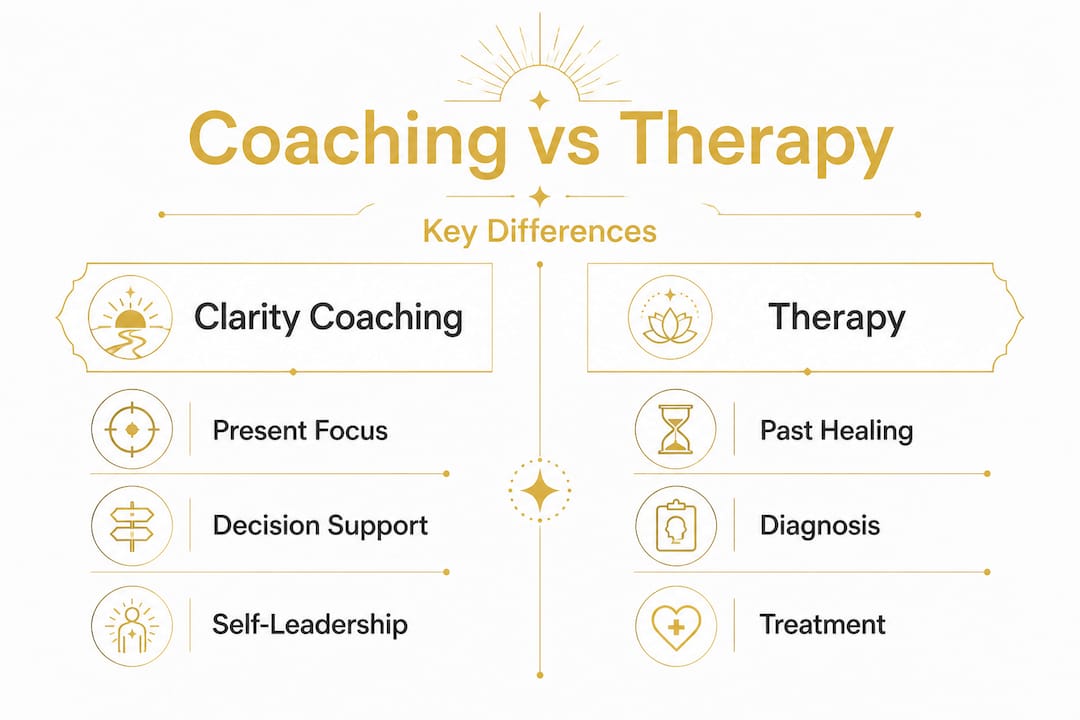
Traditional coaching, often found in corporate settings, is largely skills-focused. It might help you build a better presentation, manage your time more effectively, or hit performance benchmarks. What it typically does not do is account for the way your nervous system responds to stress, how unprocessed emotional experiences shape your decisions, or why boundary-setting feels terrifying even when you know intellectually that it is necessary.
Trauma-informed clarity coaching bridges that gap. As trauma-informed coaching research outlines, the trauma-informed variant adds nervous system safety grounded in SAMHSA principles, distinguishing it clearly from therapy focused on past-healing and from traditional coaching that addresses skills only. This matters enormously for women and creative professionals, whose emotional lives are often deeply entangled with their work, identity, and relational patterns.
Here is a direct comparison to make these distinctions concrete:
| Modality | Primary focus | Who leads | Nervous system lens? |
|---|---|---|---|
| Therapy | Healing past wounds, clinical diagnosis | Licensed clinician | Sometimes |
| Traditional coaching | Skills, goals, performance | Coach as expert | Rarely |
| Clarity coaching | Present decisions, self-leadership | Client as expert | Sometimes |
| Trauma-informed clarity coaching | Emotional clarity, boundaries, self-trust | Client as expert | Always |
What makes trauma-informed clarity coaching particularly well-suited for women and creatives is that it treats the whole person. It honors the reality that you cannot think your way out of a nervous system response. It acknowledges that your creative blocks, your boundary failures, and your emotional exhaustion are not character flaws. They are patterns with roots, and clarity coaching helps you see those roots without requiring years of clinical excavation.
"Clarity is not the absence of complexity. It is the ability to act wisely inside it." This is the operating premise of trauma-informed clarity work: you do not need to be fixed. You need to be seen clearly.
Core elements of clarity coaching: What to expect
With an understanding of what makes clarity coaching distinct, let's explore what the process looks like in practice. If you have never worked with a clarity coach before, you might expect something that resembles a structured therapy session or a goal-setting meeting. The reality is more nuanced and, for many clients, more revelatory.
Clarity coaching approaches that are trauma-informed follow a broadly similar arc, though each practitioner brings their own framework. The International Coaching Federation notes that trauma-informed coaching for specific populations must prioritize somatic methods and nervous system awareness to build genuine emotional clarity and strengthen the capacity for self-leadership, especially when working with women and creative professionals who carry distinct forms of occupational and relational stress.
Here is what you can typically expect across a clarity coaching engagement:
-
Initial intake and safety assessment. Your coach will gather information about your current situation, your emotional patterns, and what you most need right now. A trauma-informed coach will explicitly discuss what safety means in your working relationship and how they will handle moments when the conversation becomes activating.
-
Mapping your emotional patterns. Before you can shift something, you need to see it. This stage often involves identifying where your decision-making gets clouded, which relationships activate your nervous system most strongly, and what stories you carry about your own worth and capability.
-
Somatic (body-based) grounding practices. Rather than staying only in the analytical mind, trauma-informed clarity coaching incorporates body awareness. You might notice where tension lives in your body when you think about a particular decision, or practice breathing techniques that regulate your nervous system before engaging with hard questions.
-
Boundary identification and language-building. Many women and creatives know they need boundaries but struggle to articulate them or hold them under pressure. Clarity coaching gives you specific language and practices for communicating limits from a grounded, self-authoritative place rather than from fear or reactivity.
-
Aligned action and accountability. Unlike therapy, clarity coaching moves consistently toward action. Each session typically closes with an intention or small commitment that reflects your emerging clarity. These are not performance goals. They are expressions of who you are becoming.
-
Integration and ongoing self-leadership. Over time, the goal is for the clarity you develop in sessions to become internalized. You stop needing external permission to trust yourself. That is self-leadership: making decisions from your values, not your wounds.
Pro Tip: If a clarity coach you are considering never discusses nervous system safety or somatic awareness, that is worth naming directly. Ask them how they support clients who become emotionally activated during a session. Their answer will tell you everything about whether their approach is truly trauma-informed.
Benefits and outcomes: Real-world impact of clarity coaching
Understanding the process leads naturally to assessing the concrete benefits and who has access to them. The outcomes of clarity coaching are not vague or abstract. When the approach is done well and the client is genuinely engaged, the changes are measurable and often described as life-altering.
Research on trauma-informed coaching outcomes consistently shows improvements in 70 to 80 percent of clients across emotional regulation, decision-making confidence, and interpersonal boundaries. These are not small adjustments. They represent fundamental shifts in how people relate to themselves and others.
The most commonly reported outcomes include:
- Stronger, more consistent boundaries. Clients move from people-pleasing and resentment to clear, calm communication of their limits.
- Improved emotional clarity. Instead of feeling overwhelmed by complex emotions, clients develop the ability to name, locate, and respond to their feelings with intention.
- Better decision-making. When your nervous system is regulated and your emotional patterns are visible to you, decisions stop feeling paralyzing.
- Reduced anxiety around self-expression. Creative professionals in particular often report a significant loosening of creative blocks once the emotional underpinnings are addressed.
- Increased self-trust. Perhaps the most profound outcome: clients stop outsourcing their inner authority to other people's opinions.
| Outcome area | Reported improvement rate | Particularly significant for |
|---|---|---|
| Emotional regulation | 70 to 80% | All clients |
| Boundary clarity | High | Women, caregivers |
| Creative confidence | Moderate to high | Creative professionals |
| Decision-making speed | Moderate | Leaders, entrepreneurs |
| Self-trust | High over time | Women in transition |
Yet access to this kind of support is not equal. Despite the growing demand for coaching among women and creative professionals, a gender gap in coaching access persists: only 16 percent of women receive employer-offered coaching compared to 22 percent of men. That gap is not a small variance. It represents a systemic under-investment in the emotional and professional development of women precisely in the spaces where they are working the hardest.
This is why private coaching arrangements, community-based programs, and resources focused on empowering women's wellness matter so much. When institutional access is limited, women and creatives must often advocate for themselves and seek support independently. That requires both information and courage.
Choosing the right clarity coach for you
With outcomes clear, how do you find a coach who aligns with your needs? This is where many people get stuck, especially because the coaching industry as a whole is largely unregulated.
Here is the uncomfortable truth: there is no universal definition for trauma-informed coaching, which means anyone can claim the title without meeting a consistent standard of training or practice. This does not mean good coaches do not exist. It means you need to be an informed consumer.
Here is a practical process for finding your right fit:
-
Research their specific framework. Does the coach have a named methodology or approach? Vague language like "I help you grow" is a red flag. Specific descriptions of somatic practices, nervous system safety, and emotional pattern work are good signs.
-
Ask directly about trauma-informed training. Where did they train? What specific modalities do they incorporate? Do they have supervision or continuing education? A coach who cannot answer these questions concretely has not thought carefully enough about the clinical responsibility they are taking on.
-
Inquire about their safety practices. What happens if you become emotionally overwhelmed in a session? Do they have a referral network for clients who need therapeutic support? A trauma-informed coach should welcome this question.
-
Assess values alignment. Coaching is a relationship. The most technically skilled coach in the world will not be effective if their values feel misaligned with yours. Trust your body's response during a discovery call. Nervousness is normal. Dread or deflation is information.
-
Look for lived experience and cultural humility. A coach who understands the specific emotional terrain of women's lives, creative careers, or intersecting identities brings something that credentials alone cannot supply. Ask how they support clients whose backgrounds differ from their own.
The best place to begin your search is often through trauma-informed clarity coaching providers who specialize in your specific population, whether that is women in leadership, creatives navigating identity and work, or people moving through major life transitions.
Pro Tip: Do not choose a clarity coach based solely on their social media presence or testimonial volume. Schedule a discovery call and pay attention to whether they ask more questions than they answer. The best coaches are primarily curious about you, not eager to sell you on themselves.
Why the boundaries around trauma-informed coaching matter more than ever
Most articles about clarity coaching stop at the practical. They give you the definition, the process, the benefits, and the checklist. What they tend to skip over is the unresolved tension sitting at the center of this field, and that tension deserves honest examination.

The blurred lines between therapy and coaching are not just a semantic problem. They carry real ethical weight. When a coach works with clients who have experienced significant trauma and does not have adequate training in trauma response, they can inadvertently retraumatize the people they are trying to help. A client who becomes dissociated during a session with an unprepared coach is not just having a bad day. They are experiencing a safety failure.
This is not an argument against clarity coaching. It is an argument for higher standards and more transparency within it. The fact that fuzzy boundaries persist between trauma-informed coaching and therapy, combined with a documented gender gap where only 16 percent of women access employer-offered coaching compared to 22 percent of men, creates a situation where the people who need the most careful, skilled support are the least likely to receive it through formal channels.
Women are not a homogeneous group. The emotional and professional landscape for a creative woman navigating self-employment looks radically different from that of a woman in a corporate structure trying to hold boundaries with her team. Both deserve coaches who understand those specific pressures and who have done enough of their own personal work to hold a genuinely safe space. Resources that focus on balancing work and wellness for women point to how much demand exists for this kind of holistic, intersectional support.
My perspective is this: clarity coaching done well is not a luxury product. It is a form of advocacy. A good clarity coach helps you understand your emotional patterns so thoroughly that you become ungovernable by fear. That is not just personal growth. That is a political act for women who have been conditioned to shrink, defer, and doubt themselves. The field needs more accountability, but it also needs more women to claim access to it.
Explore trauma-informed clarity coaching for your next step
If this article has named something you have been searching for, you are not alone. Many women and creative professionals arrive at clarity coaching after years of feeling like they were almost getting what they needed from other support systems but never quite landing.
Rachel M. Harrison's trauma-informed coaching is built specifically for women and creative professionals who are ready to develop emotional clarity, establish boundaries that actually hold, and step into genuine self-leadership. Using the Sanctuary Symbolic Integration Method™, the work is grounded in both psychological depth and somatic safety, creating a space where you do not have to choose between feeling supported and moving forward. Whether you are brand new to coaching or returning after a difficult experience elsewhere, the invitation is to start from where you are. Your clarity is already inside you. The right support helps you access it.
Frequently asked questions
Is clarity coaching the same as therapy?
No. Clarity coaching focuses on present decisions and self-leadership, while therapy addresses past healing and clinical mental health treatment. They are complementary but distinct practices.
What makes trauma-informed clarity coaching unique?
Trauma-informed clarity coaching builds nervous system safety using SAMHSA principles and somatic methods, ensuring that the coaching relationship itself does not become a source of harm or overwhelm.
Who benefits most from clarity coaching?
Women and creative professionals seeking emotional clarity, firmer boundaries, and self-leadership often see the most significant gains, as coaching tailored for these groups prioritizes trauma-informed and somatic approaches specifically designed for their needs.
Are there standards for trauma-informed coaching?
There is no universal definition or regulatory standard, so it is essential to ask practitioners directly about their training, methodology, and safety practices before committing to the work.