TL;DR:
- Trauma-informed coaching provides women leaders with a supportive, safety-focused process that aligns with their complex realities. It emphasizes emotional regulation, internal safety, and systemic awareness to facilitate sustainable growth and clarity. Effectiveness depends on clear mechanisms, organizational context, and ongoing measurement, preventing superficial progress.
Many high-performing women reach a point where their external success feels hollow or their inner compass goes quiet. They have earned the title, built the team, and still find themselves overwhelmed, boundary-less, or running on empty. The problem is rarely a lack of drive. It is the absence of a structured, contextually aware support system that meets them exactly where the pressure lives. Trauma-informed coaching is that system, and this article walks you through what it actually does, how to evaluate whether it is working, and what to watch for when it falls short.
Table of Contents
- Why context matters: Busting coaching myths for women leaders
- Mechanisms of change: How coaching creates growth and clarity
- Evaluating coaching outcomes: What works and what to watch for
- Trauma-informed approaches: Building safety and sustainable self-leadership
- What most experts miss about coaching for women leaders
- Take the next step with trauma-informed support
- Frequently asked questions
Key Takeaways
| Point | Details |
|---|---|
| Coaching is context-specific | The success of coaching hinges on its integration with your unique leadership context and organizational system. |
| Mechanisms drive outcomes | Emotional clarity, boundary setting, and psychological safety are key results from trauma-informed coaching. |
| Beware of coaching pitfalls | Coach dependence and misaligned goals can undermine progress; always ensure stakeholder involvement and measurement. |
| Trauma-informed methods matter | Trauma-informed coaching focuses on stability, regulation, and whole-person growth, not just performance. |
Why context matters: Busting coaching myths for women leaders
Let's name the myths directly, because they do real damage. The first is that coaching is a shortcut, a place where a wise guide hands you the answers and sends you off transformed. The second is quieter but just as harmful: the idea that needing a coach signals weakness or inadequacy. Both myths miss the point entirely.
Coaching is a structured, relational process. It does not deposit wisdom into you. It creates the conditions for you to access what you already know but cannot yet act on consistently. For women leaders specifically, that distinction matters enormously because the barriers are rarely about knowledge. They are about internalized pressure, systemic friction, and a nervous system that has been running in overdrive for years.
Here is what the research actually says: coaching for women leaders functions as a system of development engagements, not a single one-size intervention, and its effectiveness depends on coaching design, mechanisms, provider credentials, measurement, and organizational integration. That sentence should reframe how you evaluate any coaching offer. A single discovery call and a twelve-week package is not automatically a system. Ask deeper questions.
Common myths that derail women before they begin:
- "A good coach will tell me exactly what to do." Real coaching builds your own decision-making capacity, not dependency on someone else's.
- "I just need accountability, not reflection." Accountability without understanding why patterns repeat often produces short-term results and long-term frustration.
- "If I were stronger, I wouldn't need support." Strength and support are not opposites. The most grounded leaders know precisely when to seek input.
- "One coach will fix everything." No single intervention addresses role dynamics, organizational culture, and personal history simultaneously.
"The effectiveness of coaching is not a fixed quantity. It emerges from the interaction between the coach's approach, the leader's readiness, and the organizational environment in which she operates."
Understanding how coaching transforms creative leadership for women helps clarify why the relational and contextual dimensions of coaching cannot be separated from its outcomes. You deserve a process designed for the actual complexity of your life, not a templated program built for a generic executive archetype.
Mechanisms of change: How coaching creates growth and clarity
Now that the myths are cleared away, let's look at what coaching actually does inside a well-designed engagement. The word "mechanism" might sound clinical, but it is simply the answer to this question: through what specific pathway does change happen?
Researchers have identified three primary mechanism categories in coaching. Affective mechanisms involve emotional safety, psychological comfort, and the reduction of shame around struggles. Cognitive mechanisms involve shifts in self-concept, how you see your own capacity and identity as a leader. Systemic mechanisms involve the organizational conditions that either support or undermine what coaching builds. Understanding which mechanism your coaching is targeting helps you measure whether it is working and why.
Workplace coaching outcomes research shows mixed empirical results: coached groups may show improvements in certain work-related attitudes and behaviors, while some metrics, such as turnover intentions, may not change, highlighting boundary conditions and the need to match measures to mechanisms. In other words, if you go into coaching hoping it will make you want to stay in a toxic role, you are aiming at the wrong target. Coaching sharpens clarity; it does not suppress it.
There is also important nuance around context. Mechanism research suggests coaching may work through specific affective, cognitive, and emotional pathways that can vary by context, and psychological safety may be more context-dependent than other mechanisms in high-pressure innovation environments. Translation: what works brilliantly for a woman in a mid-size creative agency may land differently for a woman navigating a high-stakes corporate merger. The coaching approach must match the environment.
| Mechanism type | What it shifts | Example outcome |
|---|---|---|
| Affective | Emotional safety and regulation | Reduced anxiety, more honest expression |
| Cognitive | Self-concept and identity clarity | Stronger decision-making, clearer values |
| Systemic | Organizational conditions and role fit | Improved boundaries with direct reports |
Pro Tip: Before starting any coaching engagement, ask your coach which mechanism they primarily work through and how they measure movement in that area. If they cannot answer clearly, that is useful information.
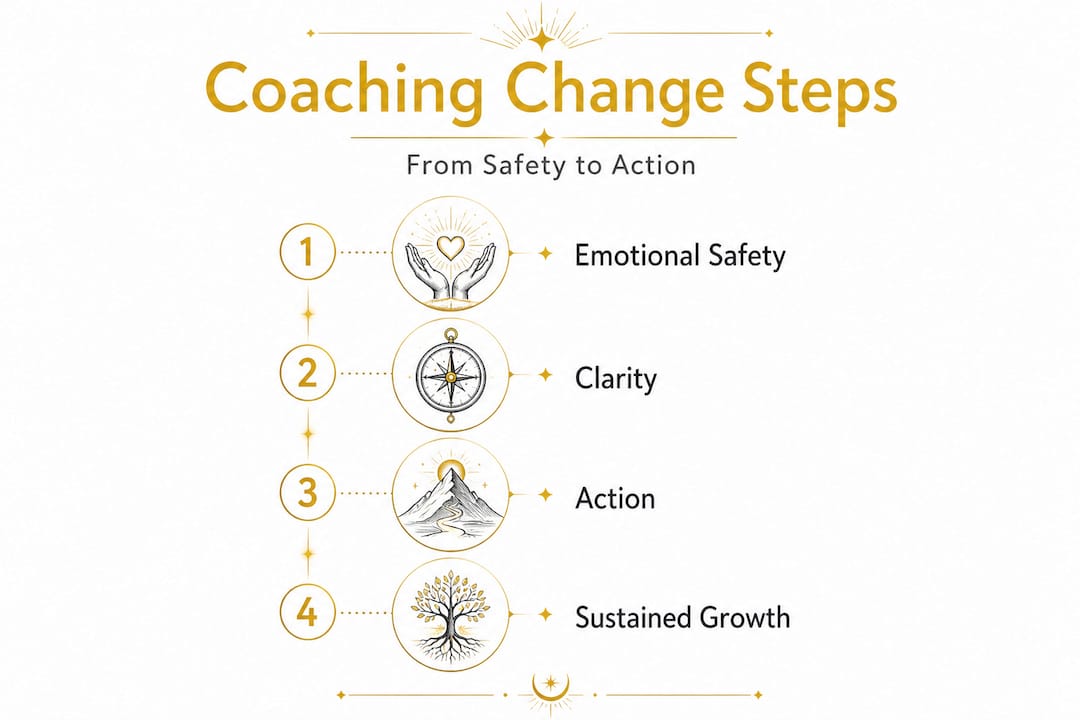
The trauma-informed coaching framework adds another layer to this: it begins with stabilization. Before you can build anything new, your nervous system needs to feel safe enough to allow it. This is why jumping straight into goal-setting in the first session often fails for women carrying high stress loads. Safety first is not a soft preference. It is a neurological prerequisite.
Working through the embodying self-trust guide for women reveals how this sequencing, from safety to clarity to action, creates the kind of change that holds under pressure rather than collapsing the moment life gets difficult again.

Evaluating coaching outcomes: What works and what to watch for
Knowing how coaching works is only valuable if you can also tell whether it is working for you. This section is about building your own internal benchmark system so you stay informed and empowered throughout any coaching relationship.
Four benchmarks to use when evaluating any coaching engagement:
- Explicit mechanism assumptions. Can your coach articulate what changes, how it changes, and under what conditions? Vague language like "you'll feel more aligned" is not a mechanism. Clarity is.
- Longitudinal measurement. Are you tracking shifts over time, not just session to session? Growth often looks like two steps forward, one step back. A longer view protects you from premature conclusions.
- Scope versus therapy. Good coaching knows its lane. There must be clear referral pathways when clinical support is needed. If your coach never acknowledges the line between coaching and therapy, pay attention to that gap.
- Alignment with role and sponsorship dynamics. Coaching that works is connected to your actual role context, not floated above it. Sponsor and stakeholder alignment matters for outcomes.
These benchmarks come directly from sound research into what separates effective coaching from expensive conversation. They are not abstract standards. They are practical questions you can bring into your very next session.
| Coaching feature | Strong indicator | Warning sign |
|---|---|---|
| Goal clarity | Specific, measurable, revisable | Vague or only aspirational |
| Mechanism awareness | Coach explains the how | Coach focuses only on outcomes |
| Boundaries | Clear referral to therapy when needed | Coaching drifts into clinical territory |
| Integration | Connected to your actual role and relationships | Treated as a private personal perk |
| Measurement | Longitudinal, multi-dimensional | Single post-session check-ins only |
One edge case deserves your attention. Coaching treated as an isolated personal perk, rather than integrated with reporting relationships, role expectations, and organizational context, can create unwanted effects including coach-dependence and strained supervisor relationships. This is a real risk. Transformation that happens only inside the coaching container and never makes contact with your actual working world is transformation that has nowhere to land.
Pro Tip: Keep a simple weekly log of moments where you made a boundary-centered decision, expressed a need clearly, or paused before reacting in a high-stakes situation. These micro-moments are the real evidence of coaching working, long before any formal review.
The clarity coaching insights framework and creative growth strategies for women leaders in transition both emphasize that real progress is lived in the body and the daily rhythm, not just reported in reflection exercises.
Trauma-informed approaches: Building safety and sustainable self-leadership
Traditional coaching often asks you to reach for higher performance. Trauma-informed coaching asks a different question first: are you safe enough to grow right now? That shift in starting point changes everything.
Trauma-informed approaches in leadership contexts are characterized as stabilizing emotional safety, modeling regulation, and creating systemic conditions for people to recover and thrive, rather than optimizing performance through pressure alone. The emphasis on modeling matters. When a coach demonstrates regulated, boundaried presence, they are not just talking about self-leadership. They are enacting it in the room with you.
What this looks like in practice:
- Sessions begin with a check-in of your current nervous system state, not your to-do list.
- Boundary-setting is practiced relationally within the coaching relationship itself, not only discussed as a concept.
- Difficult emotions are welcomed as information, not treated as obstacles to progress.
- The pace is set by your capacity, not by a fixed curriculum timeline.
- Referrals to clinical support are normalized and never framed as failure.
"Coaching cannot replace organizational change. Leadership development is necessary, but it is not sufficient. The conditions in which leaders operate must also shift for lasting change to take hold."
This point, drawn from workplace mental health leadership research, is one that organizations often overlook. They bring in a coach to fix the leader while leaving the culture untouched. The leader grows. The environment pulls her back. This pattern is exhausting and preventable.
Spiritually-aligned self-leadership integrates this understanding by addressing not just behavior but the whole interior landscape of the woman leader: her values, her nervous system, her relational patterns, and her sense of purpose. The leadership development reflections in Rachel M. Harrison's journal extend this conversation with honest, practitioner-level insight.
What most experts miss about coaching for women leaders
Here is the uncomfortable truth that most coaching articles skip over: the mainstream coaching industry has a measurement problem, and women leaders pay for it disproportionately. Programs are sold on transformation language and evaluated on satisfaction scores. Neither tells you whether the underlying mechanisms of change actually fired.
The most sophisticated coaching frameworks, including those grounded in trauma-informed practice, recognize that sustainable change requires three things happening simultaneously. First, the individual must develop internal safety and self-regulation. Second, the coaching process itself must be mechanism-mapped, meaning someone has thought carefully about how and why change will occur. Third, the organizational system around the leader must have at least some capacity to receive and support the changes she is making.
When any one of these is missing, coaching produces what I call "floating progress," growth that is real inside the coaching relationship but has no roots in the woman's actual life. She finishes the engagement feeling clear and courageous, then walks back into the same dynamics and slowly shrinks back to her old patterns. This is not her failure. It is a design failure.
For women leaders specifically, the systemic dimension is not optional. The pressures on women in leadership, including the expectation to perform strength while remaining approachable, to hold team wellbeing while suppressing their own, and to advocate for themselves without appearing difficult, are structural, not individual. Coaching that treats these as purely personal growth challenges is coaching that has misread the problem.
Trauma-informed approaches name this clearly. They do not ask you to perform resilience in an environment that is actively depleting you. They help you build real internal resources, while also helping you see clearly what the environment is doing and what choices you actually have.
The most transformative coaching work I have seen happens when a woman stops trying to optimize herself for a broken system and starts designing her leadership from her own values and nervous system outward. That is not self-indulgence. That is grounded, sustainable, and ultimately far more powerful than any performance sprint.
Take the next step with trauma-informed support
If something in this article rang true, you are likely already doing the internal work. You are asking better questions, naming the patterns, and sensing that the kind of support you need is more nuanced than generic advice.
At rachel-m-harrison.com, the work is built around the Sanctuary Symbolic Integration Method™, a framework designed specifically for women leaders who are ready to stabilize their nervous system, rebuild self-trust, and lead from genuine clarity rather than adrenaline. Whether you are just beginning to explore trauma-informed coaching or are ready to commit to a structured engagement, the first step is simply finding out whether the approach fits. You can learn more about the method, read practitioner reflections, and book a coaching session when you feel ready. No pressure, just a clear next step.
Frequently asked questions
How does trauma-informed coaching differ from traditional coaching?
Trauma-informed coaching prioritizes emotional safety, nervous system regulation, and system-level healing rather than focusing on performance metrics or goal achievement alone. Traditional coaching often begins with goals; trauma-informed coaching begins with safety.
What should women leaders look for when choosing a coach?
Look for a coach who can articulate explicit mechanism assumptions, uses longitudinal measurement, maintains clear scope boundaries versus therapy, and connects their work to your actual organizational role and relationships.
Can coaching replace therapy for women leaders processing trauma?
No. Good coaching knows its lane and maintains clear referral pathways, because proper scope boundaries protect both the client and the integrity of the work. Coaching supports growth and clarity; clinical therapy addresses trauma at a depth that coaching is not designed to reach.
How do you know if coaching is making a difference?
Track changes in emotional clarity, boundary-setting frequency, and sense of meaningful engagement at work, matched to your stated goals. Empirical outcomes research shows that coached groups demonstrate improvements in specific work-related attitudes and organizational behaviors when measures are matched to the mechanisms the coaching targets.