
TL;DR:
- Embodiment of clarity involves aligning your values, emotions, and actions through ongoing honest self-questioning. Trauma-informed preparation creates a safe container by honoring principles like safety, trustworthiness, and empowerment to support sustainable self-inquiry. The self-clearness process promotes gradual, embodied insight, fostering internal trust and authentic decision-making over time.
There's a particular kind of exhaustion that comes not from doing too much, but from not knowing who you are anymore. If you're a woman in the middle of a major life shift, whether that's leaving a relationship, pivoting careers, healing from loss, or simply waking up to patterns that no longer serve you, confusion can feel like a permanent resident in your chest. Conventional self-help often tells you to "just get clear" or "follow your intuition," but those phrases can feel hollow when your nervous system is overwhelmed and your sense of self is still rebuilding. This guide offers something more grounded: a trauma-informed, step-by-step process for embodying clarity that honors your full emotional reality and supports lasting empowerment.
Table of Contents
- What does it mean to embody clarity?
- Essentials before you begin: Trauma-informed preparation
- Step-by-step: The self-clearness process for clarity and empowerment
- Pitfalls and troubleshooting: Avoiding trauma-informed clarity mistakes
- Measuring results: How to know you're truly embodying clarity
- Perspective: Why clarity isn't one-size-fits-all — lessons from trauma-informed practice
- Take your next step: Trauma-informed clarity coaching for women
- Frequently asked questions
Key Takeaways
| Point | Details |
|---|---|
| Clarity is embodied, not just decided | Building clarity means practicing alignment and reflection, not chasing certainty. |
| Trauma-informed prep is essential | Safety, trust, and empowerment are the foundation for meaningful self-leadership. |
| Go step by step for sustainable growth | Follow a trauma-informed, repeatable process rather than quick fixes. |
| Results take time and nuance | Empowerment and emotion regulation often improve first—even if some symptoms remain. |
What does it mean to embody clarity?
Let's start by exploring exactly what it means to embody clarity and why it matters for transformational growth.
Most people think of clarity as a mental state. You either "have it" or you don't. But embodying clarity is something more rooted, more physical, and more honest than that. It's not a flash of inspiration or a sudden decision. It's an ongoing practice of aligning your values, your emotions, and your actions so that what you do in the world actually reflects who you are becoming.
The key distinction here is between rumination and reflection. Rumination keeps you spinning in the same mental loops, asking "why did this happen?" or "what's wrong with me?" Reflection, on the other hand, involves honest self-questioning that moves you forward. According to research on self-clearness processes, building a repeatable process for clarifying decisions and values through slowing down and honest questioning is far more effective than seeking certainty through rumination.
Embodied clarity looks like:
- Knowing what you value even when external pressure tells you otherwise
- Making decisions that feel grounded in your body, not just logical in your head
- Trusting your emotional responses as information rather than obstacles
- Acting from conviction rather than from fear or approval-seeking
- Returning to your own center when life gets loud
"Clarity is not the absence of confusion. It is the courage to keep asking honest questions until your actions and your values speak the same language."
This process is not about achieving a perfect state of knowing. It's about developing an internal compass that you can return to again and again. Trauma-informed coaching and clarity work builds that compass from the inside out, using practices that stabilize your nervous system while expanding your self-awareness. Research also highlights that personal coaching for trauma survivors must be individually tailored because no two journeys back to self look the same.
Essentials before you begin: Trauma-informed preparation
Once you understand the goal, it's critical to lay the right trauma-informed foundation before starting any self-inquiry or decision-clarity process.

Jumping straight into "getting clear" without proper preparation can actually destabilize you, especially if you carry unprocessed emotional experiences. Trauma affects how we perceive threat, how we regulate emotion, and how much we trust our own inner guidance. Before you begin clarity work, you need a safe container.
The trauma-informed care principles recognized by major health and human services frameworks include six foundational pillars: safety, trustworthiness and transparency, peer support, collaboration and mutuality, empowerment and choice, and sensitivity to cultural, historical, and gender contexts. These aren't just guidelines for clinicians. They are the very benchmarks that should shape any trauma-informed care principles in coaching relationship.
Here's how each principle applies to your clarity preparation:
| Principle | What it means for your clarity work |
|---|---|
| Safety | Create a physical and emotional environment where honest self-inquiry feels possible |
| Trustworthiness | Work with coaches or processes that are transparent about methods and boundaries |
| Peer support | Connect with others who are on similar journeys, without toxic positivity |
| Collaboration | Your voice shapes the process, not just the coach's agenda |
| Empowerment | You make the choices, own the pace, and retain your agency throughout |
| Cultural context | Your background, identity, and lived experience are honored as relevant data |
Before starting formal clarity work, consider these preparation practices:
- Identify at least one grounding ritual (breathwork, journaling, walking in nature)
- Create a support circle of one or two people you trust emotionally
- Set a consistent time and quiet space for self-inquiry
- Establish what "too much" feels like for you, and honor that boundary
- Choose resources or guides rooted in genuine trauma sensitivity
Pro Tip: Before any self-inquiry session, spend two to three minutes in slow, exhale-focused breathing. Lengthening your exhale activates the parasympathetic nervous system, which signals your body that it is safe enough to reflect honestly. This simple act shifts you out of reactive mode and into the regulated state where real clarity becomes possible.
Transformative life coaching rooted in safety principles gives you the container you need. Without that container, clarity exercises can feel like trying to read a map while the car is still moving.
Step-by-step: The self-clearness process for clarity and empowerment
With a solid foundation, you can now move through the core, evidence-based process of embodying clarity. Here's how to do it effectively.
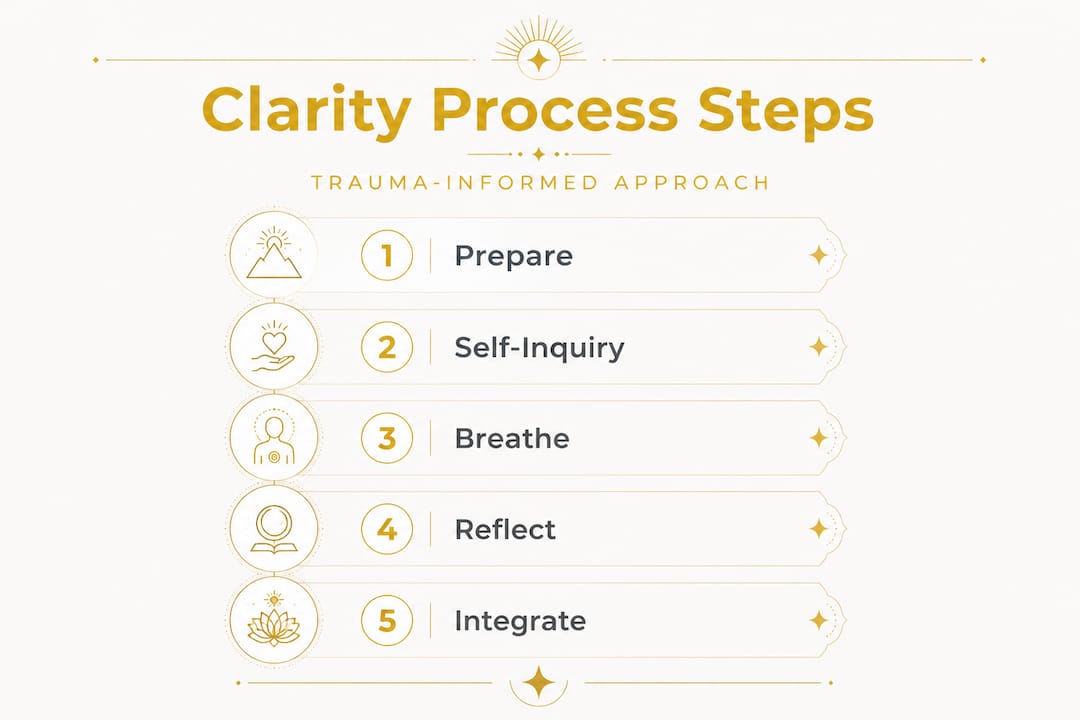
Studies show that emotion regulation outcomes are strongly associated with trauma-informed practices, especially when those practices center empowerment and personal choice. The following process draws on that research and the self-clearness approach referenced in decision-making literature.
The six-step self-clearness process:
-
Slow down. Set a timer for five minutes and sit in stillness before any clarity session. This is not wasted time. It is the most important five minutes of the process because it stops the reactive loop.
-
Name your current emotional state. Write one to three words that describe how you feel right now, without judgment. This is data, not a diagnosis. Examples: scattered, heavy, hopeful, numb, restless.
-
Ask the honest question. Instead of "What should I do?" try "What do I actually want, beneath what I think I should want?" Or: "What am I avoiding knowing?" These questions bypass the performance layer.
-
Listen to your body's response. After each question, notice physical sensations. Tightening in the chest often signals fear. Softening in the shoulders can indicate resonance with a true answer. Your body is speaking.
-
Write without editing. Freewrite for ten minutes in response to your question. Don't correct, don't perform. Let it be messy. The clarity often lives in the mess.
-
Identify one aligned action. Not a full plan. Not a five-year vision. Just one small action that reflects what you just discovered. This is where embodied clarity becomes real.
The step-by-step trauma-informed clarity process works because it builds a repeatable rhythm, not a one-time breakthrough moment. Consistency is what transforms insight into lived change.
Rumination vs. trauma-informed reflection:
| Approach | What it looks like | Result |
|---|---|---|
| Rumination | "Why can't I figure this out?" on repeat | Emotional exhaustion, stuck patterns |
| Trauma-informed reflection | Honest self-questioning with a grounded body | Gradual, embodied conviction |
| Surface clarity tools | Affirmations without inner work | Temporary relief, eventual disconnect |
| Self-clearness process | Slowing down, sensing, acting | Sustainable self-trust and empowerment |
Pro Tip: If you feel flooded or overwhelmed mid-session, place one hand on your heart and one on your belly. Say aloud: "I am here. I am safe right now." This is a somatic anchor, not a magic spell. It reminds your nervous system that this moment is survivable.
Pitfalls and troubleshooting: Avoiding trauma-informed clarity mistakes
As you work through these steps, it's also essential to look out for common pitfalls and ways to troubleshoot if things feel off.
One of the most important warnings in the coaching space today: not everyone who calls themselves trauma-informed actually is. Many self-described coaches lack depth beyond surface-level protocols, and applying trauma-informed language without genuine training can cause real harm. This is especially true when clarity work activates deep emotional material.
Watch for these warning signs in any coaching relationship or self-guided clarity practice:
- Pressure to move faster than feels safe for you
- Being told your emotional response is "resistance" rather than valid information
- Lack of transparency about what methods are being used and why
- No acknowledgment of cultural, racial, or gendered dimensions of your experience
- Promises of guaranteed outcomes or instant breakthroughs
If clarity work begins to feel destabilizing, the answer is not to push harder. It's to pause.
"The fastest way to slow your healing is to force it. Clarity that is rushed is clarity that hasn't fully landed."
Troubleshooting steps when something feels off:
- Reduce the frequency or intensity of self-inquiry sessions
- Reach out to a trusted peer or mentor rather than going it alone
- Assess whether your physical basics (sleep, food, movement) are being neglected
- Consider whether the tools or coach you're using genuinely honor your pace
Depth in trauma-informed coaching means sitting with complexity rather than rushing to resolution. Authentic coaching doesn't promise that things will feel better immediately. It promises that you will be accompanied honestly through the process.
1-to-1 coaching challenges are real, and acknowledging them upfront is a sign of integrity in any practitioner. If your guide doesn't acknowledge the hard parts, that itself is a red flag worth noticing.
Measuring results: How to know you're truly embodying clarity
So, how do you know if you're actually embodying clarity, not just thinking about it, but feeling and living it? Here's what to look for.
Progress in this work is subtle and cumulative. You likely won't wake up one morning with all the answers. What you will notice, over weeks and months, are small but meaningful shifts in how you relate to yourself and your decisions.
Six markers of embodied clarity:
- You pause before reacting, and the pause feels natural rather than forced.
- Your decisions feel like choices, not obligations or escapes.
- You notice when something is off in your environment and you trust that noticing.
- You can name what you need, even if asking for it still feels hard.
- Conflicting emotions feel less terrifying because you have a process for working through them.
- You return to yourself faster after being thrown off balance.
It's equally important to understand what research tells us about realistic expectations. Trauma-informed practices show strong associations with improved empowerment and emotion regulation outcomes. However, not every mental health symptom improves at the same rate. In some studies, depression scores decreased over time regardless of whether trauma-informed practices were received, suggesting that healing is multifactorial. This isn't discouraging. It's honest, and honesty is part of the framework.
If symptoms of anxiety, grief, or depression persist, that is not a sign that the work isn't working. It may simply mean that additional support (such as therapy, community, or medical consultation) is also needed. Embodying clarity doesn't replace clinical care. It works alongside it.
When to seek additional coaching or support:
- When self-inquiry consistently triggers shutdown rather than reflection
- When you're cycling through the same patterns despite regular practice
- When significant life decisions feel completely paralyzing
- When you want accountability, structured guidance, and a skilled thinking partner
Perspective: Why clarity isn't one-size-fits-all — lessons from trauma-informed practice
Now let's step back for a candid look at what most clarity guides leave out, and what real trauma-informed practitioners see in practice.
Here's what I've observed: the clarity conversation in the coaching world has a speed problem. Everyone wants to talk about breakthrough moments, pivotal sessions, and rapid transformation. The Instagram version of clarity looks like a woman standing on a mountaintop, finally free. The actual version often looks like someone sitting quietly at their kitchen table, slowly trusting themselves a little more than they did last month.
Most guides will give you frameworks without warning you that those frameworks can backfire. As noted in the coaching critique space, many practitioners implement trauma-informed language without the depth of understanding that language requires. The result is a client who got a framework but didn't get safety, and safety is the whole foundation.
Real trauma-informed clarity work honors the non-linear nature of healing. You might feel remarkably clear on a Tuesday, and by Friday feel like you're starting over. That's not failure. That's how nervous systems work. That's how people work. The goal is not to stay permanently on the mountaintop. The goal is to know how to find your footing again.
I also want to name something that most clarity coaches won't: sometimes the "confusion" you're feeling is actually your system doing something wise. It may be protecting you from a decision you're not yet resourced enough to make. True trauma-informed practice respects that. It doesn't bulldoze through protective mechanisms in the name of progress. It works with them.
Clarity evolves. What is true for you today may deepen, shift, or expand six months from now. That's not inconsistency. That's growth. Progress matters infinitely more than perfection, and the woman who moves forward imperfectly is far more empowered than the one who waits until everything feels certain before she takes a step.
Take your next step: Trauma-informed clarity coaching for women
If this process has resonated with you and you're ready to go deeper, you don't have to navigate it alone.
Work with a trauma-informed clarity coach who understands the full complexity of what you're moving through. At rachel-m-harrison.com, the Sanctuary Symbolic Integration Method™ offers a psychologically grounded, spiritually reflective approach specifically designed for women in transition. This isn't a one-size-fits-all program. It's a personalized, paced process that honors your nervous system, your lived history, and your emerging vision for who you are becoming. Whether you're exploring one-on-one coaching, looking for introductory resources, or simply wanting to learn more, the door is open at your pace and on your terms.
Frequently asked questions
What are the core trauma-informed principles for clarity coaching?
The six core principles are safety, trustworthiness, peer support, collaboration, empowerment, and sensitivity to cultural and gender contexts. These form the non-negotiable foundation for any coaching relationship that genuinely honors trauma.
Does trauma-informed clarity work always improve mental health?
It often strengthens emotion regulation and empowerment, but not every mental health symptom improves at the same pace. Some symptoms, like depression, may require additional support alongside coaching.
How can I tell if a coach is truly trauma-informed?
Look for depth of training, clear use of recognized principles, transparency about methods, and a genuine willingness to move at your pace. Surface-level protocols without deeper grounding are a real concern in the coaching industry.
What should I do if clarity work makes me feel worse?
Pause the practice immediately, return to a grounding ritual, and reach out to a qualified support person. Feeling temporarily uncomfortable is normal, but feeling consistently destabilized is a signal to reassess your approach or your guide.