
You can walk into a room full of confidence and still not trust yourself. For women navigating leadership, creative work, or major life transitions, this gap is not a personal failure. It is often the quiet aftermath of experiences that taught you to doubt your own instincts, minimize your needs, or push through pain rather than listen to it. Research confirms that women report higher posttraumatic stress and lower self-compassion than their counterparts, making a trauma-informed approach to self-trust not just helpful but essential. This guide walks you through what self-trust actually means, why it differs from confidence, and how to rebuild it in a way that honors your whole story.
Table of Contents
- Why self-trust matters more than confidence
- The trauma-informed foundation of self-trust
- A framework for embodying self-trust
- Common stumbling blocks and how to overcome them
- The deeper lesson: why self-trust is revolutionizing women's leadership
- How trauma-informed coaching supports your journey
- Frequently asked questions
Key Takeaways
| Point | Details |
|---|---|
| Self-trust is not confidence | Self-trust means honoring your needs and boundaries, not just believing in your abilities. |
| Healing must be trauma-informed | A trauma-informed foundation protects against retraumatization and prioritizes your safety and consent. |
| Self-compassion builds resilience | Integrating self-compassion helps buffer posttraumatic stress and supports growth. |
| Practice self-trust daily | Small, consent-based actions every day reinforce self-trust and personal growth. |
| Expert support accelerates healing | Trauma-informed coaching can provide tailored, safe guidance for embodying self-trust. |
Why self-trust matters more than confidence
Confidence and self-trust are often treated as the same thing. They are not. Confidence is the belief that you can do something well. It is competence in action, built through skill and repetition. Self-trust, on the other hand, is the belief that you are worthy of your own care, that your instincts deserve respect, and that you can honor your own needs even when the outcome is uncertain.
Here is a simple way to see the difference. You might feel confident presenting to a boardroom but completely abandon your own boundaries when someone pushes back on your ideas. You might be confident in your creative work but dismiss your exhaustion, your grief, or your need to slow down. That is the self-trust gap. And for women who have experienced trauma, that gap can feel enormous.
| Feature | Confidence | Self-trust |
|---|---|---|
| Based on | Skills and past performance | Inner worth and self-knowledge |
| Tested by | Challenges and outcomes | Setbacks and emotional moments |
| Can coexist with | Imposter syndrome | Grounded presence |
| Built through | Practice and feedback | Healing, reflection, and consent |
| Feels like | "I can do this" | "I am safe with myself" |
Self-efficacy, a core component of self-trust, is linked to significantly lower rates of PTSD and depression, with meta-analysis showing effect sizes between -0.49 and -0.52. That is not a small number. It means that how much you trust your own inner resources has a measurable, protective effect on your mental health.
Women in leadership and creative roles often experience what is sometimes called "imposter syndrome," a persistent sense that their success is undeserved or temporary. But this is rarely about skill. It is almost always about self-trust. When you have learned, through repeated experiences, that your instincts led you wrong or that your needs were too much for others, your nervous system begins to treat your own inner voice as unreliable. Trauma-informed coaching directly addresses this pattern, working at the level of the nervous system rather than just the mindset.
"Self-trust is not a luxury for women in leadership. It is the foundation everything else is built on. Without it, even the most accomplished woman is building on borrowed ground."
Pro Tip: To assess your real level of self-trust, pay attention to how you respond to setbacks, not victories. Do you spiral into self-blame? Do you abandon your plan the moment someone questions it? Your response to difficulty tells you far more about your self-trust than your response to success ever will.
The trauma-informed foundation of self-trust
While self-trust is crucial, the way we build it after trauma makes the biggest difference. A standard self-help approach might tell you to "just believe in yourself" or "take bold action." For women with trauma histories, that advice can actually cause harm. It skips over the nervous system entirely and asks you to perform trust before you have actually built it.

A trauma-informed approach starts with safety. This means creating the conditions where your nervous system feels regulated enough to make clear decisions. It means honoring consent, your own consent, at every stage. You do not push yourself into vulnerability before you are ready. You do not override your body's signals in the name of growth. You move at a pace that your whole self can sustain.
Research on posttraumatic growth shows that integrating self-compassion is a proven buffer against ongoing posttraumatic symptoms for women, and that trauma-informed methods specifically prioritize consent and pacing to avoid retraumatization. This is not soft language. It is evidence-based practice.
Trauma histories often undermine self-trust through two main channels: shame and self-doubt. Shame says "something is wrong with me." Self-doubt says "I cannot trust my own perceptions." Both are protective responses the nervous system learned during difficult times. They are not character flaws. Recognizing them as learned responses, rather than fixed truths, is the first step in working with them rather than against them.
Signs you are rebuilding self-trust with trauma-informed care:
- You notice your body's signals before overriding them
- You set boundaries without excessive guilt or explanation
- You can tolerate uncertainty without catastrophizing
- You give yourself permission to change your mind
- You choose actions based on your values, not fear of judgment
- You rest without needing to earn it first
- You seek support without shame
"Healing is not a straight line, and self-trust is not a destination. It is a practice of returning to yourself, again and again, with compassion rather than criticism."
The best practices for trauma recovery consistently emphasize that pacing is not weakness. Moving slowly and intentionally is how you build trust that actually holds under pressure. When you rush the process, you often reinforce the old pattern: push through, override your needs, perform wellness rather than embody it.
A framework for embodying self-trust
Having established the trauma-informed lens, let's turn to practical steps to make self-trust a lived experience rather than a concept you understand but cannot quite feel.
The framework below is built on four pillars: Awareness, Permission, Action, and Reflection. Each pillar supports the next, and together they create a cycle of deepening self-trust over time.
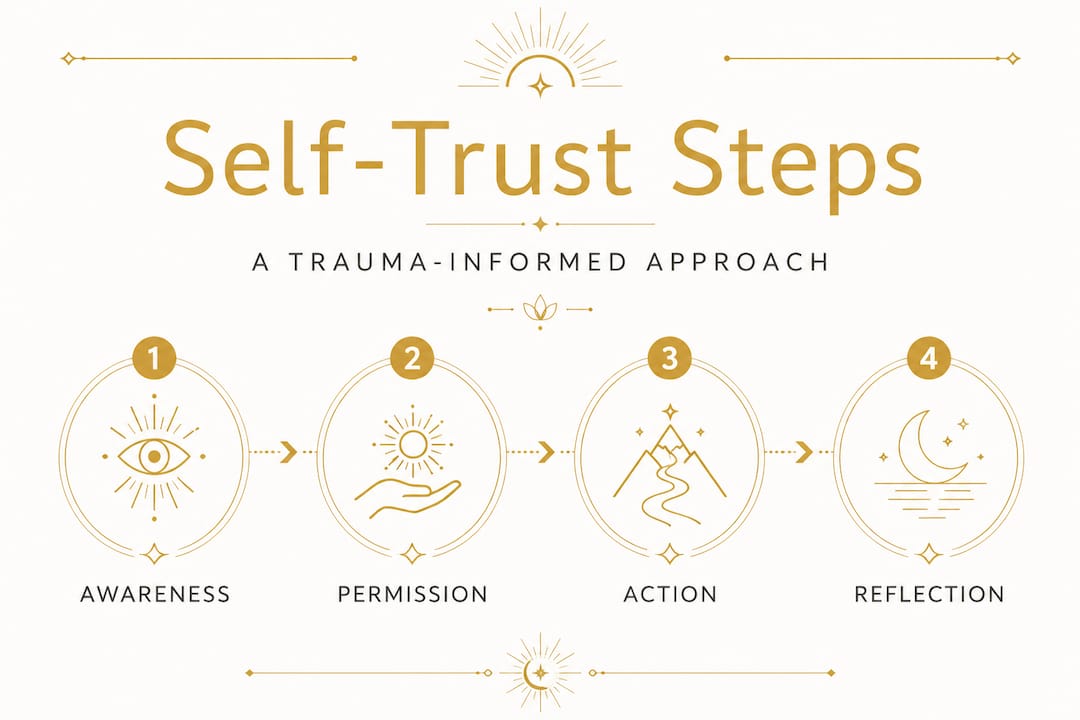
1. Awareness Notice what you are actually feeling, needing, or sensing before you decide anything. This is harder than it sounds if you have spent years overriding your inner signals. Start with small moments. Before answering an email, pause. Before agreeing to something, check in with your body. What do you notice?
2. Permission Give yourself explicit permission to honor what you noticed. This is where many women stall. Awareness without permission keeps you stuck in insight without change. Permission sounds like: "It is okay that I need more time." "It is okay that I said no." "It is okay that I do not have this figured out yet."
3. Action Take one small, aligned action based on what you noticed and permitted. Not a bold leap. A small step. Self-trust grows through repeated experiences of keeping the promises you make to yourself, especially the small ones.
4. Reflection After the action, reflect on what happened. Not to judge yourself, but to gather information. What felt true? What felt forced? What would you do differently? This is how self-trust becomes intelligent over time.
| Pillar | Daily practice | Outcome | Mindset shift |
|---|---|---|---|
| Awareness | Body scan before decisions | Clearer signals | "My body knows something" |
| Permission | Journaling your needs without editing | Less internal conflict | "My needs are valid" |
| Action | One boundary or choice per day | Increased self-respect | "I keep my word to myself" |
| Reflection | Evening check-in: what felt true? | Pattern recognition | "I am learning, not failing" |
Core self-evaluations, which include self-efficacy and self-trust, predict significant reductions in both PTSD symptoms and depression when actively strengthened through structured strategies. This framework is designed to do exactly that, one small, sustainable step at a time.
Pro Tip: If you are in the middle of a career change or a major creative project, apply this framework to one specific decision per week rather than trying to overhaul everything at once. Pick the decision that feels most charged and walk it through all four pillars. This focused practice builds more trust than a broad intention ever will.
Common stumbling blocks and how to overcome them
Next, it is important to prepare for the inevitable obstacles along the self-trust journey. Knowing what typically gets in the way means you are less likely to interpret a stumbling block as proof that you are doing something wrong.
Self-doubt is the most common barrier. It often sounds like an inner critic that questions every choice, replays mistakes, and predicts failure before you have even started. Self-doubt is not a sign of weakness. It is often a sign that your nervous system is trying to protect you from a perceived threat, even when no real threat exists.
Perfectionism is self-doubt's close companion. It sets an impossible standard and then uses every imperfection as evidence that you cannot be trusted. For creative women and leaders especially, perfectionism can masquerade as high standards when it is actually a fear response.
Guilt shows up when you start honoring your own needs, particularly if you have a history of prioritizing others. Setting a boundary, saying no, or choosing rest can all trigger guilt that feels like selfishness. It is not. It is self-trust in action.
Fear of failure keeps many women in analysis paralysis, endlessly preparing but never quite committing. This fear is often rooted in past experiences where failure had real consequences, emotionally, relationally, or professionally.
Women with lower self-compassion experience significantly higher posttraumatic stress, which means that how you treat yourself during these stumbling blocks is not incidental. It is central to your healing.
Techniques that actually help:
- Compassionate inquiry: When self-doubt arises, ask "What is this trying to protect me from?" rather than fighting it
- Paced boundary setting: Start with low-stakes boundaries and build up, do not begin with the hardest conversation you have been avoiding
- Body-based grounding: Before making a decision under pressure, take three slow breaths and notice where you feel tension
- Naming the pattern: Simply saying "this is perfectionism" or "this is fear" creates distance between you and the thought
- Scheduled reflection: Set a regular time to check in with yourself so self-trust becomes a practice, not just a crisis response
When these barriers feel overwhelming or when you notice trauma triggers repeatedly disrupting your progress, that is the right moment to seek trauma-informed guidance from a professional who understands the intersection of healing and leadership.
The deeper lesson: why self-trust is revolutionizing women's leadership
Most leadership development programs focus on skills: communication, strategy, executive presence, negotiation. These are valuable. But they consistently skip over the thing that makes all of those skills sustainable: the capacity to trust yourself under pressure.
Here is the contrarian view I hold after working with women in transition and creative leadership: imposter syndrome is not a confidence problem. It is a self-trust problem, and more specifically, it is a nervous system problem. You cannot think your way out of it. You cannot attend enough workshops or earn enough credentials to silence it. The only thing that actually resolves it is building a genuine, embodied relationship with your own inner authority.
When women begin doing self-trust work at this level, something unexpected happens. They stop performing leadership and start embodying it. The difference is palpable. Performed leadership is exhausting because it requires constant vigilance. Embodied leadership is grounded because it comes from a place of genuine self-knowledge.
I have seen this shift happen for women in the middle of career changes, creative pivots, and even organizational crises. The ones who navigate those transitions with the most grace are not the ones with the most polished skills. They are the ones who have learned to stay in relationship with themselves when things get hard. They can tolerate uncertainty without abandoning their values. They can receive criticism without collapsing. They can rest without guilt.
That is what clarity coaching insights at this level actually produces. Not a louder, more confident version of you. A more honest, more grounded, more fully present version of you. That is the version that leads with real authority.
How trauma-informed coaching supports your journey
Building self-trust after trauma is not something you have to figure out alone. In fact, trying to do it in isolation often reinforces the very patterns you are trying to shift.
At Rachel M. Harrison Coaching, the Sanctuary Symbolic Integration Method™ offers a structured, spiritually grounded, and psychologically informed path for women who are ready to stop performing and start embodying their clarity. Whether you are navigating a leadership transition, a creative reinvention, or simply a season of deep personal change, trauma-informed coaching for self-trust provides the expert, consent-paced support that makes the difference between insight and real transformation. Explore the site to find introductory resources, one-on-one coaching options, and a community built around grounded self-leadership.
Frequently asked questions
What does it mean to embody self-trust in a trauma-informed way?
It means rebuilding trust in your own decisions and boundaries at a pace your nervous system can sustain, while integrating self-compassion to buffer posttraumatic stress rather than pushing through it.
How do I know if I'm building self-trust and not just confidence?
Self-trust shows up in how you treat yourself after a setback. If you respond with compassion and realignment rather than harsh self-criticism, core self-evaluations are strengthening in a way that genuinely protects your wellbeing.
What are examples of practices to build self-trust after trauma?
Effective practices include daily body scans, consent-based journaling where you write without editing yourself, and setting one small boundary per day while checking your readiness before acting. Integrating self-compassion into each of these practices amplifies their impact significantly.
When should I consider seeking support from a trauma-informed coach?
If self-doubt, repeated setbacks, or trauma triggers are consistently disrupting your progress, a trauma-informed coach provides expert, consent-paced support that goes beyond what self-guided work alone can offer.