TL;DR:
- Creative work exposes artists to emotional vulnerability and stress, which can impair their output. Managing nervous system regulation through practices like breathwork and peer support enhances resilience and creative flow. Building consistent routines focusing on emotional health is vital for sustainable creativity and wellbeing.
Emotional wellness for creatives is the ability to consciously manage and nurture your emotional state so that creativity and resilience can coexist, even under pressure. A 2026 University of Pennsylvania study confirms that artists report higher rates of anxiety and depression than the general population. That gap exists because creative work demands emotional exposure that most professions never require. A systematic review by Jalifi et al. 2025 across 23 studies confirms that emotional intelligence skills, specifically self-awareness and self-regulation, directly sustain creative output under pressure. The industry term for this practice is emotional self-regulation, and it is the foundation every artist needs before technique, discipline, or inspiration can do their work.
What emotional challenges are unique to creatives?
Creative work carries emotional weight that most people underestimate until they are deep inside it. The vulnerability of making something personal and then releasing it into the world is not a side effect of the work. It is the work itself.
Creative burnout is defined by three core drivers: exhaustion, cynicism, and inefficacy. Somatic art therapists identify these three dimensions as accounting for up to 90% of stress-related disorders in creatives. That number matters because it means burnout is not random. It follows a predictable pattern, which means it can be interrupted.
The emotional stressors creatives face most often include:
- Vulnerability hangovers. After sharing work, many artists experience a wave of anxiety or low mood. This is a predictable post-creation cycle, not a sign that something is wrong with you or your work.
- Financial instability. Independent creatives face income uncertainty that keeps the nervous system in a low-grade state of threat. Social media pressures and comparison culture compound this stress daily.
- Isolation. Many creatives work alone. Without regular contact with peers who understand the emotional texture of creative life, isolation becomes a slow drain on mental health.
- Emotional sensitivity. The same sensitivity that makes great art also makes rejection land harder. Criticism of the work feels like criticism of the self, because for most artists, those two things are genuinely hard to separate.
Pro Tip: Keep a brief log after you share work. Note your emotional state at sharing, then again 48 hours later. Recognizing the vulnerability hangover cycle as predictable reduces its power over you.
These stressors do not just affect mood. They impair the quality and consistency of creative output. A regulated artist produces more, recovers faster, and takes creative risks with greater confidence.
How does nervous system regulation support creative flow?
Creativity requires safety to flourish. What artists often describe as needing the right conditions, the right light, the right silence, the right mood, frequently reflects the nervous system's demand for regulation rather than external circumstances.
Neurologist Dan Siegel developed the concept of the window of tolerance to describe the optimal zone of nervous system activation where a person can function, feel, and create effectively. Inside that window, you can access memory, imagination, and emotional nuance. Outside it, the brain shifts into survival mode.
"Creativity requires safety to flourish; what artists perceive as environmental needs often reflect their nervous system's demand for regulation." — Sustainable Creative Practice
When the nervous system moves outside the window of tolerance, it triggers fight, flight, or freeze responses. In creative terms, fight looks like perfectionism and self-criticism. Flight looks like procrastination and avoidance. Freeze looks like staring at a blank canvas or document with no access to ideas at all. None of these states are character flaws. They are physiological responses.
The practical implication is significant. Expanding your window of tolerance through consistent regulation practices directly increases your capacity for creative engagement. Techniques like breathwork, body-based movement, and somatic awareness all work by signaling safety to the nervous system. When the body feels safe, the creative mind opens.
What practical strategies can creatives use to manage stress and emotional health?
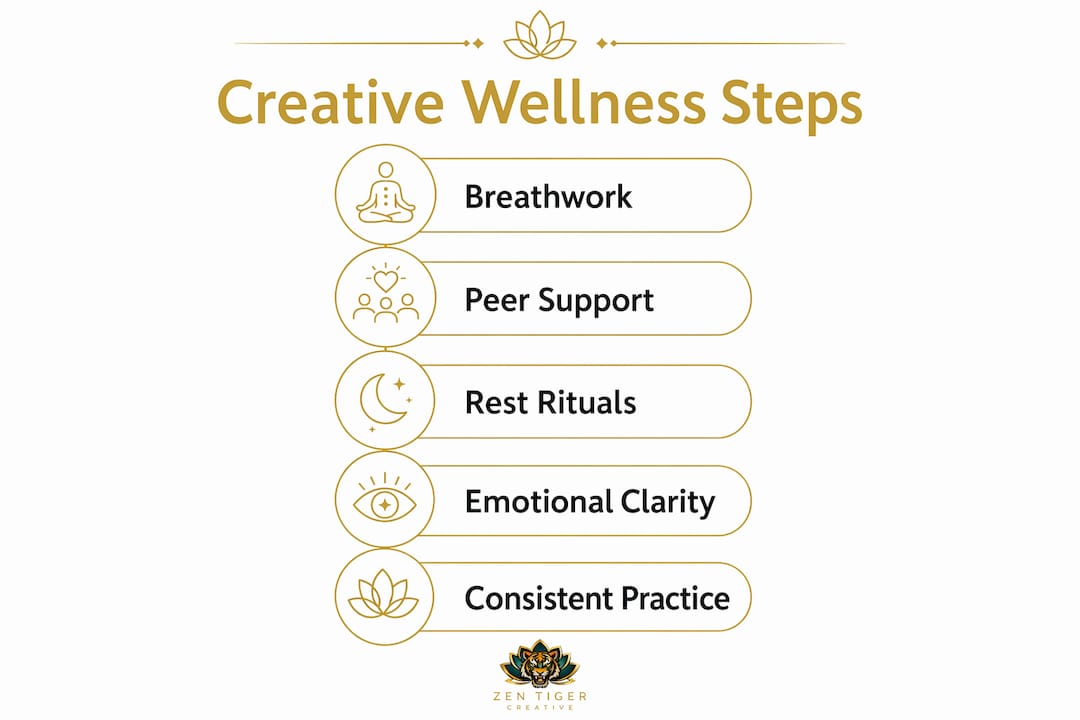
Evidence-based strategies for mental health for artists fall into four categories: somatic practices, peer support, intentional rest, and emotional intelligence development. Each addresses a different layer of the problem.
Somatic and body-based practices
Somatic therapy techniques, including breathwork, body scanning, and movement, regulate the nervous system by working through the body rather than the mind. These approaches are particularly effective for creatives because they do not require you to stop creating. A five-minute body scan before a work session can shift your nervous system state enough to access creative flow more reliably.
Art therapy itself functions as a somatic practice when used intentionally. Making marks, working with clay, or moving through a physical creative process without attachment to outcome helps discharge stored emotional tension. This is different from making work for an audience. It is making work for your nervous system.
Peer support and community
Small, cross-disciplinary peer groups that meet regularly to check in on mental health, not portfolio progress, provide a critical safety valve against isolation and burnout. The key distinction is focus. A group built around emotional support rather than critique creates a space where vulnerability is the point, not a risk.
These groups work best when they are small, diverse across creative disciplines, and consistent in meeting. Consistency builds trust. Trust makes honest emotional sharing possible.
Pro Tip: When forming a peer support group, set a standing rule: no portfolio sharing in the first 30 minutes. Open with a simple check-in question like "What are you carrying this week?" before any creative discussion begins.
Intentional rest and boundary rituals
Reframing rest as part of creative work is one of the most effective shifts a creative can make. Creative fallow time, periods of deliberate non-production, replenish the emotional and imaginative reserves that sustained output depletes. Treating rest as laziness is a direct path to burnout.
Physical or symbolic rituals that mark the boundary between creative time and personal time also protect emotional health. Some artists use a "studio door" practice: closing a physical or metaphorical door signals to the nervous system that creative mode is ending and personal time is beginning. This separation reduces the emotional bleed between work and life.
Strategy comparison
| Strategy | Primary benefit | Best applied when |
|---|---|---|
| Somatic breathwork | Nervous system regulation | Before or during creative sessions |
| Cross-disciplinary peer groups | Reduces isolation and burnout | Weekly, as a standing commitment |
| Creative fallow time | Replenishes emotional reserves | After high-output or high-exposure periods |
| Studio door ritual | Separates work from personal life | At the end of each creative session |
| Emotional intelligence practice | Builds self-awareness and resilience | Daily, through journaling or reflection |
Developing emotional clarity exercises alongside these strategies accelerates the process of recognizing your own patterns and responding to them with intention rather than reaction.
How can creatives build sustainable emotional wellness routines?
Sustainable self-care for creatives does not require adding more to an already full schedule. It requires redefining what counts as work. Rest, reflection, and emotional processing are not interruptions to creative work. They are part of it.
A practical weekly structure for emotional well-being includes:
- Start each work session with a two-minute body check-in. Notice physical tension, energy level, and emotional state before you begin. This takes 120 seconds and dramatically improves your ability to create from a regulated state.
- Set "good enough" standards for first drafts and early iterations. Perfectionism is a stress response, not a quality standard. Naming a piece of work "good enough for today" is a regulation tool.
- Schedule recovery time after sharing work. Build 24–48 hours of low-demand activity into your calendar after any public release, submission, or critique. This is planned recovery for the vulnerability hangover, not weakness.
- Hold a weekly peer check-in. Even a 20-minute call with one trusted creative peer focused on emotional state rather than output provides consistent support.
- Track your emotional patterns over time. Use a simple emotional wellness checklist to notice what conditions support your best creative states and which ones deplete you fastest.
- Practice the studio door ritual daily. A consistent closing ritual trains the nervous system to release creative tension at the end of each session.
The goal is not perfection in any of these practices. The goal is consistency over time. A small, repeated action builds more resilience than an intensive effort followed by collapse. Tracking your progress also matters. When you can see that your window of tolerance has expanded over three months, the data itself becomes motivating.
Self-leadership skills are the connective tissue between these individual practices. They help you stay accountable to your own wellness without needing external pressure to maintain the habits.
Key takeaways
Emotional wellness for creatives is not a luxury or a supplement to creative work. It is the foundation that makes sustained, courageous creative output possible.
| Point | Details |
|---|---|
| Emotional regulation sustains creativity | Jalifi et al. 2025 confirms that self-regulation directly supports creative output under pressure. |
| Burnout follows a predictable pattern | Exhaustion, cynicism, and inefficacy account for the majority of stress disorders in creatives. |
| The window of tolerance is expandable | Somatic practices and consistent rituals widen your capacity for creative engagement over time. |
| Peer support prevents isolation | Small, cross-disciplinary groups focused on mental health reduce burnout risk significantly. |
| Rest is productive | Creative fallow time replenishes emotional reserves and prevents the depletion that leads to burnout. |
What I have learned about emotional wellness as a creative
Creative work is an act of sustained vulnerability. That is not a poetic description. It is a physiological reality. Every time you make something personal and share it, your nervous system registers exposure. The vulnerability hangover that follows is not a sign of weakness. It is evidence that you showed up fully.
What I have found, both in my own work and in the work I do with clients through the Sanctuary Symbolic Integration Method™, is that most creatives are not lacking discipline or inspiration. They are lacking safety. The nervous system cannot access imagination when it is running a threat response. No amount of willpower changes that equation.
The reframe that changes everything is this: your emotional state is not a distraction from your creative work. It is the medium you work in. When you tend to it with the same care you give your craft, everything shifts. Output becomes more consistent. Recovery becomes faster. Risk-taking becomes less terrifying.
The artists I see struggle most are the ones who treat emotional care as something to get to after the real work is done. The ones who thrive treat it as the first task of every creative day. That is not a personality type. It is a practice. And it is one you can build, starting with whatever small step feels most honest right now.
— RachelMHarrison
Support for creatives who are ready to go deeper
Emotional wellness does not develop in isolation, and creative work should not have to be carried alone.
Rachel-m-harrison offers trauma-informed coaching specifically designed for women and creatives who are ready to stabilize their nervous system, build emotional clarity, and create from a grounded place. If you are unsure whether coaching or therapy is the right fit for where you are right now, the trauma-informed coach vs. therapist guide at Rachel-m-harrison clarifies exactly that. For a practical starting point, the emotional wellness checklist gives you a concrete tool to assess where you are and what to address first. Both resources are free and built for the specific emotional terrain of creative life.
FAQ
What is emotional wellness for creatives?
Emotional wellness for creatives is the ongoing practice of managing your emotional state to sustain creativity, resilience, and mental health despite the unique stressors of artistic work. It includes self-awareness, nervous system regulation, and intentional recovery practices.
Why do creatives struggle with mental health more than other professionals?
A 2026 University of Pennsylvania study found that artists report higher rates of anxiety and depression than the general population. The combination of financial instability, public vulnerability, isolation, and emotional sensitivity creates compounding stress that most other professions do not share.
What is a vulnerability hangover and how do you recover from it?
A vulnerability hangover is the wave of anxiety or low mood that follows sharing personal creative work. Experienced creatives manage it by building 24–48 hours of low-demand recovery time into their schedule after any public release or critique.
How does the window of tolerance affect creativity?
Dan Siegel's window of tolerance describes the nervous system state in which a person can access imagination, memory, and emotional nuance. Outside that window, the brain shifts into survival mode, which blocks creative access entirely.
What is the fastest way to start building emotional wellness habits as a creative?
Start with a two-minute body check-in before each work session and schedule one weekly peer check-in focused on emotional state rather than output. These two practices address nervous system regulation and isolation, the two most common drivers of creative burnout.