
TL;DR:
- Emotional clarity, supported by spiritually reflective practices and trauma-informed coaching, sustains women leaders through challenges. Coaching creates psychological safety that enables creative risks, self-trust, and emotional regulation vital for authentic leadership. Integrating small daily reflective exercises cultivates internal coherence, transforming leadership from reactive to intentionally grounded.
Talent gets you in the door, but it rarely explains what keeps a woman leader grounded when things get hard. The real differentiator in creative leadership is emotional clarity, the kind that doesn't collapse under pressure or freeze in the face of conflict. Spiritually reflective practices like mindfulness, journaling, and meditation have empirical validation for enhancing self-leadership through inner coherence, and when these tools are paired with trauma-informed coaching, something genuinely shifts. This guide walks you through what that shift looks like, what the evidence says, and how you can apply it to your leadership starting right now.
Table of Contents
- How coaching shapes creative leadership
- The science behind spiritually reflective practices
- Why trauma-informed coaching matters
- Applying coaching: Self-leadership practices for day-to-day impact
- The missing link: Why reflective coaching outperforms conventional leadership advice
- Unlock your creative clarity with expert coaching
- Frequently asked questions
Key Takeaways
| Point | Details |
|---|---|
| Safety fuels creativity | Coaching provides psychological safety, enabling genuine creative risk-taking. |
| Reflection boosts clarity | Mindfulness and journaling help leaders develop emotional intelligence and clear decision-making. |
| Trauma-aware coaching matters | Specialized coaching approaches prevent setbacks and create long-term growth for trauma-affected professionals. |
| Small habits, big impact | Integrating spiritual practices into daily routines strengthens self-leadership and resilience. |
| Expert support is key | Choosing a trauma-informed, reflective coach unlocks creative leadership growth safely. |
How coaching shapes creative leadership
Talent alone is a starting point, not a sustainable strategy. Many women leaders arrive at coaching after years of high performance that quietly eroded their sense of self. They've led teams, shipped creative work, and delivered results. But underneath the output, something feels misaligned or fragile. That's exactly where coaching enters as a real catalyst.
Coaching creates a structured environment where you can take creative risks without fear of judgment. For women and creative professionals who carry trauma histories, this kind of safety is not a luxury. It is the condition that makes genuine growth possible. When psychological safety for exploration is established in a coaching relationship, divergent thinking and experimentation become accessible in ways they simply aren't in high-pressure environments.
Here's what that support structure actually provides:
- Permission to be uncertain. Coaching normalizes the process of not knowing, which is where all creative work begins.
- Accountability without shame. A skilled coach holds you to your goals while honoring the complexity of your history.
- Emotional pattern recognition. Targeted frameworks help you see where old responses are steering current decisions.
- Clarity through reflection. Regular coaching sessions interrupt the autopilot of reactive leadership and invite intentional choice.
- Nervous system awareness. Especially for trauma survivors, noticing your body's signals is foundational to sustainable leadership.
Explore creative leadership coaching strategies to understand how this kind of structured support works in practice for women at various stages of their leadership journey.
"The most creative leaders aren't the ones with the most ideas. They're the ones with enough internal safety to let their ideas breathe." This is what coaching builds: the internal architecture that makes creative courage possible.
Self-leadership, which is the capacity to direct your own thinking, emotions, and actions toward meaningful outcomes, is not hardwired. It is developed. Coaching gives you the specific scaffolding to develop it, particularly when your history has made self-trust feel risky.
The science behind spiritually reflective practices
Once we understand what coaching provides structurally, the next piece is understanding why spiritual reflection deepens the results. This isn't about religion or ritual for its own sake. It's about the specific cognitive and emotional shifts that reflective practices produce over time.

Research supports what many practitioners have long observed: spiritually reflective practices foster what researchers call "informed mindfulness," a quality of self-awareness that moves a leader from reactive, ego-driven decisions toward compassionate, coherent ones. The contrast is significant. Ego-driven leadership is characterized by defensiveness, status protection, and emotional reactivity. Compassion-based leadership, by contrast, demonstrates curiosity, steadiness, and relational attunement.
You can build practical self-awareness steps into your existing routine without overhauling your schedule. Small, consistent practices do more for leadership clarity than occasional retreats.
| Practice | Mechanism | Leadership outcome |
|---|---|---|
| Mindfulness meditation | Reduces amygdala reactivity | Calmer responses to creative conflict |
| Journaling | Externalizes internal dialogue | Clearer decision-making and goal setting |
| Prayer or dhikr | Anchors attention in the present | Reduces fear-based decision-making |
| Contemplative reading | Stimulates reflective thinking | Deepens values alignment |
| Somatic check-ins | Builds body-based self-awareness | Improves regulation during stress |
What makes this table meaningful is the mechanism column. Knowing why a practice works helps you use it with more intention. Mindfulness doesn't just make you feel calmer. It physically reduces the reactivity in the part of your brain that responds to perceived threats. For a woman leader with unresolved trauma, that neurological shift is enormous.
A note on scale: Studies using Fry's Spiritual Leadership Scale (SLS) have empirically validated the connection between spiritual leadership behaviors and organizational commitment, which means these practices have measurable workplace impact, not just personal wellness benefits. This matters if you lead a team or manage creative projects.
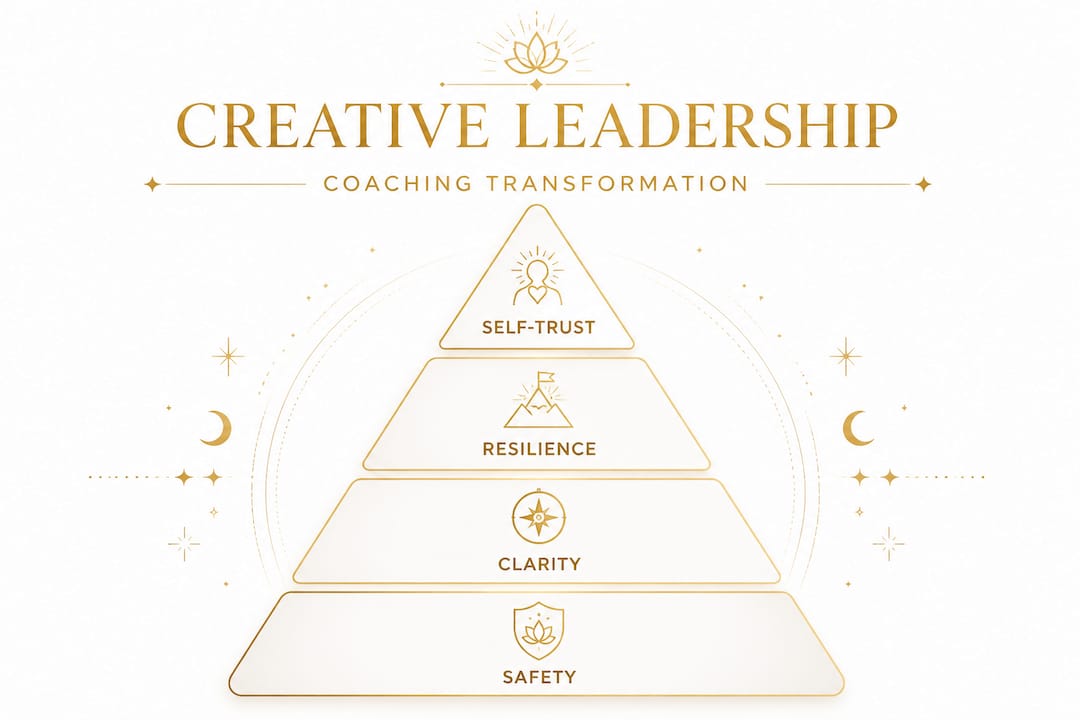
Why trauma-informed coaching matters
Spiritual practices are powerful, but their impact multiplies inside a coaching relationship that is genuinely attuned to trauma. That's because trauma changes how a person receives information, processes feedback, and tolerates uncertainty, all of which are central to creative leadership.
Trauma-informed coaching doesn't mean your coach is your therapist. The distinction is important. Trauma-informed means the coach understands how traumatic history shapes nervous system responses, uses language carefully, and creates conditions that don't accidentally trigger fight-or-flight reactions during sessions. It does not mean excavating the past or processing traumatic memories. That is therapy, and knowing the boundary protects you.
Here's how to assess whether a coach is genuinely trauma-informed:
- They speak about emotional safety proactively. Not as a reaction to a crisis, but as a design principle for every session.
- They use co-regulatory presence. This means their own regulated nervous system helps stabilize yours. You feel calmer after talking with them, not more activated.
- They understand their scope. A skilled coach knows when to refer a client to a licensed mental health professional and does so without hesitation.
- They invite, not push. Sessions feel like exploration rather than extraction. You set the pace.
- They hold confidentiality with clarity. You know exactly what is private and what is not.
According to Regent Research Roundtables 2025, success in this modality relies heavily on the coach's own regulated presence for co-regulation, and on the client's readiness and awareness. Overstepping into therapeutic territory is a documented risk, which makes it essential to choose coaches with specific training.
Pro Tip: Before beginning a coaching relationship, ask directly: "What does trauma-informed mean in your practice, and how do you handle moments when a client becomes emotionally activated?" A coach who gives you a confident, grounded answer has thought this through. A coach who fumbles through vague language has not.
Explore this personal growth guide for additional context on what readiness for this kind of work can look like and how to begin building your own foundation before entering a coaching engagement.
Applying coaching: Self-leadership practices for day-to-day impact
Knowing what works in theory is one thing. Building it into your daily leadership is where the real transformation happens. The good news is that none of this requires a complete lifestyle overhaul. It requires small, intentional practices repeated over time.
Here is a comparison of conventional leadership habits versus coaching-enhanced approaches that support creative clarity:
| Conventional habit | Coaching-enhanced approach |
|---|---|
| Reacting immediately to conflict | Pausing to name the emotion before responding |
| Avoiding creative risk to maintain control | Using structured reflection to assess risk with curiosity |
| Measuring worth by output | Evaluating choices by values alignment |
| Suppressing emotions at work | Acknowledging internal states as data points |
| Seeking external validation | Building internal self-trust through consistent small wins |
| Consuming more to stay inspired | Creating space for stillness to process and integrate |
The shift in the right column is not soft or passive. It represents a more sophisticated and sustainable form of creative leadership. Women leaders who make these shifts report clearer decision-making, stronger boundaries, and more authentic relationships with their teams.
Here are daily practices drawn directly from the research-backed outcomes of spiritual self-leadership:
- Morning journaling, five to ten minutes. Write without editing. Focus on how you feel, what you're carrying, and what you want to create. This externalizes internal noise and clarifies intention.
- A brief mindfulness pause before creative work. Even two minutes of conscious breathing before starting a project shifts your nervous system from threat-scanning to open processing.
- Weekly values check-in. At the end of each week, review your decisions through the lens of your core values. Where were you aligned? Where did you drift?
- Somatic awareness during meetings. Notice where you hold tension in your body during difficult conversations. That information tells you something about your edges and where clarity is needed.
- Intentional reflection after creative output. Rather than immediately moving to the next task, take five minutes to acknowledge what you made and what it took.
Use these clarity and self-leadership strategies to design a personalized practice sequence that actually fits your schedule and temperament. One size does not fit all in this work, and the best coach will help you identify what actually sticks for you rather than prescribing a generic program.
For additional methods on building sustained self-awareness, the self-awareness improvement methods resource offers specific, practical tools you can layer in as you develop your practice over time.
The missing link: Why reflective coaching outperforms conventional leadership advice
Most leadership development programs operate from one assumption: that the leader's main challenge is a skills gap. They offer frameworks, productivity tools, and communication strategies. For some leaders, in some seasons, that's genuinely useful. But for women leaders who've experienced trauma, this approach often makes things worse, not better.
Here's why. Standard leadership advice is delivered into a nervous system that may already be in a state of chronic stress. When a dysregulated nervous system receives new frameworks, it can't actually integrate them. The leader leaves the workshop feeling temporarily inspired and returns to exactly the same patterns within weeks. Sound familiar?
Reflective coaching works differently because it addresses the internal safety question first. Before you can truly lead others with creativity and integrity, you need a foundation of internal coherence. You need to trust your own perceptions, tolerate uncertainty without shutting down, and set boundaries without guilt. None of that can be shortcut with a productivity framework.
The psychological safety for innovation that coaching builds doesn't just help you in coaching sessions. It restructures how you show up in every leadership context. Teams notice. The quality of creative work reflects it. Your capacity to stay present during friction improves in measurable ways.
There is also something that conventional leadership advice almost never names: grief. Many women leaders are quietly grieving the creative selves they suppressed in order to appear competent in systems that didn't value emotional intelligence. Reflective coaching creates room for that grief to surface, be witnessed, and be integrated. That integration is not weakness. It is the deepest kind of leadership development there is.
The Sanctuary Symbolic Integration Method™ is built around exactly this premise. It meets you where your nervous system actually is, not where you wish it were, and builds clarity from there.
Unlock your creative clarity with expert coaching
If this guide has resonated with you, you're probably already sensing that the next step isn't another book or framework. It's a supported relationship where your specific story, your unique patterns, and your genuine creative vision are held with skill and care.

At rachel-m-harrison.com, the work is grounded in trauma-informed principles, spiritually reflective practices, and the Sanctuary Symbolic Integration Method™, a framework specifically designed for women leaders and creatives who are ready to stop managing their clarity and start embodying it. Whether you're new to this kind of work or ready to go deeper, there is a pathway here that honors both your complexity and your capacity for growth. Trauma-informed coaching and clarity work can help you move from exhausted high-performer to grounded, expressive leader, at a pace that your nervous system can actually sustain.
Frequently asked questions
How is trauma-informed coaching different from regular leadership coaching?
Trauma-informed coaching prioritizes psychological safety and the coach's own regulated presence for co-regulation, making it fundamentally different from performance-focused coaching that doesn't account for a client's trauma history or emotional readiness.
What are spiritually reflective practices and how do they help creative leaders?
Practices like mindfulness, journaling, meditation, and dhikr cultivate informed self-awareness that helps creative leaders shift from reactive, ego-driven decisions to compassionate, coherent ones rooted in their actual values.
Why is psychological safety so important for creative professionals with trauma backgrounds?
Without psychological safety, creative risk-taking is inaccessible to leaders whose nervous systems have learned to prioritize threat-avoidance over exploration, which means trauma-aware environments are a prerequisite for real creative growth.
How do I start integrating spiritually reflective practices into my leadership as a beginner?
Begin with a five-minute daily journaling practice or a short mindfulness pause before creative work, adding new practices gradually as each one becomes a natural part of your routine rather than another obligation.