
TL;DR:
- Trauma-informed self-leadership helps creative women honor their cycles, emotional safety, and spiritual grounding instead of pushing through stress. It involves recognizing patterns, regulating emotions, and aligning actions with inner seasons to sustain creativity and clarity. Building personalized routines with gentle awareness supports lasting growth and deepens inner trust during transitions.
You are mid-project, mid-transition, or mid-breakdown, and the usual advice about "just staying disciplined" feels completely hollow. Creative women carry a particular kind of emotional weight: the sensitivity that makes your work meaningful is the same thing that makes self-doubt louder, boundaries harder, and burnout faster. Trauma-informed self-leadership offers something different. It works with your nervous system, your cycles, and your creative rhythms rather than against them. This guide walks you through what that actually looks like, from the foundational frameworks to the daily practices that build real, lasting emotional clarity.
Table of Contents
- What is self-leadership for creatives?
- Preparing to lead yourself: Emotional and spiritual groundwork
- Step-by-step: Building your trauma-informed self-leadership practice
- Sustaining your practice and measuring progress
- What most self-leadership advice misses: The creative and spiritual dimension
- Ready to deepen your self-leadership journey?
- Frequently asked questions
Key Takeaways
| Point | Details |
|---|---|
| Self-leadership is dynamic | Creative women thrive by adapting self-leadership routines to changing emotional and life cycles. |
| Trauma-informed practices matter | Emotional safety, boundaries, and self-kindness create the foundation for successful leadership of self. |
| Spiritual reflection boosts clarity | Intentional spiritual practices like journaling and nature walks enhance decision-making and transition support. |
| Measurement ensures growth | Tracking emotional clarity and creative progress helps refine your approach over time. |
| Personalization is key | Routines must fit your rhythms, needs, and transitions—one size does not fit all. |
What is self-leadership for creatives?
Self-leadership is not about being your own drill sergeant. At its core, self-leadership involves consciously influencing your own thoughts, emotions, and behaviors to achieve goals while maintaining balance, using methods like self-observation, self-instruction, and self-reinforcement. One accessible framework is the ABC model: Awareness, Bolster, Create. You first notice what is happening inside you, then you strengthen your inner resources, and finally you take intentional action from that grounded place.
For creative women, this definition needs to stretch further. Modern creative leadership for women integrates feminine cycles, empathetic traits, boundary intelligence, and creative expression for sustainable success during transitions. That means your self-leadership practice honors the fact that your energy, focus, and emotional capacity shift throughout the month, the season, and life's bigger chapters. It is not a flaw to work with. It is data.
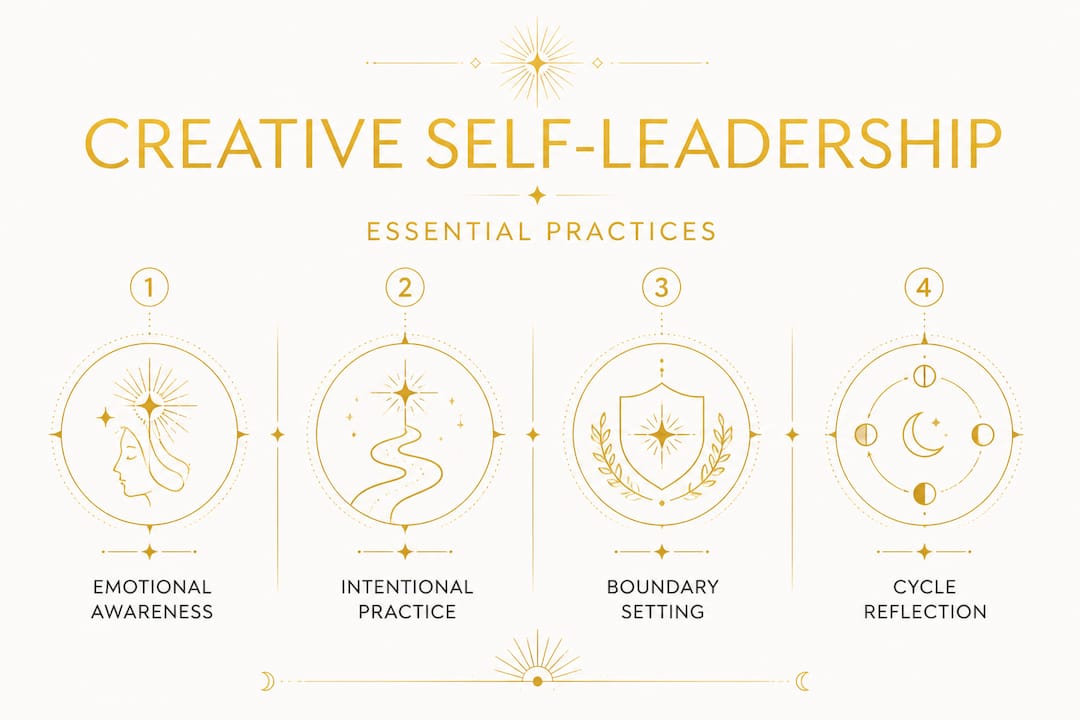
Trauma-informed self-leadership adds one more layer: it acknowledges that past stress, relational wounds, or creative setbacks live in the body and shape how you respond to pressure. A trauma-informed lens means you build practices that feel safe, not punishing, and that you approach your own patterns with curiosity rather than judgment.
Here is a quick comparison to clarify the difference:
| Feature | General self-leadership | Trauma-informed, creative-centered approach |
|---|---|---|
| Core focus | Goal achievement and productivity | Emotional safety, clarity, and sustainable creativity |
| Relationship to cycles | Often ignores natural rhythms | Honors feminine and creative cycles |
| Response to setbacks | Push through or analyze | Pause, regulate, then reflect |
| Boundary-setting | Seen as optional | Treated as a non-negotiable foundation |
| Spiritual dimension | Rarely included | Integrated as a source of grounding and guidance |
| Measurement of success | Output and results | Emotional clarity, nervous system stability, creative flow |
Key traits that make self-leadership distinctly creative and feminine include:
- Cyclical energy awareness: Recognizing that high-output phases naturally alternate with rest and integration phases
- Empathetic leadership: Leading yourself with the same care you extend to others
- Emotional intelligence in leadership: Using emotional data as a compass, not a liability
- Boundary intelligence: Knowing when to say no as an act of creative preservation
- Creative expression as processing: Using art, writing, or movement as part of your self-leadership toolkit
Preparing to lead yourself: Emotional and spiritual groundwork
Before you build a practice, you need to understand what is getting in the way. For creative women, the most common emotional blocks are imposter syndrome (the persistent feeling that your work is not enough), over-responsibility (taking on the emotional labor of everyone around you), and compassion fatigue (the depletion that comes from giving without replenishing). These are not character flaws. They are patterns, and patterns can shift.

Spiritually reflective practices for emotional clarity and transitions include reflection and intention processes, journaling, breathwork, nature walks, inner child work, meditative painting, and surrender to divine guidance. These are not luxuries. They are the actual mechanisms through which you build the self-awareness that makes self-leadership possible. Without them, you are trying to lead yourself while flying blind.
For modern creative women, boundary intelligence is especially critical during transitions. A transition, whether it is a career shift, a relationship change, a creative pivot, or a health challenge, temporarily destabilizes your sense of self. Spiritual practices create an inner anchor when the outer landscape is shifting.
Here is a practical overview of the tools and what they require:
| Tool | What it involves | Time needed | Best for |
|---|---|---|---|
| Daily reflection journaling | Writing unfiltered thoughts and observations | 10 to 20 minutes | Building self-awareness |
| Breathwork | Guided or unguided breathing patterns to regulate the nervous system | 5 to 15 minutes | Immediate emotional reset |
| Nature walks | Slow, intentional walking outdoors without devices | 20 to 30 minutes | Nervous system regulation and clarity |
| Inner child work | Guided visualization or journaling toward younger self | 20 to 45 minutes | Healing relational patterns |
| Meditative painting or creative ritual | Using art as a non-verbal processing tool | 30 to 60 minutes | Accessing intuition and releasing tension |
| Intention-setting practice | Clarifying what you are calling in for a season or week | 10 to 15 minutes | Aligning action with values |
These tools for emotional resilience are most effective when they feel chosen rather than forced. Start with one that genuinely appeals to you, not the one that sounds most productive.
Pro Tip: Track which practices feel most natural during different phases of your month or creative cycle. Many women find that journaling and intention-setting feel easiest in the first half of their cycle, while breathwork and rest-based practices feel more nourishing in the second half. Aligning your tools with your rhythms dramatically reduces resistance. Mental health strategies for creatives consistently emphasize the importance of sustainable, personalized routines over one-size-fits-all prescriptions.
Step-by-step: Building your trauma-informed self-leadership practice
With your foundation in place, here is a practical, stepwise process you can follow. This combines the ABC model with a two-part reflection and intention process, and it is designed to be adapted, not followed rigidly.
-
Awareness: Observe without judgment. Begin each day or session by simply noticing. What is your body doing? Where do you feel tension, heaviness, or ease? Use a brief journaling prompt like "What am I carrying right now?" This is not about solving anything yet. It is about seeing clearly. The ABC framework places awareness first because you cannot lead what you cannot see.
-
Bolster: Regulate and resource. Once you have awareness, you need to stabilize before you strategize. This is where breathwork and inner child work become practical tools rather than abstract concepts. A simple four-count inhale, hold, and exhale cycle can shift your nervous system from reactive to receptive in under three minutes. If a memory or emotional charge surfaces, acknowledge it gently and return to breath.
-
Reflection: Make meaning of what you observed. This is the first part of the intention process. Ask yourself: "What pattern do I notice? What emotion is asking for attention? What do I need to release or understand?" Write freely for five to ten minutes. The goal is not to produce insights. The goal is to let the inner landscape speak without interruption.
-
Intention: Choose your direction. Now you move from reflection to intention. Ask: "What do I want to create, call in, or commit to today or this week?" Keep it simple and grounded in what is actually possible given your current energy. Spiritual practices like reflection and intention-setting work best when they are honest rather than aspirational to the point of disconnection.
-
Create: Take one aligned action. This is the final step in the ABC model. From your regulated, reflected, and intentioned state, take one concrete action that matches your clarity. It does not need to be large. Sending one email, beginning one creative project, or setting one boundary counts. Consistent small actions compound into significant shifts.
-
Review and adjust. At the end of the week, revisit your intentions and observations. What worked? What felt forced? Adjust accordingly. Stress management strategies for creatives consistently point to flexibility and self-compassion as the factors that determine whether a practice lasts.
Pro Tip: During major life transitions, reduce the scope of your practice rather than abandoning it entirely. Even five minutes of breath and one written sentence keeps the thread alive. Transitions are not the time to add more. They are the time to simplify and trust the foundation you have built.
A note on safety: If any step in this process surfaces memories, emotions, or physical sensations that feel overwhelming, please pause and seek support from a trauma-informed professional. Self-leadership is a powerful practice, and it works best alongside, not instead of, appropriate care. Honoring your limits is not weakness. It is wisdom.
Sustaining your practice and measuring progress
Starting a practice is one thing. Sustaining it through creative blocks, life upheaval, and the inevitable days when nothing feels like it is working is another. The key is knowing what progress actually looks like, because it rarely looks the way you expect.
Quantitative measures of self-leadership progress include tracking how often you complete your daily practice, how frequently you set and maintain a boundary, or how many days in a row you wake without immediately reaching for your phone. These numbers matter because they show consistency. But they are not the whole picture.
Qualitative signs of positive shifts include:
- Emotional clarity: You can name what you are feeling without being overwhelmed by it
- Boundary ease: Saying no feels less like a moral failure and more like a clear choice
- Creative flow: You access your creative state with less friction and fewer warm-up rituals
- Reduced reactivity: Situations that previously sent you into a spiral now feel manageable
- Stronger self-trust: You consult your own inner knowing before seeking external validation
- Nervous system flexibility: You recover from stress more quickly than before
Personal and emotional growth is not linear, and clarity and transition work often involves periods of apparent regression that are actually integration. When you feel like you have gone backward, ask yourself whether you are actually experiencing something new, or whether you are processing something old that now has enough safety to surface.
Here is a practical table for sustaining your practice over time:
| Challenge | Adjustment strategy | Sustaining tool |
|---|---|---|
| Losing motivation | Return to your "why" through journaling | Weekly intention review |
| Feeling overwhelmed | Simplify to one core practice | Breathwork as a daily anchor |
| Creative block | Use meditative painting or nature walk | Shift from verbal to sensory practice |
| Major life transition | Reduce scope, increase gentleness | Inner child work for emotional support |
| Comparison or self-doubt | Revisit your values and past wins | Gratitude and evidence journaling |
The ABC self-leadership framework supports ongoing progress because it is designed to loop. You are never finished with awareness. You are never done bolstering your inner resources. The practice deepens, not ends.
What most self-leadership advice misses: The creative and spiritual dimension
Most self-leadership content is written for a very specific kind of person: someone who operates in linear time, responds well to productivity systems, and treats emotions as problems to manage rather than information to receive. That model works for some people. For creative women, especially those navigating trauma, transition, or deep sensitivity, it often creates more shame than progress.
Here is what I genuinely believe after working with women in this space: the cyclical, spiritual, and emotional dimensions of self-leadership are not the soft additions you sprinkle on top of the real work. They are the real work. When you honor the fact that your creative energy ebbs and flows, when you treat your intuition as a legitimate data source, and when you bring spiritual grounding into your daily practice, you are not being indulgent. You are being precise.
Mainstream advice often tells you to "push through" the hard days. Trauma-informed clarity coaching tells you something more useful: learn to distinguish between resistance that needs to be gently moved through and exhaustion that needs to be honored with rest. Those are two completely different signals, and confusing them leads to burnout, not breakthrough.
"The most radical act of self-leadership for a creative woman is not doing more. It is learning to trust the wisdom of her own inner seasons."
Pro Tip: Sync your biggest creative decisions with your clearest inner seasons. Many women find that major choices made during periods of depletion or high emotional charge rarely reflect their actual values. When in doubt, wait for a clearer window and trust that the right action will feel different from the urgent one.
Ready to deepen your self-leadership journey?
If this guide has resonated with you, you are likely ready for something more personalized than a framework on a page. Creative women in transition deserve support that actually sees them, not generic advice that asks you to fit a mold you were never meant to fit.
Rachel M. Harrison's trauma-informed coaching and clarity work is designed specifically for women like you: creatives, leaders, and seekers who are ready to rebuild emotional clarity, set boundaries that actually hold, and lead themselves from a place of genuine inner knowing. Through the Sanctuary Symbolic Integration Method™, you will move from confusion and depletion to grounded, spiritually aligned action. Whether you are navigating a major life transition or simply ready to stop abandoning yourself under pressure, there is a space here for you to begin.
Frequently asked questions
What is a trauma-informed approach to self-leadership?
A trauma-informed approach integrates emotional safety, awareness of past stress, and practical self-kindness into leadership routines, recognizing that feminine cycles and empathetic traits shape how creative women lead themselves most sustainably.
How can spiritual practices support self-leadership?
Practices like reflection and breathwork help clarify emotions and provide spiritual grounding during transitions, giving you an inner anchor when outer circumstances feel unstable.
What if I struggle staying consistent with self-leadership routines?
Start with just one core practice, celebrate small wins, and expect your needs to ebb and flow with life cycles. Consistency looks different in different seasons, and that is completely normal.
Are there quick exercises for emotional clarity?
Yes. A five-minute daily reflection, a brief nature walk, or a short round of mindful breathwork can reset your nervous system and bring you back to clarity without requiring a large time commitment.
How can I tell if my self-leadership practice is working?
Notice more emotional clarity, improved boundaries, and smoother creative transitions as signs of progress. The ABC self-leadership model also suggests tracking your self-observation and self-reinforcement patterns over time to see measurable shifts.