TL;DR:
- Reflective practice actively builds self-clarity, which is linked to greater life purpose and resilience. Consistent reflection paired with emotional regulation enhances self-awareness, especially during transition phases. Stability in self-concept through daily practices enables deeper healing and authentic self-expression over time.
Most people assume self-clarity is a fixed trait, something you either have or don't. That assumption costs you. Research shows that self-clarity actively strengthens through intentional reflection, and that a clearer sense of self is directly tied to greater meaning in life. If you've been feeling scattered, creatively blocked, or emotionally untethered during a period of change, the way through isn't waiting for clarity to arrive. It's learning to reflect in ways that actually build it.
Table of Contents
- Why self-clarity matters in personal growth
- How reflection fosters self-awareness and emotional clarity
- Navigating daily self-appraisal: Timing and approach
- Turning reflection into a practical tool for healing and growth
- What most guides miss: Reflection isn't just about insight, it's about stability and growth
- Experience clarity and healing through trauma-informed coaching
- Frequently asked questions
Key Takeaways
| Point | Details |
|---|---|
| Reflection builds clarity | Intentional reflection strengthens your self-concept, leading to greater clarity and meaning. |
| Structured practices work | Even brief, evidence-backed reflective programs deliver measurable results in self-awareness and emotional regulation. |
| Timing matters | Choosing the right moment for reflection helps manage mood and maximize self-clarity. |
| Move beyond insight | Sustained reflection provides stability, not just breakthrough moments, enabling deeper healing and growth. |
Why self-clarity matters in personal growth
Self-clarity, sometimes called self-concept clarity, is your ability to hold a consistent, confident, and well-defined understanding of who you are. It doesn't mean having all the answers. It means your inner sense of self doesn't collapse under pressure or shift wildly with every opinion someone throws at you.
When self-clarity is strong, you make decisions more easily. You set boundaries without second-guessing yourself to exhaustion. You bounce back faster from setbacks. When it's fragile, even small conflicts can feel destabilizing, and creative work suffers because you can't trust your own perspective enough to follow through.

The connection between self-clarity and a meaningful life is not accidental. Self-concept clarity correlates with greater meaning in life, and reflection is one of the most direct ways to build it. This is especially significant for women in transitional phases, whether that's a career pivot, a relationship ending, early motherhood, or a creative reinvention. These phases crack open old identities, and without reflection, that cracking can feel purely like loss rather than growth.
Explore personal growth strategies that complement reflective practice and you'll notice a consistent pattern: the women who move through transitions with the most grace aren't the ones who avoid inner work. They're the ones who have a container for it.
High vs. low self-clarity: A comparison
| Feature | High self-clarity | Low self-clarity |
|---|---|---|
| Decision-making | Grounded, values-aligned | Reactive, easily swayed |
| Response to criticism | Curious, not defensive | Destabilizing, identity-threatening |
| Creative output | Consistent, authentic voice | Blocked, inconsistent, doubt-heavy |
| Boundary-setting | Clear and sustainable | Porous or rigid as a defense |
| Meaning in life | Stronger sense of purpose | Vague or absent sense of direction |
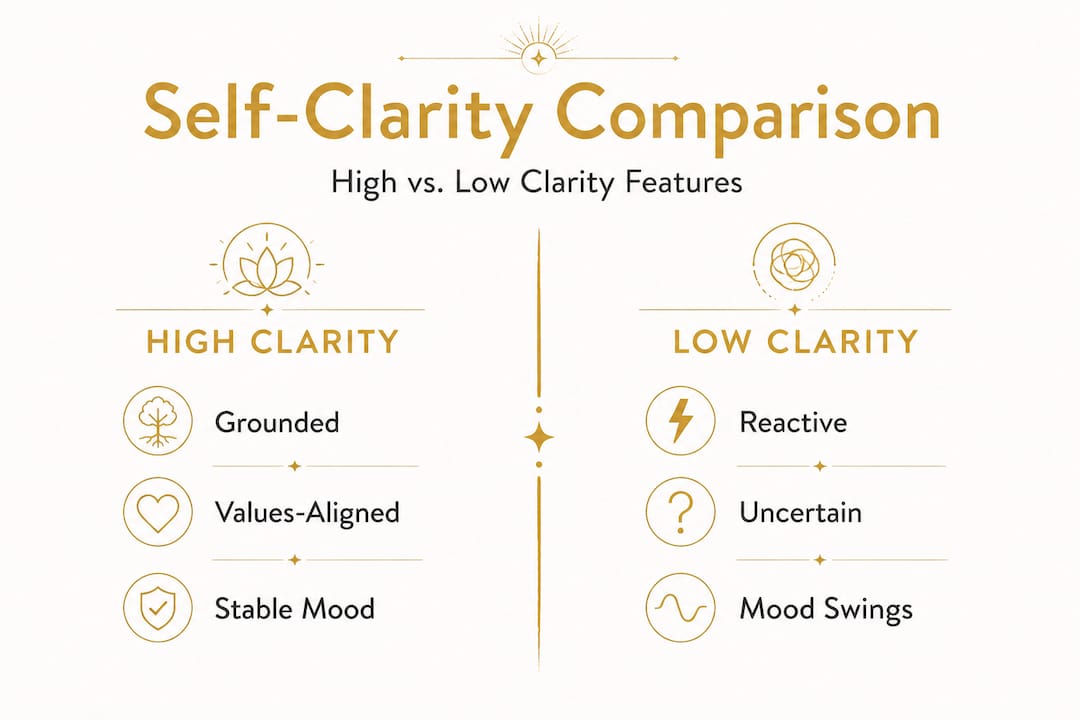
Women navigating transition tend to sit in the low self-clarity column, not because they lack depth, but because the transition itself has disrupted their previous anchors. Reflection provides new anchors. It doesn't restore the old self; it helps you recognize the self that is emerging.
If you're working with a coach or considering coaching for clarity, this is exactly the kind of internal architecture that gets rebuilt over time. Not through analysis alone, but through consistent, structured reflection.
"Knowing yourself is the beginning of all wisdom." That sentiment holds up, but wisdom doesn't arrive from passive hoping. It comes from the active practice of looking inward with honesty and care.
How reflection fosters self-awareness and emotional clarity
Reflection alone isn't always enough. If you've ever journaled your way into a spiral or replayed a painful situation on loop without resolution, you know this already. The key is pairing reflection with emotional regulation, and the research backs this up clearly.
Reflective mindfulness combined with emotional regulation training significantly improves self-awareness and self-understanding, the exact skills you need to lead yourself well. These aren't soft skills. They're foundational competencies for making grounded decisions, managing creative and emotional overwhelm, and rebuilding trust in your own inner voice.
Explore self-awareness techniques and you'll find that the most effective ones share a common thread: they move you toward insight rather than rumination. That distinction matters more than most guides acknowledge.
Practical benchmarks from a six-week structured program
Research from a randomized controlled trial (RCT) found that participants who completed a structured six-week program combining reflective mindfulness and emotional regulation training showed measurable improvements in self-awareness and emotional clarity. The results were consistent across varying starting points, meaning this approach worked for people who began the program with very low self-awareness, not just those who were already introspective.
| Week | Focus | Measurable outcome |
|---|---|---|
| 1-2 | Body-based awareness and grounding | Reduced emotional reactivity |
| 3-4 | Identifying emotional patterns | Increased recognition of triggers |
| 5-6 | Values-based reflection and integration | Stronger self-concept clarity |
A step-by-step reflection practice for emotional clarity
- Ground yourself first. Before reflecting, spend two to three minutes regulating your nervous system. Slow breathing, a hand on your chest, or grounding your feet work well. Reflection requires a regulated state to produce insight rather than anxiety.
- Choose one specific question. Broad journaling prompts like "How do I feel?" often produce scattered responses. Try instead: "What did I need today that I didn't give myself?" or "What am I avoiding and why?"
- Write without editing. Let the first pass be unfiltered. Emotional clarity doesn't come from polished prose. It comes from honest raw material.
- Look for patterns, not answers. After writing, read back and highlight recurring themes. Patterns carry more signal than any single entry.
- Close with one action or one acknowledgment. Either name something you're going to do differently or acknowledge something you're choosing to accept. This step prevents reflection from becoming an endless loop.
Pro Tip: The difference between productive reflection and rumination is the direction of focus. Rumination circles the same wound repeatedly without movement. Insight-based reflection asks: what does this experience tell me about what I value or need? If you find yourself asking "why did this happen to me?" rather than "what does this show me about myself?", gently redirect.
If you're working on building this capacity, emotional clarity coaching can offer the structure and support that makes this kind of reflection feel safe rather than overwhelming.
Navigating daily self-appraisal: Timing and approach
Even when you have a reflection practice, daily life doesn't always cooperate. Moods shift. Energy drops. A difficult conversation can temporarily distort your self-perception in ways that make your usual clarity feel unreachable.
This is not a failure of practice. It's a feature of being human. Self-perceptions fluctuate in daily life, and how you appraise yourself, whether through your own internal lens or through imagined external judgment, can vary depending on your emotional state and the kind of self-evaluation you're doing.
There's an important distinction here worth holding: internal self-appraisal is how you assess your own traits and patterns from the inside. Reflected appraisal is how you believe others see you. Both matter, and both fluctuate. On a low-mood day, reflected appraisal often becomes more prominent and more distorted. You may feel seen as incompetent, unlikeable, or burdensome, even when there's no real evidence of that.
Understanding this distinction helps you use self-appraisal guidance more effectively. It also protects you from making sweeping self-judgments on days when you're emotionally depleted.
Find more effective self-awareness methods that help you identify what kind of self-appraisal is actually happening in any given moment.
Tips for timing reflection for best results
- Reflect after, not during, emotional peaks. High emotional arousal narrows your perspective. Give yourself at least 30 minutes after a charged moment before sitting down to write or think through what happened.
- Morning reflection works best for intention-setting. Your mind is less cluttered and social input hasn't accumulated yet. Use this window for values-based journaling.
- Evening reflection works best for pattern-recognition. Reviewing the day when it's complete allows you to spot themes you couldn't see while inside the moments.
- Skip reflection when you're dissociated or extremely fatigued. If you can't feel your feet or you've been awake for 20 hours, grounding and rest come first. Forced reflection in a depleted state produces distorted material, not insight.
- Check your mood before choosing your method. Structured prompts work better on heavy emotional days. Free writing works better when you have creative energy and relative emotional stability.
Pro Tip: Before any reflection session, rate your mood on a simple 1 to 10 scale. Below a 4, prioritize grounding and rest. Between 4 and 7, use structured prompts. Above 7, free writing and creative expression tend to yield the richest material.
Turning reflection into a practical tool for healing and growth
Understanding the research is one thing. Using it on a Tuesday when your motivation is low and your creative project feels meaningless is another.
The good news is that a six-week structured program can produce measurable gains in self-awareness even when someone begins with low motivation. You don't need to feel inspired to start. You need a structure that carries you through the days when you don't feel like doing the work.
For women in creative or transitional phases, reflection serves a particularly specific role. It helps with mastering personal and emotional growth by providing continuity. When external circumstances are shifting fast, regular reflection becomes the thread that connects who you were last month to who you're becoming. That continuity is not sentimental. It's stabilizing.
Supporting your clarity work in transitions with a structured reflective framework can make the difference between feeling lost in change and feeling like an active participant in your own becoming.
A reflection framework for healing and growth
- Set a consistent container. Same time, same place when possible. Consistency signals safety to your nervous system and makes reflection feel less like a chore.
- Name where you are today. Literally: "Today I feel _____ and I notice _____." This orients your nervous system before you go deeper.
- Choose a growth edge question. Pick one question tied to your current season: "What am I learning about my needs right now?" or "What would my most grounded self do here?"
- Acknowledge resistance without fighting it. If you don't want to reflect, write that down. "I don't want to do this today because ___." That sentence often becomes the most useful one in the session.
- End with a self-compassion statement. Healing requires kindness. Close each session by writing one sentence that treats yourself as someone you genuinely care about.
Statistic to hold: Research shows that six weeks of structured reflective practice produces measurable, clinically relevant gains in self-awareness. That's roughly 42 days. Most meaningful transformations take longer, but the evidence suggests that even short, consistent effort moves the needle significantly.
What most guides miss: Reflection isn't just about insight, it's about stability and growth
Most articles about reflection treat it as a tool for having "aha" moments. Do the journaling, get the insight, move on. That framing is too thin.
Reflection strengthens and stabilizes the self-concept, which then becomes the foundation for meaning. Insight is a by-product of that stability, not the goal itself. When you chase insight, you end up performing reflection rather than practicing it. You look for the big realization instead of doing the quiet, consistent work that actually reorganizes your inner world.
In my experience working with women navigating creative and transitional phases, the most transformative shifts don't come from a single journaling entry. They come from months of showing up to the same practice, slowly building an inner environment where clarity can take root. It's less like solving a puzzle and more like tending a garden.
The contrarian truth is this: if your reflection practice feels boring on most days, it's probably working. The dramatic sessions are memorable, but the ordinary ones are where the real stabilization happens.
Stability is what enables deeper healing. When your self-concept is stable enough to hold complexity, you can look at difficult memories or patterns without collapsing into them. You can hold grief and gratitude at the same time. You can create from a place of genuine expression rather than approval-seeking.
That's what the coaching perspective at the heart of trauma-informed clarity work centers: not the breakthrough moment, but the steady accumulation of self-trust built through practice.
Reflection is not a quick fix. It's a commitment to knowing yourself well enough to live on your own terms. And for women who've spent years navigating others' expectations, that commitment is quietly radical.
Experience clarity and healing through trauma-informed coaching
Reflection is powerful, and it's even more powerful when you're not doing it alone.

If this article has resonated with you, especially if you're in a season of transition, creative reinvention, or emotional rebuilding, consider what it might feel like to have a structured, safe container for this work. Trauma-informed coaching at Rachel M. Harrison offers exactly that: a grounded, psychologically informed space where your reflection practice becomes part of a larger process of reclaiming your clarity and self-leadership. Through the Sanctuary Symbolic Integration Method™, sessions are designed to help you understand your emotional patterns, stabilize your nervous system, and move toward aligned, embodied action. Your story deserves to be held with care. This is where that begins.
Frequently asked questions
How does reflection lead to greater meaning in life?
Reflection strengthens self-concept clarity, and a clearer, more stable sense of self is directly associated with experiencing greater meaning and purpose in daily life.
Can reflection improve emotional regulation?
Yes. Structured reflection formats paired with emotional regulation training have been shown in randomized controlled trials to meaningfully boost both self-awareness and the ability to manage emotional responses.
How long does it take to see benefits from reflection training?
Measurable gains in self-awareness can appear after as little as six weeks of consistent, structured practice, even in people who begin with low intrinsic motivation.
Do moods affect self-clarity during reflection?
Yes. Self-perceptions fluctuate daily, and your emotional state directly influences both internal self-appraisal and how you imagine others perceive you, which is why timing and approach matter so much.