TL;DR:
- Stress can temporarily impair even capable leaders, blurring boundaries and distancing purpose. Spiritual intelligence, a developable skill, helps leaders find meaning and act from core values under pressure. Combining trauma-informed practices with spiritual self-leadership promotes grounded, compassionate, and resilient leadership, especially for women managing emotional climates.
You are a capable, perceptive leader, and yet there are moments when stress strips you of your clarity so completely that you barely recognize your own thinking. You make a decision, then second-guess it. A meeting triggers something you cannot name. Your boundaries blur, your purpose feels distant, and the woman who normally leads with conviction goes quiet. This experience is far more common than leadership culture admits, and it is precisely where spiritual intelligence paired with trauma-informed self-leadership tools offers something genuinely different.
Table of Contents
- The foundation of spiritually aligned self-leadership
- Essentials for trauma-informed self-leadership
- Step-by-step: Practicing spiritually aligned self-leadership
- Troubleshooting and verifying your progress
- A deeper perspective: What most guides miss about spiritual self-leadership
- Next steps: Coaching and support for spiritually aligned self-leadership
- Frequently asked questions
Key Takeaways
| Point | Details |
|---|---|
| Spiritual intelligence matters | Cultivating spiritual intelligence is proven to support mental, physical, and emotional wellbeing. |
| Trauma-informed tools essential | Using trauma-informed principles helps women leaders create healthier boundaries and greater clarity. |
| Respond with compassion | Self-leadership is strengthened when strong reactions are approached compassionately, not with blame. |
| Progress is measurable | Indicators like increased peace and better boundaries show genuine advancement in self-leadership. |
The foundation of spiritually aligned self-leadership
Spiritual intelligence, for the purposes of self-leadership, is not about religion or doctrine. It is the developed capacity to find meaning, connect with purpose, and act from a values-centered place even under pressure. As a leadership capability, it is entirely learnable. Research published in Forbes describes spiritual intelligence as a developable skill tied directly to well-being and performance outcomes. That is significant. It means this is not a fixed trait you either have or do not. It is a skill you build, practice, and refine.
The empirical support is growing. A study in the MDPI journal on nurse leaders found that spiritual intelligence correlates with both work-life quality and servant leadership effectiveness. Women who cultivated spiritual intelligence tended to lead with greater empathy, maintained healthier perspectives under organizational stress, and reported stronger overall satisfaction in their roles. These are not soft outcomes. These are measurable differences in how leaders function day to day.
So what does trauma-informed mean in this context? Trauma-informed principles, as applied to self-leadership, are a set of practices and perspectives that account for how past experiences of overwhelm, loss, or harm shape current reactions. Rather than labeling your stress responses as weakness or dysfunction, trauma-informed frameworks invite you to understand them as nervous system patterns that made sense once, even if they no longer serve you. For trauma-informed clarity for women, this means meeting your inner landscape with curiosity rather than judgment.
Here is a quick overview of what these two frameworks contribute when combined:
| Framework | Core Contribution | Leadership Benefit |
|---|---|---|
| Spiritual intelligence | Purpose, meaning, values alignment | Sustained motivation and ethical clarity |
| Trauma-informed principles | Nervous system awareness and compassion | Reduced reactivity and healthier boundaries |
| Combined approach | Integrated self-leadership | Grounded, responsive, values-led action |
Why does this matter specifically for women in leadership? Because women are disproportionately expected to manage others' emotional climates while suppressing their own. The combination of spiritual and trauma-informed tools directly addresses that imbalance by rebuilding your inner authority, which is also central to self-leadership for creative women.
Key foundations to understand before diving deeper:
- Spiritual intelligence is measurable and learnable, not mystical or inaccessible
- Nervous system regulation is a prerequisite for clear, values-based decisions
- Self-compassion is not optional in this work; it is the operating system
- Boundaries emerge naturally when you trust your internal signals rather than override them
With the importance of foundations established, it is time to explore what you need to begin integrating spiritual and trauma-informed methods.
Essentials for trauma-informed self-leadership
Before you can practice spiritually aligned self-leadership in the heat of a high-pressure moment, you need to assemble the right tools and internal conditions. Think of this as equipping yourself before entering unfamiliar terrain.
The core tools are straightforward, though their depth is anything but superficial.
Journaling is one of the most reliable instruments for this work. Not journaling as performance, not a catalog of tasks, but reflective writing that asks: What am I feeling right now? Where in my body is this showing up? What story am I telling myself? Regular journaling builds the self-observation muscle that spiritual self-leadership requires.
Mindfulness practices, including breath-centered awareness and body scans, help you recognize your nervous system states in real time. When you know you are activated, you can pause before you respond. That pause is where your self-leadership actually lives.

Spiritual inquiry involves asking deeper questions, such as: What does this situation mean to me? What value of mine is being challenged here? What would I do if I trusted myself completely? These questions are not rhetorical. They are navigational.
Support networks, including mentors, coaches, and trusted peers, matter enormously. Trauma-informed practices are not solo pursuits. Spiritual trauma care outcomes research shows that structured spiritual care programs generate increased peace, healthier boundaries, and greater compassion, outcomes that are amplified within supported, relational contexts.
The comparison below illustrates how traditional leadership development differs from the trauma-informed approach:
| Dimension | Traditional approach | Trauma-informed approach |
|---|---|---|
| Reaction to stress | "Push through it" | "What is my body telling me?" |
| Boundary-setting | Rules-based or reactive | Values-centered and compassionate |
| Self-reflection | Performance reviews | Ongoing, curiosity-led inquiry |
| Emotional response | Managed or suppressed | Understood and integrated |
| Leadership identity | External validation | Inner authority and self-trust |
Before you begin, you also need to prepare internally. Ask yourself honestly: Can I sit with discomfort without immediately trying to fix it? Am I willing to slow down long enough to hear what my nervous system is signaling? These are the true prerequisites. Skills like clarity coaching for boundaries and growth can support you in building this internal readiness over time.
Pro Tip: When you notice a strong emotional reaction in a leadership context, resist the urge to interpret it immediately. Instead, place one hand on your chest and take three slow breaths before you assign any meaning to what you felt. This tiny intervention creates enormous space for clarity. Your emotional clarity resources can help you build on this practice systematically.
Once you are equipped with essentials, the next step is moving into practical application through step-by-step practices.
Step-by-step: Practicing spiritually aligned self-leadership
The integration of spiritual intelligence and trauma-informed tools is not a single event. It is a daily practice that gradually reshapes how you lead, respond, and recover. Here is a clear sequence for putting it into action.
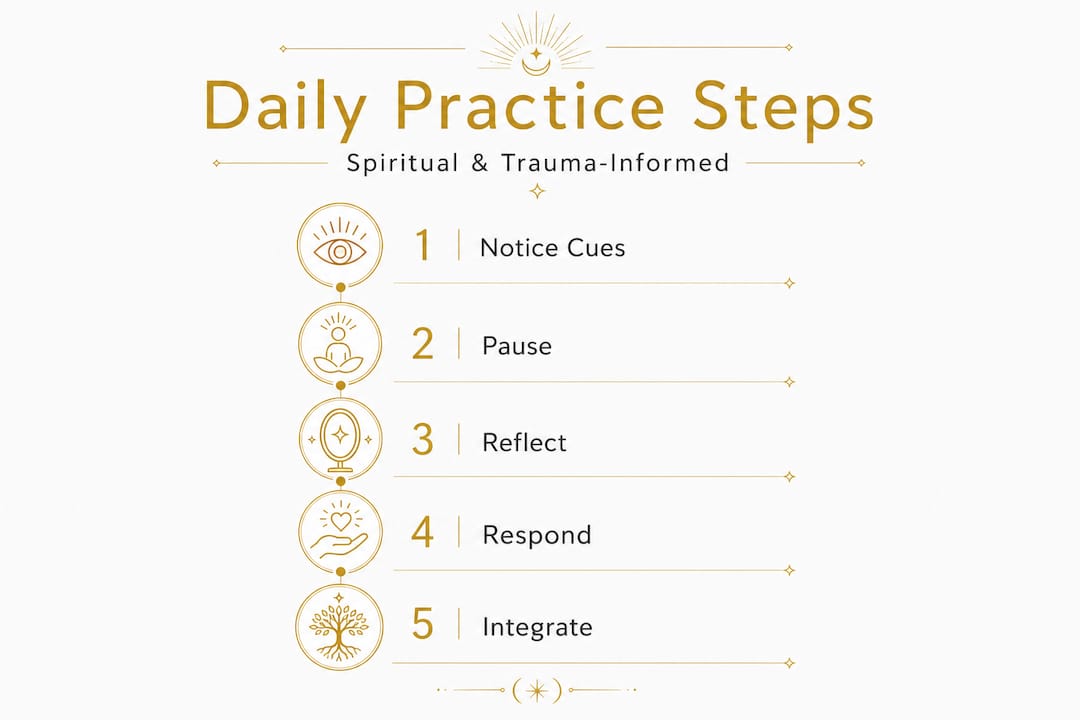
1. Recognize your nervous system cues under stress. Your body is always communicating. Tight chest. Racing thoughts. Sudden withdrawal from a conversation. These are not personality quirks. They are nervous system signals that deserve attention. Begin your practice by simply noticing, without judgment, what happens physically when stress enters your leadership environment. Keep a brief daily log for two weeks. Patterns will emerge.
2. Pause before reacting. Once you can recognize a cue, you can insert a pause. This is not about suppressing your response. It is about creating enough space to choose your response deliberately. Spiritual intelligence is, in part, this very capacity. According to Forbes research, spiritual intelligence is a developable skill anchored in meaning and purpose, and the pause is where that meaning becomes accessible rather than bypassed.
3. Engage in spiritual reflection. During or after the pause, ask yourself: What is most important to me here? What am I being asked to protect or honor? This is not a lengthy meditation. Even 60 seconds of intentional reflection on your values can redirect how you engage a difficult situation. Women who regularly practice this find that their decisions feel more congruent with who they actually are rather than reactive to external pressure.
4. Set a boundary using compassion and awareness. Boundaries in trauma-informed self-leadership are not walls or punishments. They are clear expressions of what you need in order to show up with integrity. When you are regulated and connected to your values, boundaries become far easier to articulate. Practice naming a boundary as a statement of care: "I care about this relationship enough to be honest about what I need."
5. Reflect on outcomes and recalibrate. At the end of each week, spend 15 minutes reviewing: What went well? Where did I override my inner signals? What would I do differently? This is not self-criticism. It is feedback. Building self-trust after trauma requires repetition of this reflection cycle, and over time it creates compounding clarity.
Statistic to remember: Research on spiritual care programs found measurable improvements in peace, boundary-setting, and compassion within structured program participants, underscoring that this work produces verifiable results, not just subjective shifts.
These practices also directly support longer-term growth strategies for leaders who are in periods of transition or rebuilding.
After developing your daily practice, it is crucial to anticipate common missteps and ways to verify progress.
Troubleshooting and verifying your progress
Even with the best tools and intentions, certain obstacles arise consistently for women doing this work. Recognizing them early saves significant time and frustration.
Common mistakes to watch for:
- Ignoring nervous system signals until they become a crisis, then labeling yourself as "too emotional"
- Confusing boundary confusion with a values problem, when the real issue is nervous system dysregulation
- Expecting linear progress, spiritual self-leadership grows in spirals, not straight lines
- Using self-reflection as self-punishment rather than honest inquiry
- Treating spiritual intelligence as a performance for others rather than an internal practice for yourself
One of the most important reframes in this work comes from trauma-informed leadership research, which emphasizes that disproportionate reactions are nervous-system responses, not personal shortcomings. This single insight changes everything. It removes shame from the equation and replaces it with curiosity.
"Self-compassion is not an indulgence. It is the infrastructure that makes every other aspect of self-leadership possible."
Here is a practical progress tracker based on spiritual trauma-care research:
| Progress indicator | Early stage | Growing stage | Established stage |
|---|---|---|---|
| Emotional clarity | Foggy, reactive | Occasional clarity | Consistent inner knowing |
| Boundary comfort | Avoidance or rigidity | Tentative naming | Grounded, clear expression |
| Compassion toward self | Self-blame dominant | Fluctuating | Reliably present |
| Response to stress | Overwhelm or shutdown | Aware but struggling | Regulated and purposeful |
| Sense of meaning | Disconnected | Emerging | Embodied and lived |
If you find yourself stuck at the early stage across multiple indicators for more than a few weeks, that is a signal to seek additional support rather than push harder alone. Trauma-informed coaching methods are specifically designed for exactly this kind of recalibration, offering structure when the internal process feels too tangled to navigate independently. Working with a guide who specializes in coaching for creative leadership can accelerate this process considerably.
With obstacles and solutions mapped out, it is time to examine what a deeper perspective reveals about the real gaps in spiritually aligned self-leadership.
A deeper perspective: What most guides miss about spiritual self-leadership
Most leadership guides approach spiritual intelligence as a nice bonus, a layer of meaning you add on top of your existing leadership strategy. What they miss entirely is that, for women with histories of overwhelm, chronic stress, or unprocessed trauma, spiritual intelligence is not an add-on. It is the repair work. It is what restores the internal architecture that stress and survival patterns eroded.
The guides that bother me most are the ones that frame nervous-system reactions as personality problems. "Too sensitive," "too reactive," "needs to toughen up." These labels are not just unhelpful. They are actively harmful because they teach women to distrust the very signals that are trying to protect them. Labeling a trauma response as a character flaw is one of the most common ways women leaders lose access to their own inner authority.
What actually works is this: you must treat compassion and healthy boundaries as structural, not situational. Not as something you practice when you feel strong enough, but as the daily foundation from which everything else grows. Spiritual self-leadership without these two pillars is like building a house on sand. It looks intact until pressure arrives.
The other gap I see consistently is the illusion of arrival. Women work hard, implement the tools, experience a breakthrough, and then expect to stay there. Real spiritual self-leadership requires ongoing recalibration. Your nervous system shifts. Your circumstances change. Your edges expand. What worked beautifully six months ago may need updating now. This is not failure. This is the actual nature of practicing creative self-leadership as a living, evolving practice rather than a destination to reach and leave behind.
The women I watch thrive in this work are not the ones who achieve the most, they are the ones who stay the most honest with themselves.
Next steps: Coaching and support for spiritually aligned self-leadership
If this article has resonated, it is worth knowing that you do not have to build this practice alone. The principles outlined here sit at the core of how we work with women leaders at rachel-m-harrison.com.
The Sanctuary Symbolic Integration Method™ is a framework specifically built for women who want to integrate trauma-informed awareness with spiritual clarity and grounded self-leadership. Whether you are just beginning to explore this work or you have been in it for years and need a deeper level of support, there are clear next steps available to you. Trauma-informed coaching support provides one-on-one guidance tailored to your specific nervous system patterns and leadership context. If you want to explore clarity work for leaders at your own pace first, those resources are available too. When you are ready for direct support, you are welcome to book a coaching session and begin where you are.
Frequently asked questions
What is spiritual intelligence, and how can I develop it as a leader?
Spiritual intelligence is the capacity to find purpose, meaning, and connection in your experiences, and it is entirely developable through intentional reflection and self-awareness practices. Research confirms that spiritual intelligence is a leadership skill tied directly to well-being and performance, not a fixed personality trait.
How does trauma-informed self-leadership help women in leadership roles?
Trauma-informed self-leadership helps women recognize stress responses as nervous-system signals rather than personal flaws, which supports healthier boundaries and more compassionate decision-making. Studies show that structured spiritual care programs produce measurable outcomes including increased peace, stronger boundaries, and greater compassion.
What are the signs of progress in spiritually aligned self-leadership?
Signs of progress include growing emotional clarity, increased comfort with compassionate boundary-setting, and a stronger felt sense of meaning and purpose in daily leadership. Research on trauma-based spiritual care identifies these outcomes as consistent markers of genuine growth.
What if I struggle with reacting strongly under stress?
Strong reactions under stress are nervous-system responses, not evidence of weakness or poor leadership. Trauma-informed leadership frameworks encourage gentle inquiry and self-compassion rather than self-blame when these moments arise.