TL;DR:
- Self-leadership for women navigating healing involves responding intentionally to thoughts, emotions, and behaviors grounded in trauma awareness. Establishing trauma-informed habits, including self-compassion and emotional regulation, builds resilience and authentic mastery. Rest and self-care are integral to leadership, countering harmful norms and fostering sustainable growth.
You've probably been told that self-leadership is about discipline, drive, and showing up consistently. But if you carry the weight of emotional trauma, self-doubt, or chronic overwhelm, that advice can feel like a door you don't have the key to. A genuine step by step self-leadership practice looks very different for women navigating healing alongside ambition. It's slower in some places, bolder in others, and always grounded in the truth of your nervous system and emotional history. This guide gives you a clear, trauma-informed path forward.
Table of Contents
- Understanding self-leadership: your foundation for emotional mastery
- Preparation: honest self-assessment and setting your personal vision
- Execution: building trauma-informed self-leadership habits step by step
- Verification: reviewing progress and adapting your self-leadership path
- Reimagining self-leadership: from heroic endurance to human-centered mastery
- Discover trauma-informed coaching to deepen your self-leadership journey
- Frequently asked questions
Understanding self-leadership: your foundation for emotional mastery
To build effective self-leadership, start with a clear and honest understanding of what it actually entails. Not the glossy version. The real one.
Self-leadership means intentionally directing your own thoughts, emotions, and actions toward your chosen goals and values. It's not about control in the harsh, suppressive sense. It's about response. Choosing how you engage with yourself before you engage with the world.
Effective self-leadership encompasses cognitive, behavioral, and emotional dimensions working together. For women in emotional healing, this matters deeply because trauma disrupts all three at once. A belief gets distorted. A habit gets formed around avoidance. Emotional regulation collapses under stress. Understanding these self-leadership dimensions as interconnected rather than separate is the first real insight.
Here's what each dimension looks like in practice:
- Cognitive self-leadership: Examining the beliefs that drive your decisions. Are you leading from values, or from fear? Trauma often plants beliefs like "I'm too much" or "I don't deserve this." Noticing those thoughts is where your work begins.
- Behavioral self-leadership: The habits and routines you build to follow through on your intentions. Small, consistent actions compound faster than dramatic changes.
- Emotional self-leadership: Developing the ability to feel your emotions without being swept away by them. This is regulation, not repression.
Resilience is the clearest marker of mature self-leadership. Not the kind that means you never fall apart, but the kind that means you know how to come back. That capacity grows incrementally through the steps ahead.
Preparation: honest self-assessment and setting your personal vision
With a solid understanding of self-leadership, you're now ready to prepare your personalized roadmap through honest assessment and goal setting.

An honest self-assessment is the essential starting point to identify gaps between where you are and where you want to be. The goal isn't a painful audit of your flaws. It's a compassionate inventory.
Two tools work especially well for this phase:
- SWOT analysis for self-leadership: Map out your personal strengths, areas for growth, opportunities (relationships, environments, practices that support you), and threats (triggers, patterns, external pressures).
- Reflective journaling using self-reflection techniques: Write without editing yourself. Ask: Where do I abandon myself under pressure? When do I feel most grounded? What values am I not honoring right now?
After self-assessment, clarify your vision. What does emotional mastery feel like in your daily life? Name it specifically. "I want to feel calm when I receive criticism" is more actionable than "I want to be less reactive."
Once your vision is clear, use the SMART framework to set goals that are Specific, Measurable, Attainable, Relevant, and Time-bound. SMART goals aligned with personal values significantly improve motivation and achievement. For example: "For the next 30 days, I will spend 10 minutes each morning journaling about one emotional pattern I noticed the day before."
Comparison table: self-assessment tools for emotional clarity
| Tool | Best for | Time investment | Trauma-informed tip |
|---|---|---|---|
| SWOT analysis | Seeing the full picture | 45 to 60 minutes | Focus on patterns, not character flaws |
| Reflective journaling | Uncovering emotional patterns | 10 to 15 min/day | Use prompts, not blank pages, to reduce overwhelm |
| Values mapping | Identifying authentic goals | 30 minutes | Choose values that feel like relief, not obligation |
| Coaching session | External perspective and clarity | 60 to 90 minutes | A trauma-informed coach prevents retraumatization |
Pro Tip: When setting goals, prioritize the ones tied to emotional clarity and healing first. These create the internal stability that makes every other goal more achievable. External achievements built on an unsteady emotional foundation rarely last.
Execution: building trauma-informed self-leadership habits step by step
Once your goals and vision are clear, the next critical phase is executing consistent trauma-informed habits that build your self-leadership muscle.
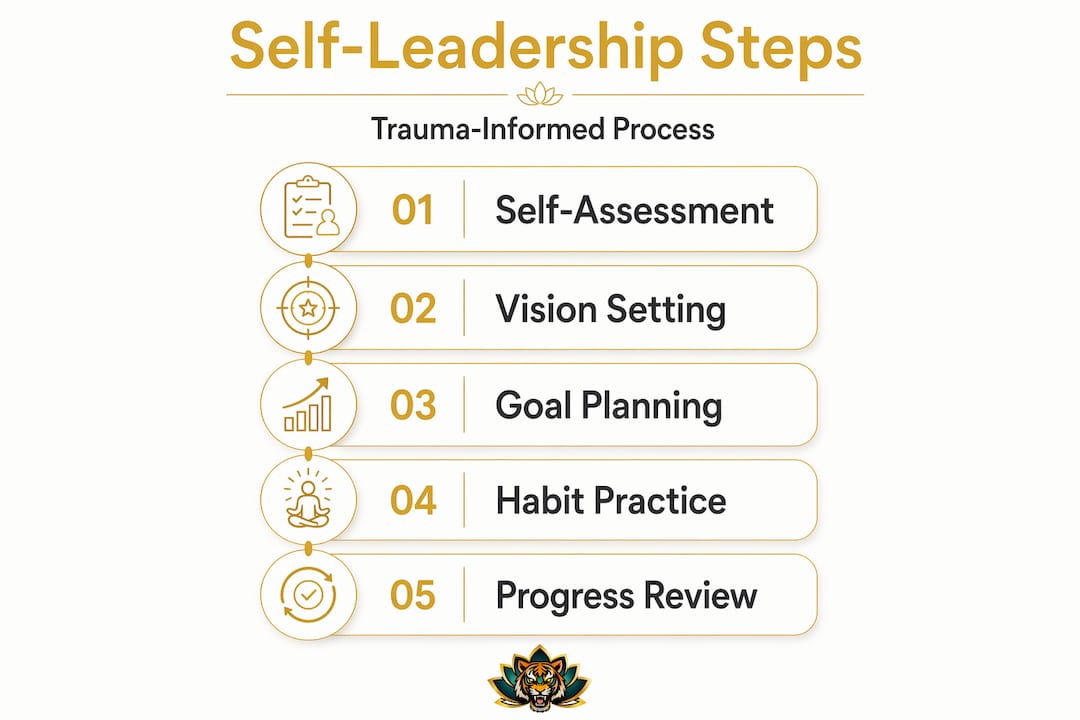
Start with body-first self-compassion practices. Before any productivity habit, your nervous system needs a signal of safety. Self-compassion as a research-backed tool supports trauma healing and directly counters shame, which is the internal force most likely to derail your self-leadership efforts. Simple body-first practices include placing a hand on your heart when stress rises, softening your jaw and shoulders intentionally, and speaking to yourself the way you'd speak to a woman you deeply respect.
For moments of acute emotional crisis, DBT (Dialectical Behavior Therapy) distress tolerance skills are practical and fast. DBT distress tolerance skills effectively manage acute emotional crises by lowering physiological arousal, which helps you respond rather than react. Three core skills to learn:
- Paced breathing: Slow your exhale to be longer than your inhale. This activates the parasympathetic nervous system within minutes.
- TIPP: Temperature (cold water on face), Intense exercise, Paced breathing, Progressive relaxation. Use these when emotion is at its peak.
- STOP: Stop what you're doing, Take a step back, Observe what you're feeling, Proceed mindfully. This is your emergency pause button.
Self-compassion practice milestones
| Timeline | Expected milestone | What it looks like |
|---|---|---|
| Week 1 to 2 | Increased awareness of self-critical thoughts | Noticing the inner critic without acting on it |
| Week 3 to 4 | Meta-awareness developing | Pausing before reactive responses |
| Month 2 to 3 | Consistent self-compassion in low-stress moments | Speaking kindly to yourself becomes a default |
| Month 3 to 6 | Full integration in daily practice | Self-compassion responds even in high-stress situations |
Here's a step-by-step process to build one trauma-informed self-leadership habit over 60 days:
- Choose one habit (example: five-minute morning body scan).
- Anchor it to an existing routine, like right after you wake up.
- Practice it daily for 14 days without evaluating whether it's "working."
- At day 15, note how it feels physically and emotionally when you do it.
- At day 30, assess whether it's reducing any emotional reactivity patterns.
- At day 60, decide whether to deepen this habit or introduce a second.
Explore how embodying emotional clarity through body-based practices reinforces these habits over time.
Pro Tip: Keep a simple daily log with two columns: "What I practiced" and "How my body felt afterward." This isn't a performance review. It's a data collection exercise to learn what genuinely regulates your nervous system.
Verification: reviewing progress and adapting your self-leadership path
Execution builds momentum, but regular verification ensures your self-leadership journey evolves productively and authentically.
Experts recommend weekly, monthly, and quarterly structured reviews with increasing depth to keep personal development on track. For women healing alongside leading, these reviews also need to be emotionally safe spaces, not just productivity audits.
Here's a three-tier review structure:
- Weekly check-in (15 minutes): Ask yourself three questions. What did I practice this week? What felt difficult? What felt like ease? This isn't about what you achieved. It's about noticing your honest experience.
- Monthly evaluation (60 minutes): Review your SMART goals. Are they still relevant? Has your emotional landscape shifted enough to warrant a different focus? Adjust without judgment. Flexibility is a self-leadership skill, not a failure.
- Quarterly deep reflection (2 to 3 hours): Take your journals, your notes, your tracking logs. Look for patterns across three months. Where did you consistently thrive? Where did you consistently struggle? These patterns are your most important growth strategy reviews for the next cycle.
Review cadence comparison table
| Review type | Frequency | Duration | Primary focus |
|---|---|---|---|
| Quick check-in | Weekly | 15 minutes | Habit tracking and emotional temperature |
| Progress evaluation | Monthly | 60 minutes | Goal relevance and emotional clarity shifts |
| Strategic adaptation | Quarterly | 2 to 3 hours | Pattern recognition and roadmap refinement |
Pro Tip: In your progress logs, circle what worked rather than crossing out what didn't. The brain internalizes circled wins more readily than corrected failures. This is a small reframe that changes the entire tone of your reviews.
Reimagining self-leadership: from heroic endurance to human-centered mastery
Here's something conventional self-leadership content will rarely say directly: the dominant model of leadership that most women have been handed was not designed for them.
It was built around pushing through. Around performing. Around heroic endurance as proof of worth. And for women who already carry unprocessed trauma, that model doesn't develop self-leadership. It accelerates self-abandonment.
"True self-leadership requires a shift from 'heroic' leadership to 'human' leadership, where rest is a requirement rather than a reward."
When you've grown up in environments where your needs were minimized or ignored, it becomes almost invisible to you how often you override your own signals. You normalize exhaustion. You treat rest as something you haven't earned yet. You mistake chronic stress for high standards.
But here's what I've seen over and over: women who learn to honor their body's signals, who practice embodying self-trust as a daily act, build a quality of leadership that productivity culture simply cannot manufacture. They lead from genuine clarity rather than anxiety-driven momentum. They make better decisions. They sustain their work longer without burning out. They model something rare and necessary.
Rest is not what you do when self-leadership is complete. Rest is self-leadership. So is saying no to something that misaligns with your values. So is choosing to heal before you scale. These are not delays on your journey. They are the journey.
Redefine productivity to include self-care as an essential leadership behavior, not a supplemental one. When you log your weekly check-in, rest and nervous system regulation belong on that list right alongside your goals.
Discover trauma-informed coaching to deepen your self-leadership journey
If you're ready to move beyond self-study and deepen your growth, trauma-informed coaching offers expert support tailored to your unique path.
Reading frameworks is one thing. Integrating them in your actual life, with your actual emotional history, is another. Trauma-informed coaching with Rachel M. Harrison offers a personalized space to accelerate your self-leadership growth without pushing past your window of tolerance.
Working with a trauma-informed coach means someone holds your complexity while helping you build clarity. It means your healing and your leadership goals are treated as one continuous journey, not competing priorities. Whether you're navigating creative blocks, rebuilding self-trust after burnout, or developing emotional clarity in your leadership role, book a coaching session to explore what's possible. If you're new here, start your transformative journey with resources designed specifically for women stepping into their own authority.
Frequently asked questions
How long does it take to develop effective self-leadership habits?
Meaningful improvements in self-compassion and self-leadership become noticeable within 8 weeks of consistent practice, with full integration often taking 3 to 6 months. Consistency matters more than intensity.
What are practical ways to manage emotional crises when practicing self-leadership?
DBT distress tolerance skills like paced breathing, TIPP, and STOP lower physiological arousal in the moment, giving you a calmer, clearer foundation for response rather than reaction.
How should I track my progress without triggering self-judgment?
Keep simple logs that record what you practiced and how your body responded, without grading yourself. Non-judgmental logs identify effective coping patterns without feeding the inner critic.
Why is rest important in self-leadership, especially for women with trauma histories?
Rest counters the normalized chronic stress that trauma survivors often carry and actively supports emotional clarity and resilience. Rest is a leadership requirement, not something you earn after you've performed well enough.