
Most people assume integration is a straightforward process where you apply a formula and get a clean answer. That assumption breaks down fast once you meet functions that resist every known technique. Symbolic integration, the practice of finding exact antiderivative expressions rather than numerical approximations, sits at a fascinating crossroads between precision and limitation. Understanding how it actually works, where it succeeds, where it stops, and how practitioners choose between competing strategies, offers surprising lessons for anyone navigating complexity, whether in mathematics or in life itself.
Table of Contents
- What is symbolic integration? Foundations and scope
- Behind the algorithms: The Risch method and rule-based approaches
- Benchmarks, coverage, and the art of method selection
- Symbolic integration for clarity: Practical parallels for creative professionals
- What most guides miss about symbolic integration and emotional clarity
- Next steps: Integrate clarity with the Sanctuary Symbolic Integration Method™
- Frequently asked questions
Key Takeaways
| Point | Details |
|---|---|
| No universal algorithm | Not all integration problems can be solved symbolically, highlighting the need for flexible strategies. |
| Risch versus rule-based | Algorithms like Risch target precise cases, while rule-based methods handle broader, practical challenges. |
| Benchmarks matter | Rule counts and test suites are essential for measuring symbolic integration effectiveness. |
| Integration parallels clarity | The nuanced search for symbolic solutions mirrors the pursuit of emotional and psychological clarity. |
What is symbolic integration? Foundations and scope
Symbolic integration is fundamentally different from numerical integration. Where numerical methods approximate the area under a curve using sums and algorithms, symbolic integration aims to express the antiderivative as an exact formula. Think of it as the difference between measuring a room with a tape measure and knowing its exact architectural blueprint.
The goal sounds clean. The reality is messier. As documented by SciML, symbolic integration seeks an antiderivative expressed exactly in symbolic form, but a general procedure that always succeeds for elementary functions does not exist. That single fact changes everything about how you approach the problem.
Elementary functions are the familiar building blocks: polynomials, exponentials, logarithms, trigonometric functions, and their combinations. You might expect these to behave nicely. But even among elementary functions, many combinations produce antiderivatives that cannot be written in elementary form at all. The integral of e^(x²) is a classic example. There is no elementary antiderivative. The function simply resists that form of expression.
Here is what makes symbolic integration worth studying closely:
- It demands exact answers, not approximations, making it essential for analytical mathematics and engineering
- It exposes the limits of rigid algorithmic thinking, since no single procedure handles every case
- It requires practitioners to understand why a method fails, not just that it fails
- It rewards flexible, layered strategies over single-track approaches
- It mirrors the kind of nuanced problem-solving that real clarity work demands in personal growth
The scope of symbolic integration spans computer algebra systems (CAS) like Mathematica, Maple, and Julia's SymbolicIntegration.jl. These systems try to automate the process of finding exact antiderivatives, but each one confronts the same fundamental truth: some integrals will always return unevaluated because no elementary solution exists.
Behind the algorithms: The Risch method and rule-based approaches
Now that you know symbolic integration's aim and scope, let's see how experts use algorithms to tackle its many challenges.
The Risch algorithm is the gold standard for symbolic integration of elementary transcendental functions. It was developed by Robert Risch in 1969 and represents one of the most elegant results in computer algebra. As the SymbolicIntegration documentation confirms, the Risch algorithm is complete for elementary transcendental functions, meaning it will either find an elementary antiderivative or definitively prove none exists.

That word "complete" matters enormously. The Risch algorithm does not guess. It does not try heuristics and hope for the best. It works within a precise mathematical framework that decides the question conclusively. For the class of functions it covers, there is no ambiguity.
But here is the catch: its coverage is bounded. Real-world integration problems frequently involve functions outside that neat classification. Algebraic extensions, non-integer powers, and combinations that blend transcendental and algebraic forms often fall outside the Risch framework's robust handling. This is exactly why practitioners cannot rely on the Risch algorithm alone.
Rule-based systems step in where pure algorithms leave off. These systems encode thousands of known integration patterns as explicit rules, essentially a large library of "if you see this form, apply this transformation." They handle special cases, trigonometric identities, reduction formulas, and edge cases that pure algorithmic approaches miss.
| Feature | Risch algorithm | Rule-based systems |
|---|---|---|
| Coverage | Elementary transcendental functions | Broad, including many special forms |
| Completeness | Complete for its class | Incomplete by design; heuristic |
| Speed | Can be computationally intensive | Generally fast on recognized patterns |
| Failure mode | Returns "no elementary antiderivative" | May return unevaluated or wrong result |
| Best use case | Guaranteed answers for defined scope | Flexibility across varied function types |
"The Risch algorithm is a powerful guarantor of correctness, but its power is narrow. Real integration systems need more than one tool in the workshop." This captures precisely why hybrid strategies are necessary: pure Risch coverage is limited, and practical systems layer rule-based methods on top to extend reach.
Pro Tip: When working with a computer algebra system that returns an unevaluated integral, do not assume you made an error. The system may be telling you honestly that no elementary solution exists. That information is itself valuable.
The hybrid approach represents mature thinking in symbolic computation. You start with a general algorithm where possible, layer in specialized rules for known forms, and acknowledge openly when no solution exists. This is sophisticated problem-solving, not a workaround.
Benchmarks, coverage, and the art of method selection
With methods established, let's examine how effectiveness and adaptability are measured and why choosing the right technique matters enormously in practice.
Evaluating symbolic integration systems requires moving beyond theoretical completeness. Real performance is measured empirically. SymbolicIntegration.jl on GitHub demonstrates that rule-based methodology can be benchmarked through rule counts and empirical test suites, giving developers concrete metrics to assess coverage and accuracy.
| Benchmark metric | Reported figure |
|---|---|
| Integration rules encoded | Over 3,400 |
| Test integrals in suite | 27,585 |
| Continuous integration runs | Automated per update |
| Target accuracy | Exact symbolic match |
Those numbers are not trivial. Over 3,400 rules represent thousands of hours of mathematical research encoded into a system. A test suite of 27,585 integrals ensures that updates do not quietly break previously working solutions. This is engineering discipline applied to symbolic mathematics.
But coverage alone does not answer everything. The question of which method to apply to a given integral is itself a hard problem. Research shows that selecting the optimal integration method for a specific instance measurably improves results, and machine learning approaches now assist with this selection challenge. The system must effectively predict which algorithmic pathway is most likely to succeed before committing computational resources.
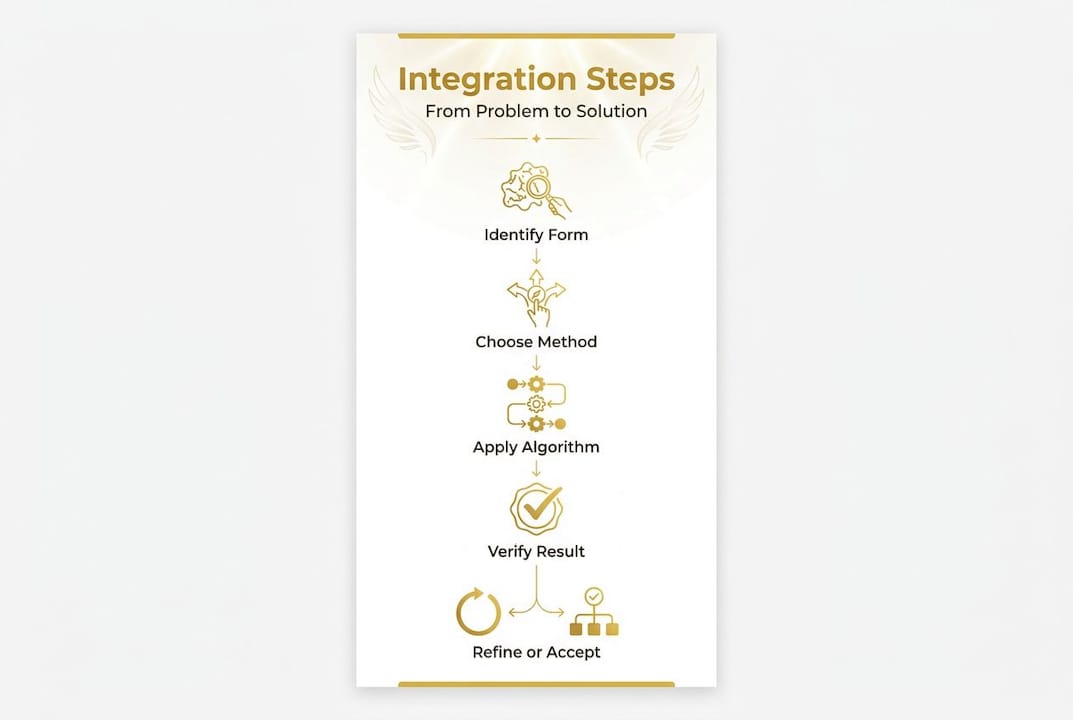
Here is how modern symbolic integration systems typically work through method selection:
- Classify the integrand. The system identifies the function's structural type: polynomial, rational, trigonometric, exponential, algebraic, or a combination.
- Check rule-based matches first. Fast pattern matching runs against the rule library to catch common forms without expensive computation.
- Apply the Risch algorithm if applicable. For elementary transcendental forms, the Risch decision procedure runs to guarantee an answer.
- Fall back to heuristic and ML-guided methods. For cases outside clear classification, learned strategies guide the next attempt.
- Return unevaluated if no solution is found. Honest reporting of failure preserves integrity in the system.
This stepwise process reflects something important: good systems do not brute-force their way through problems. They bring structured judgment to each case, apply the most appropriate tool, and know when to stop. That restraint is as important as the computational power itself.
Symbolic integration for clarity: Practical parallels for creative professionals
Let's take these technical lessons and see how they can enlighten your own personal integration journey.
The phrase "Sanctuary Symbolic Integration Method" resonates differently once you understand what symbolic integration actually involves. The mathematical discipline is not about mechanically applying formulas. It is about navigating complexity with a layered, flexible framework that honors both precision and the reality of uncertainty.
Your personal clarity journey works the same way. You come in hoping there is a clean formula. Process the experience, apply the insight, arrive at peace. But real emotional integration does not work like that. Some experiences resist the standard approaches. They are your personal edge cases, the moments that fall outside the elegant algorithms of conventional advice.
As current research confirms, the Risch algorithm is designed for elementary functions, and many integrands involving algebraic extensions or non-integer powers fall outside its robust handling. In emotional terms: the tools that work beautifully for straightforward challenges will sometimes fail completely when you bring in complexity, layered history, or experiences that do not fit neat categories.
Here are the practical lessons symbolic integration offers to your clarity work:
- There is no universal formula. Accept that some challenges require custom approaches rather than off-the-shelf solutions.
- Failure to find a solution is information. When an approach is not working, that is not defeat. It tells you something important about what the problem actually needs.
- Layered strategies outperform single methods. Just as hybrid integration systems beat pure algorithmic approaches, personal growth benefits from combining different frameworks and perspectives.
- Edge cases are where the real learning happens. The integrals that break the standard algorithm reveal the system's true architecture. Your hardest experiences reveal yours.
- Classification matters before action. Symbolic integration systems classify the integrand before choosing a method. In your own work, identifying what kind of challenge you are actually facing before choosing a response makes a real difference.
Pro Tip: When you hit a wall in your personal growth work, ask yourself which "method" you have been using and whether the challenge might require a completely different approach. Switching frameworks is not failure. It is skilled navigation.
The creative professional's ability to think metaphorically and cross-conceptually is actually a genuine advantage here. You are already trained to look for unexpected patterns and connections. That skill transfers directly into effective integration work, both symbolic and personal.
What most guides miss about symbolic integration and emotional clarity
Most guides on symbolic integration focus entirely on the algorithms themselves. Here is what they skip: the edge cases are not a problem to be solved. They are a feature of the system's design. And that reframe changes everything.
Mathematical researchers found that model performance on out-of-distribution integrands remains a genuine challenge, even when systems achieve high accuracy on familiar data. In other words, the places where a system stumbles most are precisely the places furthest from its training data, the unexpected, the novel, the unprecedented.
This is where the parallel to emotional clarity becomes most instructive. Most emotional processing frameworks are built around common patterns. Grief, transition, relationship dynamics, identity shifts. The frameworks are good at what they were built for. But you are not an average case. You are a specific person with specific history, specific wiring, and experiences that do not map cleanly onto standardized templates.
The coaches and systems that serve you best are not the ones with the most rigid procedures. They are the ones that treat your particular complexity with particular attention. Rule-based flexibility over algorithmic rigidity. That is not a compromise in quality. It is actually the higher-order approach.
Here is the perspective I want to offer directly: most people treat the inability to find a clean solution as evidence that something is wrong with them. In symbolic integration terms, they blame themselves for being "unsolvable." But the mathematics tells us something different. Some functions genuinely have no elementary antiderivative. That does not make them less valid or less important. It means they require different tools, different representations, or simply honest acknowledgment that this form of expression does not apply here.
Your complexity is not a defect. It is your actual structure. The work is finding the framework that fits your particular form.
Next steps: Integrate clarity with the Sanctuary Symbolic Integration Method™
If these parallels felt more than academic, that is because they are. The Sanctuary Symbolic Integration Method™ was built exactly for this kind of complexity, because real clarity work demands more than a one-size-fits-all algorithm.

Whether you are working through an emotional edge case that standard approaches have not touched, or you are a creative professional seeking grounded self-leadership frameworks, the approach at rachel-m-harrison.com offers trauma-informed coaching designed to meet your specific structure. The method layers symbolic understanding with nervous system awareness, helping you find the exact expression of clarity that fits your real experience. This is not generic personal development. It is precision work for people who have already tried the generic routes and know they need something more adaptive.
Frequently asked questions
Can all functions be integrated symbolically?
Not all functions have symbolic antiderivatives. As established in symbolic integration research, a general procedure that always succeeds in elementary functions does not exist, so algorithms often return results unevaluated when no elementary solution is available.
Why do symbolic integration systems use hybrid strategies?
Hybrid systems combine algorithmic precision with rule-based flexibility to handle functions that neither approach covers alone. Pure Risch coverage is limited, so practical systems layer multiple methods to increase overall reliability across varied function types.
How are symbolic integration methods benchmarked?
Empirical benchmarks use rule counts and large test suites, with continuous integration pipelines verifying that updates maintain accuracy. Rule-based systems in particular are assessed against thousands of solved examples to measure coverage and consistency.
How does symbolic integration relate to self-leadership?
Both disciplines require flexible, layered frameworks that adapt to complexity rather than forcing every problem into a single procedure. Embracing uncertainty and knowing when to switch methods is a mark of maturity in both mathematical and personal integration work.