
Something shifts when your life changes in a big way. A divorce, a career pivot, the loss of someone you loved, a move across the country. Suddenly the spiritual practices that once felt grounding seem hollow, and the emotional noise inside you gets louder than any meditation can quiet. You are not broken. You are in transition, and your nervous system knows it. This guide offers a trauma-informed, evidence-backed path toward genuine spiritual clarity, one that honors your pace, your body, and the full complexity of who you are becoming.
Table of Contents
- Understanding spiritual clarity in the context of trauma
- Preparation: Tools and mindsets for trauma-informed spiritual clarity
- Step-by-step process: Trauma-informed practices for spiritual clarity
- Troubleshooting common obstacles and verifying progress
- Why trauma-informed spiritual clarity is the only sustainable path
- How trauma-informed coaching supports your clarity journey
- Frequently asked questions
Key Takeaways
| Point | Details |
|---|---|
| Spiritual clarity defined | Spiritual clarity means understanding your values and emotions, especially during life transitions. |
| Trauma-aware practices | Trauma-informed preparation and steps foster safety and authentic growth, avoiding spiritual bypass. |
| Proven steps that work | Mindfulness, self-compassion, and journaling are evidence-backed strategies for emotional clarity and healing. |
| Overcoming obstacles | Recognizing and troubleshooting common pitfalls improves your spiritual clarity journey. |
| Coaching for deeper growth | Trauma-informed coaching accelerates clarity and supports sustainable self-leadership. |
Understanding spiritual clarity in the context of trauma
Spiritual clarity is not a permanent state of bliss or a sign that you have finally figured everything out. It is the ongoing capacity to hear your own inner knowing clearly, without the static of unprocessed fear, grief, or old survival patterns distorting the signal. For women navigating major life transitions, this kind of clarity is not a luxury. It is the foundation for every decision, every boundary, and every step forward.
Midlife spiritual practices that support this process include mindfulness, breathwork, yoga, journaling, nature connection, intuition strengthening, and inner wound healing. These practices work because they bring you back into relationship with yourself, not away from your experience, but more fully into it. They are most effective when they are used as tools for honest inquiry rather than escape.
Here is where a critical distinction matters: spiritual bypassing. Spiritual bypassing happens when spiritual ideas or practices are used to avoid dealing with painful emotions or unresolved trauma. It looks like forcing gratitude when you are actually grieving, or telling yourself that your pain is just "low vibration" energy you need to release. This approach can cause real harm. New Age frameworks sometimes blame victims by framing trauma as self-created or spiritually deficient, which deepens shame rather than healing it.
A trauma-informed approach does the opposite. It emphasizes:
- Embodiment: Staying connected to your physical experience rather than transcending it
- Boundaries: Recognizing that safety is a prerequisite for spiritual openness
- Self-compassion: Meeting your inner experience with warmth instead of judgment
- Pacing: Moving at the speed your nervous system can actually integrate
"True spiritual clarity is not the absence of difficulty. It is the presence of yourself within the difficulty."
This distinction between bypassing and genuine clarity will shape every practice you choose and every step you take from here.
Preparation: Tools and mindsets for trauma-informed spiritual clarity
Before you can do the deeper work, you need to build a foundation. Think of this as setting up the container before you pour anything into it. Without the right internal and external supports in place, spiritual practices can feel overwhelming or even destabilizing, especially if your nervous system has been running on high alert.

Research on spiritually integrated therapy for PTSD and post-traumatic growth (PTG) proposes weaving religious and spiritual meaning-making directly into cognitive processing, helping survivors reappraise beliefs that trauma has shattered. This tells us something important: your spiritual life and your psychological healing are not separate tracks. They inform each other at every turn.
Essential tools for trauma-informed spiritual work:
- Journaling for clarity: Writing is one of the most accessible and powerful ways to externalize your inner world. When you write, you create enough distance from your thoughts to actually see them. Journaling for clarity can help you track patterns, name emotions, and notice the quiet voice beneath the noise.
- Mindfulness practice: Even five minutes of intentional breath awareness can shift your nervous system from reactive to receptive.
- Somatic practices: Body-based approaches like gentle movement, grounding exercises, or progressive muscle relaxation help anchor your awareness in the present moment.
- Safe community or support: Healing rarely happens in isolation. A trusted friend, a coaching relationship, or a small group of women who understand your journey can provide the relational safety your nervous system needs.
Mindsets that make the work possible:
| Mindset | What it looks like | Why it matters |
|---|---|---|
| Non-judgment | Observing thoughts without labeling them good or bad | Reduces shame and resistance |
| Curiosity | Asking "what is this feeling here to tell me?" | Opens insight instead of shutting it down |
| Self-compassion | Treating yourself as you would a dear friend | Builds the inner safety needed for honest inquiry |
| Openness to inquiry | Holding spiritual questions lightly, without needing immediate answers | Allows for genuine discovery rather than performance |
Pro Tip: Before any spiritual practice, spend two minutes grounding yourself physically. Feel your feet on the floor, take three slow breaths, and place one hand on your heart. This simple ritual signals to your nervous system that you are safe enough to go inward.
Step-by-step process: Trauma-informed practices for spiritual clarity
With your foundation in place, you are ready to move through a structured, body-aware process for building genuine spiritual clarity. This is not a race. Each step is meant to be returned to, not completed and discarded.
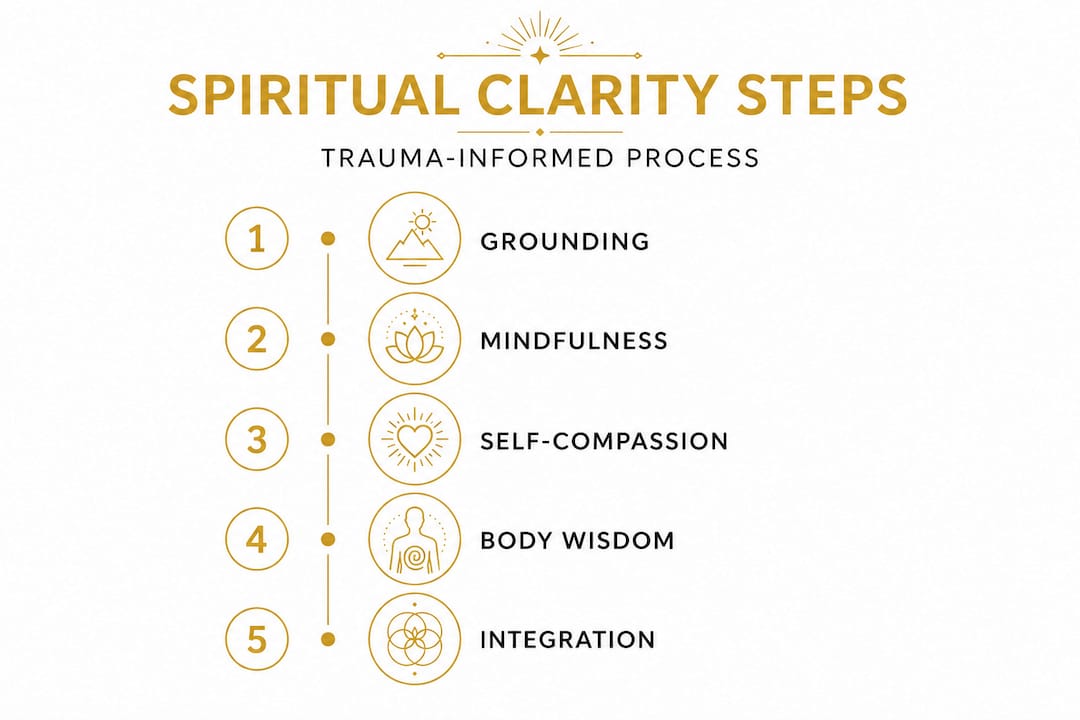
The five-step trauma-informed clarity process:
-
Prioritize safety and grounding. Before any inner work, establish physical and emotional safety. Use the grounding ritual from the section above. Ask yourself: "Do I feel safe enough right now to go inward?" If the answer is no, that is important information. Stay with grounding until there is a small sense of settling.
-
Practice mindfulness with self-permission. Mindfulness does not mean emptying your mind. It means observing what is present without fighting it. MBSR research in women with PTSD showed medium effect sizes, with reduced depression scores ranging from d=-0.53 to -0.70, as well as decreased anxiety and improved quality of life. Start with five minutes of breath awareness and build slowly over weeks.
-
Cultivate active self-compassion. This is not passive acceptance. It is an intentional practice of speaking kindly to yourself, especially when you are struggling. A simple phrase like "This is hard, and I am doing my best" can interrupt the inner critic and create space for clarity to emerge.
-
Discover and name your core values. Spiritual clarity often comes through knowing what matters most to you, not what you were told should matter, but what actually resonates in your body as true. Write down five values that feel alive for you right now. Notice which ones feel like relief and which feel like obligation.
-
Integrate through emotional clarity techniques and journaling. After each practice session, spend five to ten minutes writing. What did you notice? What surprised you? What felt like resistance? Integration is where the real clarity lives. Without it, insights evaporate before they can change anything.
Comparison of spiritual practice types:
| Practice | Trauma-sensitivity | Primary outcome |
|---|---|---|
| Mindfulness meditation | High, when paced gently | Nervous system regulation |
| Breathwork (intense) | Low to moderate, needs guidance | Emotional release, can overwhelm |
| Journaling | High | Pattern recognition, integration |
| Yoga (gentle, somatic) | High | Body awareness, grounding |
| Energy healing (unguided) | Low, risk of bypassing | Variable, often surface-level |
| Values clarification | High | Directional clarity, self-trust |
Pro Tip: Resist the urge to push through discomfort in the name of spiritual growth. Your nervous system is not an obstacle to clarity. It is the vehicle for it. Gentle, consistent practice will always outperform intense but sporadic effort.
Troubleshooting common obstacles and verifying progress
Even with the best tools and intentions, you will hit walls. Doubt will creep in. You will have a hard week and wonder if any of this is working. You might catch yourself slipping into spiritual bypassing without realizing it. All of this is normal, and none of it means you are failing.
Common obstacles and how to address them:
- Doubt and skepticism: When you question whether spiritual practices can actually help, get curious rather than dismissive. Ask what the doubt is protecting you from. Often it is grief, or the fear of hoping again.
- Overwhelm: If practices feel like too much, scale back. One minute of mindfulness is better than twenty minutes of forcing it. Overwhelm is a signal to slow down, not push harder.
- Spiritual bypass behaviors: Watch for signs like dismissing your emotions as "just ego," using positive affirmations to cover pain, or feeling superior to others who are "still stuck." These are signs the practice is being used as armor rather than a doorway.
- Inconsistency: Missing days or weeks is not failure. It is human. Return without drama. The practice is always available.
- Isolation: Doing this work entirely alone can stall progress. Seek out clarity work for women that offers relational support alongside solo practices.
Verifying real progress looks quieter than you might expect. You will notice:
- A small but consistent increase in calm, even in difficult moments
- Insights that feel grounded in your body rather than just intellectual
- A growing capacity to sit with uncertainty without immediately needing to fix it
- Self-compassion that arises more naturally and requires less effort to access
Research confirms that self-compassion moderates both post-traumatic stress and post-traumatic growth. Higher self-compassion is linked to greater PTG even when PTS symptoms are still present. Notably, women tend to report higher PTS and lower self-compassion than men, which makes cultivating this quality especially important in your practice.
"Self-compassion is not a reward for healing. It is the condition that makes healing possible."
If you are unsure whether you are making progress, look for the small shifts. They are the most reliable evidence of real change.
Why trauma-informed spiritual clarity is the only sustainable path
Here is what most spiritual content will not tell you: the "good vibes only" approach does not just fail to help. It can actively set you back. When you are encouraged to transcend your pain before you have actually processed it, you do not become spiritually advanced. You become spiritually brittle. The unprocessed material does not disappear. It waits.
I have seen this pattern repeatedly in women who come to clarity work after years of spiritual practice that left them feeling secretly ashamed of their own struggles. They had done the retreats, the affirmations, the vision boards. They had tried to vibrate higher. And yet the same patterns kept showing up, the same relationships, the same self-abandonment, the same quiet despair beneath the performance of peace.
The body knows the difference. Body wisdom in discernment is one of the most underused tools in spiritual development, and it is especially powerful when you learn to distinguish between the wisdom of your direct inner experience and the rules of any external system, religious or otherwise. Your body will tell you when a practice is helping you expand and when it is helping you hide.
Trauma-informed trauma-informed spiritual guidance honors the pace of your nervous system. It does not ask you to perform healing. It asks you to be honest about where you actually are, and to meet that place with both skill and compassion. That is the only path to clarity that lasts beyond the next retreat high or journaling breakthrough.
True empowerment is not about bypassing discomfort. It is about building enough inner safety that you can stay present with discomfort long enough to hear what it is trying to tell you. That is where the real spiritual information lives.
How trauma-informed coaching supports your clarity journey
When self-guided practices reach their natural limit, personalized support can open doors that solo work simply cannot. Clarity deepens when someone trained in trauma-informed approaches can reflect your patterns back to you with both precision and care.
At rachel-m-harrison.com, the Sanctuary Symbolic Integration Method™ offers exactly that kind of support. This framework helps you understand your emotional patterns, stabilize your nervous system, and move from insight into aligned action. Whether you are navigating a major life transition or ready to reclaim your inner sovereignty after years of self-abandonment, trauma-informed clarity coaching can accelerate your healing and prevent the setbacks that come from working without a map. You are invited to take the next step toward grounded, lasting clarity.
Frequently asked questions
How do trauma and spirituality intersect for women in transition?
Trauma often reshapes spiritual beliefs and disrupts a woman's sense of meaning, making a trauma-informed approach essential for safe and authentic spiritual clarity. Spiritually integrated therapy specifically addresses how interpersonal trauma survivors can rebuild spiritual meaning without bypassing their psychological healing.
What are signs of spiritual bypass versus genuine clarity?
Spiritual bypassing includes suppressing emotions, forcing positivity, or framing trauma as a spiritual failing, while genuine clarity shows up as embodied calm, honest self-awareness, and increasing acceptance of your full experience.
Which practice helps most with emotional clarity?
Mindfulness and self-compassion practices are among the most research-supported approaches, with MBSR studies showing meaningful reductions in depression, anxiety, and stress for women navigating trauma.
How long does it take to feel spiritually clear?
The timeline is personal and nonlinear, but consistent trauma-informed practice typically produces noticeable shifts in calm and inner clarity within several weeks to a few months of regular engagement.