
TL;DR:
- Aligned action involves making daily decisions that authentically reflect your core values and promote growth.
- For trauma survivors, establishing clear boundaries and practicing emotional self-regulation create a safe foundation for consistent progress.
You know your values. You can name them. You might even have them written on a sticky note somewhere. But somehow, when the moment arrives — when a conversation gets hard, when someone asks too much of you, when you feel the pull to shrink — your actions don't quite match what you believe. This is the gap that aligned action addresses. Understanding what is aligned action is not about becoming a better goal-setter. It's about learning to express who you actually are through the choices you make every single day, especially when you're healing and reclaiming your sense of self after trauma.
Table of Contents
- What is aligned action and why does it matter?
- Aligned action in trauma-informed coaching: setting boundaries and safety
- Emotional self-regulation: creating space for aligned choice
- The alchemical pause: presence, self-compassion, and choosing aligned action
- Practical steps to take aligned action through mindfulness and micro-commitments
- A fresh perspective: why aligned action is a practice of ongoing translation, not a destination
- Explore trauma-informed coaching to support your aligned action journey
- Frequently asked questions
Key Takeaways
| Point | Details |
|---|---|
| Alignment is direction | Aligned action means your overall behavior leans toward your core values, not perfection in every step. |
| Boundaries create safety | Clear boundaries in coaching provide the structure trauma survivors need to take aligned actions safely. |
| Pause to choose | Emotional self-regulation creates a critical space between feeling and acting that supports aligned decisions. |
| Micro-commitments build trust | Small, consistent actions foster safety and self-trust better than big resolutions after trauma. |
| Mindfulness fuels awareness | Mindfulness helps you notice when your actions stray from your values so you can adjust effectively. |
What is aligned action and why does it matter?
The definition of aligned action comes down to one essential idea: aligned action converts your meaning and values into concrete daily decisions, with a focus on direction rather than perfection. It's not about maximizing productivity or getting every choice exactly right. It's about closing what you might call the "alignment gap" — the space between what you believe matters and how you're actually living.
This distinction is important, especially for women navigating emotional growth and boundaries after difficult life experiences. Alignment is not optimization. It doesn't ask you to perform your values flawlessly every hour of the day. It asks you to tilt your overall direction toward what's meaningful to you.
Here's what the aligned action meaning looks like in practice:
- Values-based decisions: Choosing not to overschedule yourself because rest is a value, even when productivity culture tells you otherwise.
- Instrumental actions that still count: Making an appointment for therapy isn't glamorous, but it enables your deeper growth work. That's aligned action.
- Direction over perfection: Snapping at someone you love doesn't disqualify your alignment. It's information, not failure.
- Closing the gap daily: Asking yourself, "Does this choice move me toward or away from the life I want to build?" — and answering honestly.
Misunderstanding alignment as a kind of perfection is one of the most common ways women undermine their own self-trust. When every imperfect decision becomes evidence that you're "not aligned," you've replaced genuine growth with another form of self-criticism. The role of aligned action is to serve your growth, not to become another way to judge yourself.
Aligned action in trauma-informed coaching: setting boundaries and safety
For women healing from trauma, the idea of aligned action carries an extra layer of complexity. Trauma affects your nervous system's ability to read safety, make clear decisions, and trust your own instincts. Before you can take meaningful aligned steps, you need a stable foundation. That foundation is built from clear, honest boundaries.
Trauma-informed coaching emphasizes the importance of scoped, consistent support windows and warns explicitly against over-giving, which can foster unhealthy dependence rather than genuine empowerment. In other words, the structure of the coaching relationship itself models aligned action.
Why aligned action matters in this context:
- Predictability creates safety. When a coach holds clear boundaries, clients learn that limits are not rejection. They're safety infrastructure.
- Consistency teaches self-trust. Being met with the same kind response repeatedly helps rebuild the nervous system's ability to predict outcomes — which trauma often disrupts.
- Coaching boundaries are part of the practice. They demonstrate, in real time, what it looks like to act from values rather than from anxiety or people-pleasing.
- Micro-commitments over big leaps. For trauma survivors, small and repeatable actions build more genuine momentum than ambitious overhauls that overwhelm the nervous system.
Pro Tip: Before any deep coaching work begins, write down two or three concrete, realistic boundaries you want to honor during the process. These become your first acts of aligned action — evidence to your nervous system that you can be trusted to protect yourself.
Emotional self-regulation: creating space for aligned choice
Here's something worth sitting with. You cannot consistently take aligned action if you're in a reactive state. When your nervous system is flooded — by fear, shame, grief, or overwhelm — your brain defaults to survival patterns, not values-based choices. This is not a personal failure. It's biology. And it's why self-regulation creates space between emotional triggers and responses, giving you the room to choose aligned actions instead of automatic reactions.
One practical framework for building this skill is the STOP technique. It's simple enough to actually use in real moments:
- Stop what you're doing or saying.
- Take a breath, long and slow, signaling safety to your body.
- Observe what you're feeling, naming it without judging it.
- Proceed with a choice that reflects your values, not your fear.
This is what self-leadership practice looks like at the micro level. Not grand gestures of transformation, but small, practiced moments of pausing long enough to choose.
You don't need perfect control over your emotions to build aligned action. You need the habit of this pause. Even pausing three seconds longer than you used to is meaningful progress. Emotional self-regulation is not about becoming unfeeling or "zen." It's about creating a reliable gap between stimulus and response, so your values can walk through that gap and lead.

Pro Tip: Practice the STOP technique in low-stakes situations first, like when you're frustrated in traffic or mildly annoyed by an email. Building the muscle in easy moments means it's available when the emotional intensity is higher.
The alchemical pause: presence, self-compassion, and choosing aligned action
The alchemical pause takes self-regulation one step further. It's not just about stopping yourself from reacting. It's about being fully present with what you're feeling before you decide how to act.
"The alchemical pause is a moment of presence between emotion and action that enables choice beyond reactive behavior."
That phrase, "choice beyond reactive behavior," is worth staying with. Most of us learned, in difficult childhoods or difficult relationships, that feeling something strongly meant we had to act on it immediately. The pause unlearns that. It says: you can feel this fully, and still choose.
What collapses the pause is self-judgment. When you feel anger, grief, or fear and immediately label yourself as "too much" or "broken," you lose access to the choice point. Self-compassion, on the other hand, maintains the pause. It lets you say, "Of course I feel this. Now what do I want to do with it?"
The alchemical pause doesn't dissipate emotional energy. It redirects it. Instead of the emotion running you, you make a conscious choice about where that energy goes. For women embodying self-trust after trauma, this practice is genuinely transformative. It's the moment where healing becomes lived, not just understood.
Practical steps to take aligned action through mindfulness and micro-commitments
Aligned action in personal growth doesn't require a dramatic life overhaul. It requires honesty, repetition, and a willingness to notice when you've drifted without shaming yourself for it. Mindfulness increases self-awareness, giving you the ability to notice and adjust when your actions don't reflect your values — and that noticing is everything.
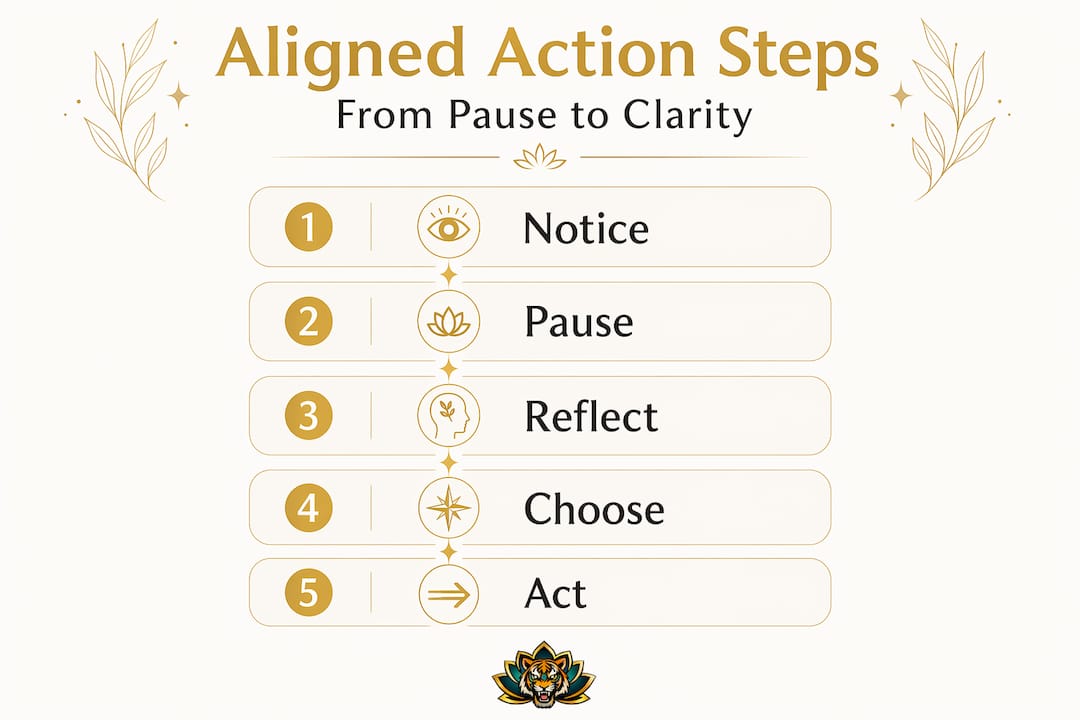
Here's a grounded process to start:
- Name your core values. Not aspirational ones you think you should have. The actual ones. Safety, creativity, rest, truth, connection — whatever genuinely matters to you right now.
- Pause before committing. When asked to take on something new, practice a breath before responding. Ask: "Does this fit what I'm building?"
- Design micro-commitments. Choose one small, repeatable action per value, per week. Not a goal. A behavior. "I will say no to one request that doesn't feel right this week."
- Review weekly, without drama. Look at your choices. Notice patterns. Adjust without judgment.
- Follow a spiritually aligned approach to self-leadership that honors your nervous system, not just your ambitions.
| Misaligned pattern | Aligned action alternative |
|---|---|
| Saying yes to avoid conflict | Pausing and offering a considered, honest response |
| Skipping rest to appear productive | Scheduling rest as a non-negotiable part of your week |
| Apologizing for having needs | Stating needs clearly and without excessive explanation |
| Reacting from fear in relationships | Using the STOP technique to choose your response |
| Waiting for big moments to change | Building a self-leadership workflow from small daily habits |
Benefits of aligned action include reduced decision fatigue, stronger self-trust, clearer emotional boundaries, and the quiet but powerful sense that your life is actually yours. These aren't abstract outcomes. They show up in how you feel after a hard conversation, how quickly you recover from a difficult moment, and how much of your energy you stop leaking to resentment or regret.
Pro Tip: Treat your micro-commitments as data, not promises. If you can't keep one, the data tells you something — maybe the commitment was too large, too vague, or not actually aligned with a real value. Adjust and try again.
A fresh perspective: why aligned action is a practice of ongoing translation, not a destination
Most content about aligned action frames it as something you achieve once you "figure yourself out." I want to push back on that directly, because for women healing from trauma, that framing is not just unhelpful. It's subtly harmful.
Alignment is not a state you arrive at. It's a practice of translating meaning into daily decisions over and over, in different seasons of your life, as your values evolve and your circumstances shift. What aligned action looked like for you two years ago may not serve who you're becoming now.
Here's what I've come to understand through this work: the women who build the most durable sense of self-leadership are not the ones who made the most dramatic changes. They're the ones who paid attention to their small, default habits. The way they respond to a text message. The way they walk into a meeting. Whether they eat lunch or push through to prove something to no one in particular. Those tiny moments, accumulated, are what alignment is actually made of.
For trauma survivors, this matters even more. Your nervous system builds trust through repetition, not revelation. One powerful insight in a coaching session is meaningful. But it's the consistent micro-commitments — showing up the same way, holding the same boundaries, choosing the same small acts of self-respect — that actually rebuild clarity and trust at a felt level.
Aligned action doesn't ask you to be fixed. It asks you to be honest and consistent with what's true for you right now. That's it. And that, for many women, is the most radical thing they've ever tried.
Explore trauma-informed coaching to support your aligned action journey
Understanding the theory of aligned action is a meaningful start. Putting it into practice, consistently, within a safe and structured environment, is where the real shift happens.
Trauma-informed coaching services at rachel-m-harrison.com are designed to help you close the gap between knowing your values and actually living them, without overwhelm, without pressure, and without losing yourself in the process. Whether you're just beginning to explore this work or you're ready to go deeper, there's a path that fits where you are right now. You can book a coaching session to begin working one-on-one, or start your coaching journey with introductory resources built for women exactly where you are.
Frequently asked questions
What does aligned action mean in simple terms?
Aligned action means making daily choices that reflect your true values rather than reacting from fear or pressure. Daily decisions grounded in meaning are the foundation of aligned action, with direction mattering more than perfection.
How can trauma survivors practice aligned action without feeling overwhelmed?
By focusing on small, consistent micro-commitments within safe, predictable coaching boundaries, trauma survivors build momentum without overwhelm. Micro-commitments build safety and reduce the risk of dependence dynamics that can derail healing.
What is the role of emotional self-regulation in aligned action?
Emotional self-regulation creates a pause between feeling triggered and acting, allowing you to choose actions that truly align with your values. Space between triggers and responses is where aligned choice becomes possible.
Can perfectionism hinder aligned action?
Yes, treating alignment as a performance of flawless choices will consistently block your progress and erode your self-trust. Alignment is directional, not maximal, and approaching it like a perfection standard misses the point entirely.
How does trauma-informed coaching help establish boundaries for aligned action?
It sets clear, consistent support windows and realistic relational limits that create the safety trauma survivors need to take aligned steps. Scoped, consistent coaching structures give your nervous system the predictability it needs to trust the process.