TL;DR:
- Clarity integration in personal development is a structured process of turning emotional insight into lasting behavioral change through ongoing practices and coaching. It requires time, repetition, and reflection, unlike the real-time data linking tools used in software analytics. Consistent practice over months enhances self-trust, decision-making, and emotional regulation.
If you searched "what is clarity integration" expecting to find something about emotional wellness or personal growth, you may have landed on pages about Microsoft software analytics instead. That confusion is common, and it matters. Clarity integration, in the personal development sense, is the structured process of translating emotional insight into lasting behavioral change. It goes far beyond a single breakthrough moment. This article explains what clarity integration actually means for your emotional wellness and self-leadership, how it works in practice, and why understanding it can shift the way you relate to yourself and your decisions.
Table of Contents
- Key takeaways
- What clarity integration really means in emotional wellness
- Understanding the technical vs. emotional meaning
- Frameworks that guide the clarity integration process
- How to apply clarity integration in your daily practice
- The real benefits of clarity integration over time
- My honest take on clarity integration
- Ready to begin your own clarity integration work
- FAQ
Key takeaways
| Point | Details |
|---|---|
| Insight alone is not enough | Real change requires structured integration over weeks or months, not just one powerful moment of awareness. |
| Two very different meanings exist | "Clarity integration" can refer to software analytics tools or emotional wellness processes. Knowing the difference saves you confusion. |
| Emotional calibration has three phases | The Mirror, Architect, and Visionary framework guides you from feeling through reflection to aligned decision-making. |
| Integration is a long-term practice | Sustained clarity work involves coaching checkpoints, daily rituals, and a forward plan that extends well beyond initial sessions. |
| The benefits compound over time | Improved focus, reduced reactivity, and stronger self-trust build progressively as you practice clarity integration consistently. |
What clarity integration really means in emotional wellness
When most people encounter an insight about themselves, they feel a rush of recognition. "That's why I keep doing that." But within days, the old patterns return. That gap between insight and change is exactly what clarity integration addresses.
In the emotional wellness context, clarity integration is the deliberate, structured process of moving awareness into your nervous system, your habits, and your decision-making. It is not about collecting more self-knowledge. It is about processing what you already know deeply enough that it changes how you actually live.
Programs built around this model take time intentionally. A good example is the Clarity Blueprint, which runs six weeks with live coaching and post-program support designed specifically to sustain integration. That extended timeline is not padding. It reflects a real psychological truth: new emotional patterns need repetition, reflection, and reinforcement before they become your default.
The Clarity Blueprint approach identifies several core components that clarity integration must include:
- Live coaching sessions to process emotions in real time with a guide
- Structured assessments to identify existing patterns and their roots
- Integration rituals between sessions to practice new responses
- Post-program checkpoints to review progress and reinforce shifts
- A forward plan (often spanning 90 days) to carry the work beyond formal support
What distinguishes this from standard self-help is the sequencing. You do not jump straight from insight to action. You process first, then decide.
Pro Tip: If you finish a coaching session or workshop feeling inspired but return to old habits within a week, that is a sign you are getting insight without integration. Ask your coach explicitly: "What is the integration plan between sessions?"
Understanding the technical vs. emotional meaning
Here is where the confusion starts. When you search for clarity integration online, a large portion of results describe Microsoft Clarity's analytics integrations with platforms like Google Ads. These tools link behavioral data from session replays and heatmaps with campaign performance metrics. That is genuinely useful technology, but it has nothing to do with your inner life.
The two uses of the term share only the word "clarity." Their purposes, users, and outcomes are entirely different.
| Feature | Software clarity integration | Emotional clarity integration |
|---|---|---|
| Primary purpose | Linking behavioral data with marketing metrics | Converting emotional insight into sustained behavioral change |
| Who it serves | Marketers and developers | Individuals, coaches, and leaders |
| Time frame | Real-time data syncing | Weeks to months of structured work |
| Success measure | Campaign performance improvement | Emotional stability and aligned decision-making |
| Tools required | APIs, analytics platforms | Coaching, journaling, reflection practices |
Successful software integrations also require careful data mapping to align event definitions and avoid misleading conclusions. That technical precision is genuinely complex, but it operates on an entirely different plane than emotional processing.
The takeaway is simple. If you are looking for personal development support, filter your research. When you see "clarity integration" alongside terms like "heatmaps," "session replays," or "Google Ads," you are in the wrong place. When you see it alongside "self-leadership," "emotional processing," or "coaching," you are in the right one.
Frameworks that guide the clarity integration process
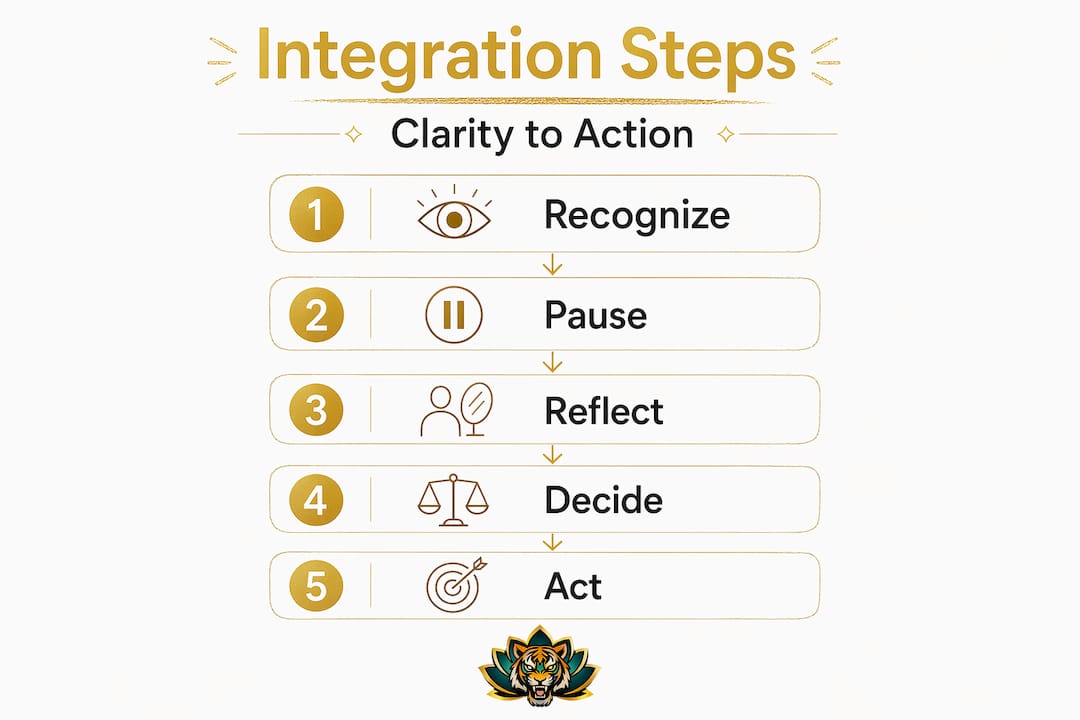
The most practical model for understanding how clarity integration works emotionally comes from the Emotional Calibration framework, which sequences processing into three distinct modes.
| Phase | Mode | What happens |
|---|---|---|
| Feel | Mirror | You observe and name what you are actually experiencing without judgment |
| Reflect | Architect | You identify what the emotion signals beneath its surface expression |
| Decide | Visionary | You integrate that processed clarity into a future-focused, values-aligned choice |
Most people skip straight from "feel" to "decide," which is exactly how reactivity happens. You feel something intense, and you act from that raw state. The Architect mode interrupts that pattern by inserting structured reflection before any decision is made.

This sequencing matters more than most people realize. Emotionally focused leadership models consistently show that pausing to reflect slows emotional loops and produces decisions with far less collateral damage. You stop reacting and start responding.
A structured clarity integration program typically maps these phases across several weeks. Early sessions focus on the Mirror phase: naming what is actually present. Mid-program work shifts to the Architect phase: understanding patterns and their origins. The final stretch and post-program support focus on the Visionary phase: building new decision-making habits that reflect your processed clarity.
Pro Tip: The next time you feel an emotion strongly, pause and ask yourself two questions before responding: "What am I actually feeling right now?" and "What does this feeling signal about what I need?" Those two questions are the Mirror and Architect phases in miniature.
How to apply clarity integration in your daily practice
Understanding the concept intellectually is the starting point. Applying it changes your life. Here is how to build clarity integration into your daily practice without needing a formal program to begin.
-
Start a morning check-in. Spend three minutes naming your emotional state before your day begins. Not "I feel fine" but something specific: tightness in the chest, restlessness, quiet calm. Naming creates the Mirror phase in real time.
-
Journal one signal per day. After naming your feeling, write one sentence about what it might be signaling. "The anxiety I feel before the meeting might be signaling that I need to set a boundary about my workload." This is the Architect phase in writing.
-
Create a decision pause protocol. Before any significant decision, give yourself a defined window of time, even just 24 hours, to let your processed emotions inform your choice rather than your immediate reaction.
-
Build a weekly reflection ritual. At the end of each week, review your journal notes. Look for patterns across your emotional signals. Personal reflection is not just a nice habit. It is how integration actually consolidates.
-
Work with a coach for harder patterns. Some emotional loops run deep, especially if they are rooted in trauma or long-term conditioning. A clarity-focused coach can help you process what solo journaling cannot reach. The role of clarity consultancy in this context is not advice-giving. It is guided emotional processing with professional support.
Common challenges people encounter include:
- Resistance to sitting with discomfort. The Mirror phase requires tolerating uncomfortable feelings without immediately fixing or suppressing them. Start with short windows of two to three minutes.
- Confusion between thinking about feelings and processing them. Analyzing your emotion from a distance is not the same as feeling it. Processing means letting the body register it, not just the mind.
- Losing motivation between sessions. Integration slows without consistency. Insight without continued integration rarely produces lasting change.
The real benefits of clarity integration over time
The benefits of consistent clarity integration are not abstract. They show up in specific, measurable ways.
- Reduced emotional reactivity. You stop being triggered into responses you later regret because you have practiced the pause.
- Clearer decision-making. When emotions are processed before choices are made, decisions align more closely with your actual values and needs.
- Increased self-trust. Over time, you recognize that you can handle your emotional experience. That recognition builds confidence that cannot be faked.
- Sustained energy. Suppressing unprocessed emotion costs enormous cognitive and physical energy. Integration frees that energy for meaningful work.
- Stronger boundaries. Signs of emotional clarity consistently include the capacity to set limits from a grounded place rather than from fear or exhaustion.
The compound effect is real. Clarity integration done consistently over months shifts how you interpret yourself, not just how you behave.
"Emotional clarity is less about gathering more information and more about alignment and processing to guide choices." — Clarity OS
Coaching programs that offer structured integration support often range from a few hundred to several thousand dollars depending on length and intensity. For many women and leaders, that investment pays off not in productivity metrics but in the quality of their relationships, their self-trust, and their ability to lead without burning out.
My honest take on clarity integration
I have worked with enough women in transition to say this plainly: the insight moment is not the finish line. It is the starting gun.
What I see repeatedly is someone arrive at a profound realization about a pattern in their life, feel genuinely moved by it, and then return six months later carrying the same pattern with a new layer of frustration added. Not because they are weak or unmotivated. Because nobody gave them an integration container.
The confusion between the software meaning of "clarity integration" and the emotional wellness meaning is not just a terminology issue. It reflects something deeper: our culture under-invests in the work that comes after insight. We celebrate breakthroughs. We rarely celebrate the quiet, consistent practice of integrating what we have learned into how we actually live.
What I have learned from my own work and from supporting others is this: the structures matter as much as the insight. The scheduled reflection, the check-in call three weeks later, the ritual that anchors your new pattern into the body. Without those structures, awareness evaporates. With them, it becomes part of who you are.
Integration is not dramatic. It does not feel like transformation in the moment. It feels like small, repeated choices that one day you look back on and realize have added up to a different life.
— RachelMHarrison
Ready to begin your own clarity integration work
If this article has named something you have been experiencing, the next step is finding a container for the work.
At Rachel-m-harrison, the Sanctuary Symbolic Integration Method™ is built precisely for this. It is a trauma-informed, psychologically grounded framework that takes you from emotional pattern recognition through to embodied, aligned self-leadership. Whether you are just beginning to explore these ideas or you are ready to go deep, there is a place to start. You can explore the coaching guide to understand what working together looks like, or go straight to booking a session when you are ready. If you are new and want to orient first, the start here page is the right place.
FAQ
What is clarity integration in personal development?
Clarity integration is the structured process of converting emotional insight into lasting behavioral and decision-making change. It goes beyond awareness to include ongoing practices, coaching support, and reflection rituals that embed new patterns over time.
How does clarity integration work in a coaching program?
A structured clarity integration program typically includes live coaching sessions, self-assessments, integration rituals between sessions, and a post-program forward plan designed to sustain the work for 90 days or more after formal sessions end.
What is the difference between software and emotional clarity integration?
Software clarity integration refers to tools like Microsoft Clarity connecting behavioral analytics with marketing platforms. Emotional clarity integration is an inner process of aligning your emotional experience with your values and decisions. The terms share a name but serve entirely different purposes.
What are the main benefits of clarity integration?
The primary clarity integration benefits include reduced emotional reactivity, stronger self-trust, clearer decision-making, and sustained energy. These benefits build progressively with consistent practice rather than arriving all at once.
How long does clarity integration take to produce results?
Most structured programs span six weeks to several months, with many coaches recommending a 90-day integration period after initial sessions. Noticeable shifts in reactivity and decision-making often appear within the first few weeks of consistent practice.