
TL;DR:
- Embodied clarity is the integrated state where your body and mind reach the same conclusion, fostering deep knowing. It depends on nervous system regulation and interoceptive awareness to create a calm, present, and coherent experience. Practice techniques like breath awareness, posture checks, and felt sense listening build this capacity, transforming decisions and healing processes with lasting impact.
Most people assume clarity is something you think your way into. You analyze the situation, weigh your options, and eventually your mind delivers an answer. But that model leaves out more than half the story. What is embodied clarity? It's the state where your body and mind reach the same conclusion at the same time, where a decision doesn't just make sense intellectually but settles into you physically. This article breaks down the science, the felt experience, and the daily practices that help you access this deeper form of knowing.
Table of Contents
- Key takeaways
- What is embodied clarity: the definition that changes everything
- The neuroscience behind it
- What embodied clarity actually feels like
- Practices that build embodied clarity
- Embodied clarity in healing and daily decisions
- My perspective on why this work changes everything
- Take the next step with Rachel M. Harrison
- FAQ
Key takeaways
| Point | Details |
|---|---|
| Clarity lives in the body | Embodied clarity is a mind-body state, not just a mental insight, and requires physical regulation to arise. |
| Interoception is the mechanism | Your brain's ability to read internal body signals directly shapes how clear or confused you feel. |
| Safety comes before clarity | A dysregulated nervous system blocks clarity from landing, no matter how much you think things through. |
| Calm is the signature feeling | Embodied clarity feels quiet and settled, not urgent or loud, which is why many people miss it at first. |
| Practice builds the skill | Breath awareness, posture checks, and felt sense listening are trainable habits that cultivate clarity over time. |
What is embodied clarity: the definition that changes everything
The definition of embodied clarity is simpler than it sounds, and more profound than most self-help frameworks let on. Embodied clarity is the experience of knowing something not just with your thoughts but through your entire physical and emotional state. Your nervous system is regulated, your body feels settled, and your perception of a situation or choice becomes coherent without effort or force.
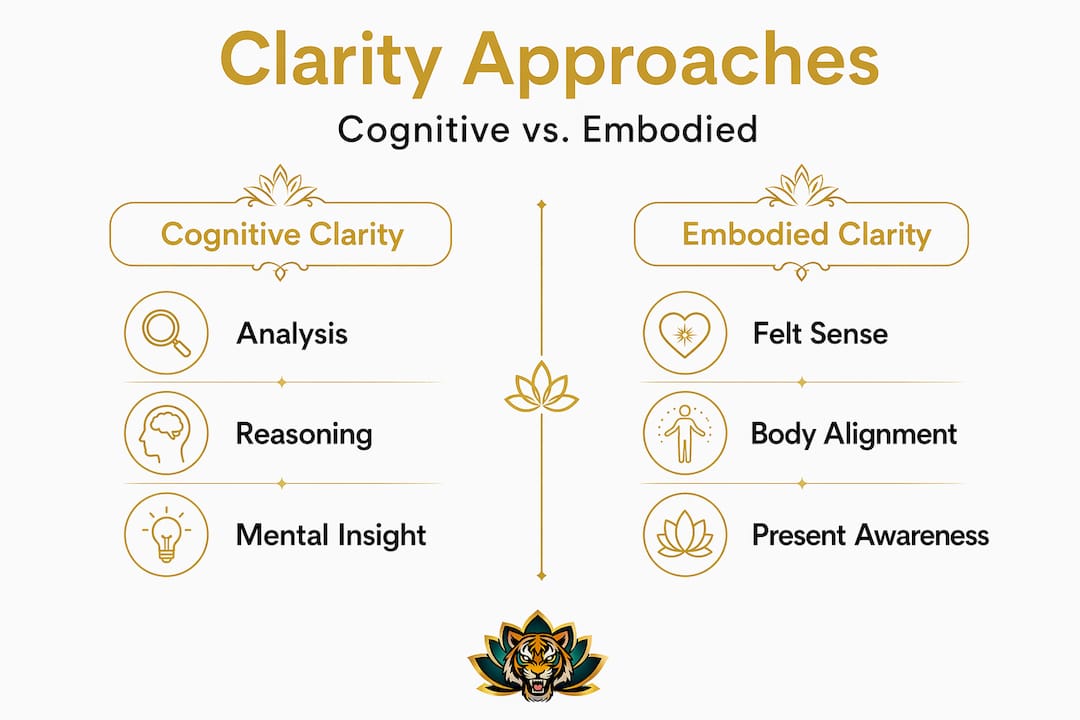
This is different from the clarity you get after an intense journaling session or a long conversation with a trusted friend. That kind of clarity is cognitive. It's real and useful, but it doesn't always stick. You understand something in your head, but two days later the old anxiety creeps back. You're second-guessing yourself again. That's because conceptual understanding alone cannot produce embodied clarity without the coordination of your physiology and nervous system.
Think of it this way. You can fully understand, intellectually, that a past relationship was harmful. But if your body still tenses when you see a message from that person, if your chest tightens and your breath goes shallow, you haven't yet reached embodied clarity about it. The mind knows. The body hasn't caught up. Embodied clarity is what happens when they finally meet.
Understanding the embodied clarity concept also means recognizing what it is not. It isn't certainty. It isn't the absence of fear. It's a grounded, present-tense relationship with your own inner state that allows you to act from alignment rather than reaction.
The neuroscience behind it
Your body has a sensory system dedicated to reading its own internal state. Scientists call this interoception, and it's increasingly recognized as a foundation for emotional health. Interoception involves how the brain interprets signals from inside the body, covering three distinct layers: interoceptive accuracy (how well you detect what's happening inside), interoceptive sensibility (how much attention you pay to those signals), and interoceptive awareness (how consciously you reflect on them).
When these three components are working together, your inner world feels coherent. When they're misaligned, as often happens under chronic stress or after trauma, the signals get scrambled. Your body sends one message and your mind reads it as something else entirely. Interoceptive mismatches can cause anxiety by misreading body signals, which explains why some people experience a racing heart and immediately spiral into panic, even when no real threat is present.
Here's where nervous system safety enters the picture. Your brain can only integrate clear signals when it feels safe enough to do so. When you're in a state of fight, flight, or freeze, your nervous system is running a threat detection program, not a meaning-making one. Tension prevents clarity from landing, and calming the system is what allows clarity to arrive quietly and stay.
Consider the difference between trying to make a major life decision at 2 a.m. after a stressful week versus sitting with the same question on a calm Sunday morning after a slow breakfast. The question hasn't changed. You have changed. Your nervous system's state determines whether clarity is even available to you.
"Embodied clarity is both a measurable interoceptive skill and a felt sense shaped by nervous system state."
This isn't metaphor. It's physiology. And understanding it repositions the entire pursuit of clarity from a mental task into a somatic practice.
What embodied clarity actually feels like
One of the biggest obstacles to recognizing embodied clarity is that most people are waiting for it to feel dramatic. They expect a thunderclap moment, a sudden rush of certainty, a feeling of doors swinging wide open. But embodied clarity often manifests as a subtle, calm presence rather than dramatic insight or urgency.
Here's what it typically feels like when it arrives:
- A quiet settling in the chest. Not excitement. More like relief. The tension around a question simply releases.
- Slower, deeper breathing. Without trying, your breath drops into your belly and your shoulders drop away from your ears.
- Reduced mental chatter. The internal debate goes quiet. Not because you've suppressed it, but because it's resolved at a level below thought.
- A sense of alignment. Your body's response and your mental understanding point in the same direction without conflict.
- Decisions feel less effortful. You still have to act, but the body and mind aligning means actions flow with less internal resistance.
A common misconception is that if clarity feels calm, it must be passive or disconnected. The opposite is true. Embodied clarity is highly present. It's a grounded attentiveness, not a checked-out numbness. You can also find useful signs of emotional clarity that help you recognize when you're moving in that direction.
Pro Tip: If you're unsure whether what you're feeling is clarity or avoidance, check your body's baseline. Clarity tends to feel open and steady. Avoidance often comes with a slight holding of breath or a vague unease beneath a surface sense of calm.

The felt sense, a term coined by philosopher and psychologist Eugene Gendlin, is the body's whole, pre-verbal sense of a situation. It's not an emotion exactly, and it's not a thought. It sits somewhere in between. Learning to listen to it is central to the self-reflection and clarity work that supports lasting emotional change.
Practices that build embodied clarity
The good news about the embodied clarity concept is this: it's cultivable. You don't have to wait for it to arrive. You can create the conditions where it becomes possible, repeatedly, through practice. Somatic coaching sessions begin with nervous system regulation before expecting any cognitive clarity, and you can apply this same sequencing yourself.
Start with regulation before reflection. That means before you sit down to journal, make a decision, or process a difficult emotion, you spend a few minutes settling your body first. The following practices support this:
- Breath awareness. Slow your exhale to twice the length of your inhale. This activates the parasympathetic nervous system and signals safety to your brain. Even three minutes makes a measurable difference.
- Posture check. Uncross your legs, plant both feet on the floor, and soften your jaw. Posture sends real-time signals to your brain about your level of threat. An open, grounded position communicates that it's safe to be present.
- Gentle movement. A slow walk, light stretching, or even shaking your hands gently can discharge built-up tension from the nervous system before you ask it to produce clarity.
- Felt sense listening. After regulation, bring a question or situation to mind and ask your body, not your mind, to respond. Notice where you feel it physically. Notice the quality of the sensation. Don't interpret it immediately. Just observe.
- Reflective journaling. Write not just what you think but what you feel as you write. Note physical sensations alongside mental observations. Embodied awareness through mindfulness enhances the brain networks responsible for self-regulation and emotional balance.
Pro Tip: Pair each journaling session with a two-minute body scan beforehand. This primes your interoceptive system to stay online as you write, which deepens the quality of insight you access.
Intentions matter here too. Intention paired with embodied awareness improves attention, reduces stress, and supports presence in ways that pure mental intention cannot. You can explore emotional clarity exercises designed specifically for women and creatives who want to build this practice into their routine.
Embodied clarity in healing and daily decisions
Understanding embodied clarity is one thing. Applying it to real life is where the importance of embodied clarity becomes undeniable. The table below shows the practical contrast between decision-making and healing from a cognitive state versus an embodied state.
| Situation | Cognitive approach | Embodied clarity approach |
|---|---|---|
| Setting a boundary | You reason through what's fair and logical | You notice the body's tightness and use it as data to name the limit |
| Processing grief | You analyze what happened and what it means | You allow sensation to move through without fixing or suppressing |
| Making a career decision | You list pros and cons until exhausted | You sit with each option and notice which one allows you to breathe more fully |
| Healing from trauma | You understand the event intellectually | You work with the body's stored response to complete and release it |
| Navigating a conflict | You rehearse what you'll say | You regulate first so your response comes from presence, not protection |
The importance of embodied clarity in trauma-informed healing is especially significant. Trauma is not stored primarily in the mind. It's stored in the nervous system, in the body's patterns of response. Insight alone can't shift those patterns. Only when the body feels safe enough to reorganize does lasting change become possible. The trauma-informed steps toward embodied clarity outlined at Rachel-m-harrison walk through this process with care and precision.
For relationships and work, embodied clarity changes the quality of your presence entirely. When you know how to achieve embodied clarity before a difficult conversation, you bring your whole self into the room. Your words match your body. Your intent matches your tone. People feel the coherence, even when they can't name it. That coherence is what makes trust and leadership possible at the deepest level.
Clarity coaching that integrates the body changes how you set boundaries and emotional direction, not through willpower but through alignment.
My perspective on why this work changes everything
I want to be honest about something I've seen repeatedly, in my own practice and in the women I work with. The biggest block to embodied clarity isn't a lack of information. It's the assumption that if you just think hard enough, long enough, or speak to the right therapist enough times, clarity will eventually arrive in your head and stay there.
It doesn't work that way. I learned this the long way. I could articulate exactly what I needed to change in my life. I could explain my patterns, name my wounds, and outline the path forward. And then I'd find myself making the same choices again, because my body hadn't yet caught up with what my mind had figured out.
What shifted wasn't a new concept. It was the moment I stopped treating my body as a vehicle for my mind and started treating it as the primary organ of knowing. That's when things actually moved. Not dramatically, but quietly and permanently in ways that felt like ground underfoot instead of ideas in the air.
If you're in that space right now, where you understand everything but nothing has changed yet, I want you to know that's not a failure of intelligence. It's a signal that the next layer of work lives below the neck. Be patient with that. Be curious about it. Your body isn't behind. It's waiting for an invitation.
— RachelMHarrison
Take the next step with Rachel M. Harrison

If what you've read here resonates, you're likely ready for more than information. You're ready for a process. At Rachel-m-harrison, the Sanctuary Symbolic Integration Method™ was built specifically for women and creatives who want to move from intellectual understanding into genuine, lived clarity. It's trauma-informed, body-based, and grounded in real emotional healing work. You can start your journey here to explore what coaching looks like, or if you're ready to work together directly, book a session and begin the process of making your clarity something you can actually feel.
FAQ
What is the simplest definition of embodied clarity?
Embodied clarity is the state where your body and mind align around the same understanding, so that knowing something intellectually and feeling it physically happen at the same time. It's a regulated, settled form of insight rather than a purely mental conclusion.
How is embodied clarity different from regular clarity?
Regular clarity is typically cognitive. Embodied clarity includes the body's confirmation. When you have it, decisions feel settled rather than effortful, and insight tends to persist rather than fade under stress.
Why does nervous system regulation matter for clarity?
A dysregulated nervous system runs in threat-detection mode, which blocks the brain's capacity to integrate meaning. Calming the nervous system is what creates the internal conditions where clarity can arrive and stay.
Can embodied clarity be developed over time?
Yes. Intentional pairing of breath, posture, and attention activates brain networks for improved emotional self-regulation, which means the skill of embodied awareness is trainable through consistent practice.
How do I know if what I'm feeling is embodied clarity or avoidance?
Embodied clarity feels open, steady, and physically settled. Avoidance often carries a subtle tension, a held breath, or a vague unease beneath a surface-level sense of calm. Learning to distinguish between the two is itself a key part of the practice.