TL;DR:
- Emotional clarity is the ability to specifically identify, name, and understand your emotions through practice. Developing this skill improves self-regulation, decision-making, and relationships by transforming vague feelings into useful information. Consistent effort over weeks, using techniques like body check-ins and mindful labeling, can strengthen emotional granularity and grounding.
You feel something, but you can't name it. It sits in your chest, your gut, or behind your eyes, and all you can say is that something feels off. That experience is more common than most people realize, and it has a name: low emotional clarity. Understanding what is emotional clarity, and how to build it, is one of the most practical things you can do for your mental health, your relationships, and your ability to make decisions that actually reflect who you are. This article breaks down the definition, the research, the barriers, and the tools to help you move from emotional fog to grounded self-awareness.
Table of Contents
- Key Takeaways
- What is emotional clarity, really
- Why emotional clarity matters for your life
- Common barriers to emotional clarity
- Practical emotional clarity techniques that work
- Applying emotional clarity in daily life
- My honest take on emotional clarity
- Ready to build your emotional clarity
- FAQ
Key Takeaways
| Point | Details |
|---|---|
| Emotional clarity is a skill | It is trainable through consistent practice, not a fixed personality trait you either have or don't. |
| Precise labeling changes your brain | Naming emotions specifically activates the rational brain and reduces the intensity of fear responses. |
| Barriers are real and common | Vague distress, body disconnection, and broad labeling are normal starting points, not signs of failure. |
| Mind-body practices accelerate growth | Mindfulness, interoception, and journaling are among the most evidence-backed methods for building clarity. |
| Progress takes weeks, not days | Consistent effort over three to six weeks produces measurable improvement in emotional labeling and regulation. |
What is emotional clarity, really
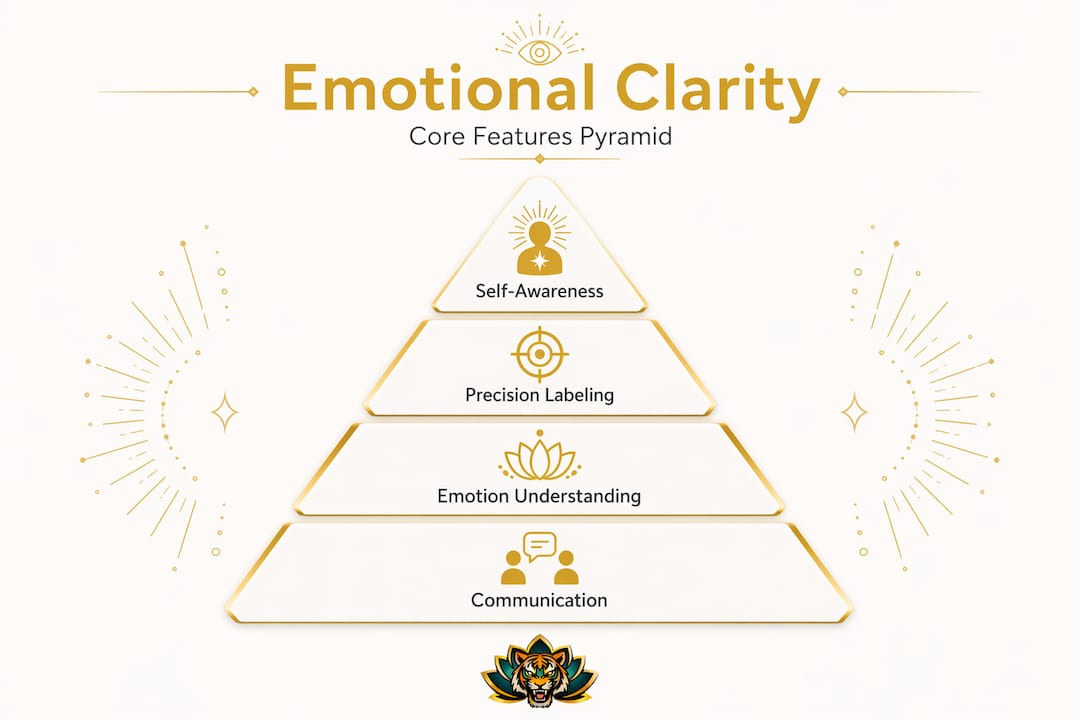
Emotional clarity is your ability to identify, name, and understand your emotions with precision. Not just "I feel bad" but "I feel ashamed because I said something I didn't mean, and I'm afraid of how it landed." That level of specificity is the difference between a vague inner signal and information you can actually use.
Psychologists connect this closely to the concept of emotional granularity, which describes how finely you can differentiate between emotional states. Someone with low granularity collapses many feelings into broad categories: upset, stressed, or fine. Someone with high granularity recognizes the difference between frustration and resentment, between loneliness and grief, between nervousness and dread. Research shows that higher emotional granularity is linked to a 15% reduction in the intensity of negative emotions during stressful periods.
Emotional clarity also sits at the core of emotional intelligence. Self-awareness, one of the five pillars of emotional intelligence, depends entirely on your ability to know what you are feeling and why. Without that foundation, the other skills, including empathy, self-regulation, and social navigation, have nothing to build on.
| Feature | Low emotional clarity | High emotional clarity |
|---|---|---|
| Emotion labeling | Vague ("I feel off") | Specific ("I feel disappointed") |
| Regulation | Reactive, impulsive | Measured, intentional |
| Decision-making | Driven by mood | Aligned with values |
| Relationships | Miscommunication is frequent | Needs expressed clearly |
The good news is that emotional clarity is a trainable skill improved through targeted mind-body practices. It is not something you are born with or without.
Why emotional clarity matters for your life
The benefits of emotional clarity show up in every area of life, and most people don't realize how much unclear emotions are costing them until they start doing the work.

Better emotion regulation is the most immediate payoff. When you can name what you are feeling, you interrupt the automatic chain from trigger to reaction. Labeling emotions engages the prefrontal cortex, the rational part of your brain, and reduces activity in the fear center. That's not a metaphor. It is a neurological shift that gives you a window of choice where there used to be only impulse.
Clarity also reshapes how you make decisions. When emotions are murky, you tend to make choices based on what relieves discomfort in the moment rather than what moves you toward what matters. With clarity, you can ask: Is this anxiety telling me something real, or is it a pattern from the past? That question alone can change the outcome of hundreds of decisions over a lifetime.
"Emotional clarity allows you to act from understanding rather than react from confusion. It transforms feelings from obstacles into information." — Rachel-m-harrison
The relational benefits are just as significant. When you understand your own emotional state, you can communicate your needs without blame, withdraw less during conflict, and repair misunderstandings faster. People around you feel the shift, even if they can't articulate why.
Research also links emotional clarity to reduced rumination and lower anxiety. When your feelings stay unnamed, your mind loops over them searching for meaning. Naming them stops the loop. Studies on emotion regulation confirm that problem-solving approaches outperform avoidance and self-blame in producing positive outcomes, and emotional clarity is what makes problem-solving possible in the first place.
Common barriers to emotional clarity
Understanding why emotional clarity matters is one thing. Developing it is another. Most people encounter real obstacles, and naming those obstacles is itself an act of clarity.
- Vague, undifferentiated distress. You know something is wrong but can't locate it. This is often the starting point. The feeling is real; the vocabulary just hasn't caught up yet.
- Broad emotional labeling. Collapsing everything into "I'm stressed" or "I'm fine" is a habit, not a character flaw. It usually forms because precise emotional language was never modeled or encouraged.
- Disconnection from the body. Your emotions live in your body before they ever reach your conscious mind. Tension in the jaw, a tight chest, a hollow stomach. When body awareness is low, these signals get missed entirely. Interoceptive sensibility is associated with better mood and emotional awareness, though building it takes deliberate practice.
- Learned emotional suppression. Many people, especially those who grew up in households where emotions were treated as problems, learned to override their feelings rather than read them. The suppression becomes automatic over time.
- Non-linear progress. People expect emotional clarity to develop in a straight line and give up when it doesn't. The development of emotional clarity is non-linear. Some weeks feel like breakthroughs; others feel like you are back at the beginning.
Pro Tip: When you notice vague distress, try asking: "Where do I feel this in my body?" before asking "What is this emotion?" The body often knows before the mind does.
Emotional confusion also drives maladaptive coping. Without clarity, avoidance, self-blame, and emotional numbing step in to manage the discomfort. Those strategies work short-term and cost considerably more long-term.
Practical emotional clarity techniques that work
Building emotional awareness and clarity does not require years of therapy before you see any results. Several well-researched methods create real progress in weeks.
-
Name it to tame it. Identify your emotion with as much specificity as possible. Instead of "upset," try to land on a more precise word: humiliated, overlooked, envious, relieved. Research on seven core emotions shows that each has distinct physiological and behavioral patterns, meaning even basic differentiation between anger, fear, sadness, and worry produces measurable shifts in how the brain processes them.
-
Practice interoceptive check-ins. Twice a day, pause and scan your body. Notice tension, heaviness, openness, or ease. Then ask what feeling might be underneath that sensation. This builds the body-to-emotion connection that emotional clarity depends on.
-
Use mindfulness meditation. Mindfulness creates space between stimulus and response, and it directly improves the brain-body connection that supports emotion regulation. Even ten minutes a day produces measurable changes in interoceptive awareness over time.
-
Try the 10-second diagnostic. When you feel emotionally blocked, a quick internal scan can identify which internal capability is currently offline. Are you unable to sense the feeling? Unable to name it? Unable to act on it? Pinpointing the breakdown point directs you toward the right response.
-
Journal with structure. Unstructured journaling can reinforce rumination. Structured prompts work better: "What did I feel today? Where did I feel it? What triggered it? What did I need in that moment?" This process builds the reflective habit that deepens emotional self-clarity over time.
-
Work with a trauma-informed professional. For persistent emotional fog, especially after loss, chronic stress, or trauma, professional guidance can accelerate what individual practice alone might take years to untangle.
Pro Tip: Pair your journaling with a feelings wheel, a visual reference of emotions organized by intensity and category. It expands your emotional vocabulary faster than trying to recall words under pressure.
| Technique | Best for | Time investment |
|---|---|---|
| Name it to tame it | Immediate regulation | Seconds to minutes |
| Interoceptive check-ins | Building body awareness | 5 minutes, twice daily |
| Mindfulness meditation | Long-term brain change | 10 to 20 minutes daily |
| Structured journaling | Deepening self-reflection | 15 minutes daily |
| 10-second diagnostic | Breaking emotional blocks | Under a minute |
Applying emotional clarity in daily life
Knowing the techniques is useful. Actually weaving them into your days is where transformation happens. Here is what that looks like in practice.
- Label before you respond. When conflict arises, name your emotion silently before saying anything. That pause is not weakness. It is information-gathering that protects both you and the other person.
- Check clarity before big decisions. Before committing to anything significant, ask yourself whether you are deciding from a grounded emotional state or from fear, people-pleasing, or urgency. Recognizing the difference is itself a form of emotional awareness that protects your long-term wellbeing.
- Use clarity to set limits. When you can name what you feel and why, setting a limit stops feeling like conflict and starts feeling like honesty. "I feel overwhelmed when I take on more than I've agreed to. I'm not able to add this right now" is only possible when you know what you are feeling.
- Practice compassion toward confusion. There will be days when you genuinely cannot identify what you are feeling. That is not regression. It is part of the process. Treat those moments as data, not failure.
- Support yourself through transitions. If you are moving through grief, a career change, a relationship ending, or a health challenge, emotional clarity becomes even more necessary and even more difficult. Seeking support during those periods is not weakness. It is strategy. You can explore signs of emotional clarity to understand where you are in that process.
Consistent effort over three to six weeks produces real shifts in how quickly and accurately you can label and respond to your emotions. The timeline is encouraging, but only if you actually put the work in.
My honest take on emotional clarity
What I have seen again and again, both personally and in working with women navigating serious life transitions, is that emotional clarity gets mistaken for emotional control. People come in wanting to stop feeling certain things. What they actually need is to understand what those things are telling them.
The shift from suppression to clarity is not comfortable. At first, naming your emotions precisely means sitting with them long enough to recognize them. That feels counterintuitive when the whole point of numbing was to avoid exactly that. But here is what I know to be true: you cannot regulate what you cannot see. And once you can see it, the grip it has on you loosens considerably.
I have also watched people give up too early because the progress felt slow or inconsistent. Emotional clarity develops like a muscle, not a light switch. The days when you feel like nothing is shifting are often the days the deepest work is happening underneath the surface.
The exercises that build this capacity do not have to be elaborate. They have to be honest and consistent. That is the whole practice.
— RachelMHarrison
Ready to build your emotional clarity
If this article resonated, you are already asking the right questions. Rachel-m-harrison offers one-on-one coaching sessions grounded in trauma-informed practice and the Sanctuary Symbolic Integration Method™, designed to help you identify your emotional patterns, stabilize your nervous system, and make decisions from a place of genuine self-knowledge.

Whether you are just starting out or have been on this path for a while, there is a space here for you. Browse the coaching guide to understand what working together looks like, or when you are ready to take the next step, book a session and begin the work of reclaiming your emotional clarity with real support behind you.
FAQ
What is emotional clarity in simple terms?
Emotional clarity is your ability to identify and name your emotions with precision rather than vague awareness. It means knowing not just that you feel "bad" but recognizing the specific feeling, such as grief, shame, or anxiety, and understanding what triggered it.
How long does it take to develop emotional clarity?
Progress in developing emotional clarity is non-linear, but consistent practice over three to six weeks typically produces measurable improvement in emotional labeling and a reduction in the intensity of emotional reactions.
Can emotional clarity improve my relationships?
Yes. When you understand your own emotional state, you can communicate your needs without blame and repair misunderstandings more quickly, which directly improves the quality of your relationships with others.
Why do I struggle to identify my emotions?
Difficulty identifying emotions often stems from low body awareness, broad emotional labeling habits, or learned suppression. These are common starting points, not permanent limitations. Techniques like body check-ins and structured journaling build this capacity over time.
Is emotional clarity the same as emotional intelligence?
They are closely related but not identical. Emotional clarity, specifically the ability to identify and label feelings precisely, is one of the foundational skills within emotional intelligence. Without it, the other components of emotional intelligence have a much weaker foundation to stand on.