TL;DR:
- Mindful boundary setting involves intentionally recognizing internal signals, assessing limits, and communicating them kindly to protect relationships and well-being. It differs from reactive boundaries by fostering present-moment awareness, resulting in more intentional and sustainable limit-setting. Practicing awareness, discernment, and clear expression helps build self-trust, reduce guilt, and create honest connections grounded in genuine self-knowledge.
Mindful boundary setting is the conscious practice of noticing your internal signals, identifying your limits, and expressing them clearly and compassionately to protect both your well-being and your relationships. Unlike reactive boundary setting driven by guilt or conflict avoidance, the mindful approach draws on psychological frameworks like Dialectical Behavior Therapy (DBT) and practical tools such as the DEAR MAN method to help you pause, assess, and respond with intention. Boundaries are not walls. They are relational communication that signals what you need to participate fully and honestly in any relationship. When you set limits from a grounded, aware place, you protect your energy without damaging connection.
What is mindful boundary setting and how does it differ from regular boundaries?
Mindful boundary setting is the intentional process of combining present-moment awareness with assertive communication to establish and maintain personal limits. The word "mindful" is doing real work here. It refers to the psychological practice of paying attention to your inner experience with curiosity and without immediate reaction, which is precisely what separates this approach from conventional boundary setting.

Traditional boundary setting is often reactive. You feel overwhelmed, resentful, or cornered, and then you either explode or shut down. Mindful boundary setting interrupts that cycle. It asks you to notice what you feel before you speak, decide what you actually need, and then communicate that need with clarity and respect.
Healthy boundary practices built on mindfulness replace resentment with honesty. They support genuine generosity because you are giving from a place of choice, not depletion. That distinction matters enormously for anyone who has spent years saying yes when they meant no.
The importance of boundary setting becomes clear when you recognize that boundaries signal to others how you expect to be treated and protect you from exhaustion when those limits are repeatedly crossed. Mindfulness simply makes that process more deliberate, more sustainable, and far less guilt-ridden.
How does mindfulness support setting healthy limits?
Mindfulness supports boundary setting by giving you the ability to observe your internal experience without being controlled by it. When you practice present-moment awareness, you catch the early signals: the tightness in your chest, the drop in your stomach, the flash of resentment before it becomes a full emotional reaction.
That pause is where everything changes. Mindfulness reduces overwhelm by helping you observe emotions and respond thoughtfully rather than react impulsively. This is not a soft skill. It is a neurological shift in how you process threat and discomfort.
Here are three practical mindfulness exercises that directly support boundary work:
- The 10-second pause. Before responding to a request that feels uncomfortable, take ten seconds to breathe and check in with your body. Ask: "Do I actually want to say yes, or am I reacting from obligation?"
- Body check-ins. Scan your body for tension, constriction, or fatigue when someone makes a demand. These physical signals are your nervous system's first report on whether a limit is being approached.
- Breath awareness. Three slow, deliberate breaths before a difficult conversation lower your cortisol response and help you access your prefrontal cortex, where clear, grounded communication lives.
Mindfulness also reduces the guilt that derails so many boundary attempts. When you practice self-compassion alongside awareness, saying no stops feeling like a moral failure and starts feeling like honest self-care.
Pro Tip: Before any conversation where you anticipate pushback, write down your boundary in one clear sentence. This anchors you when the emotional pressure rises.
What are the core stages of mindful boundary setting?
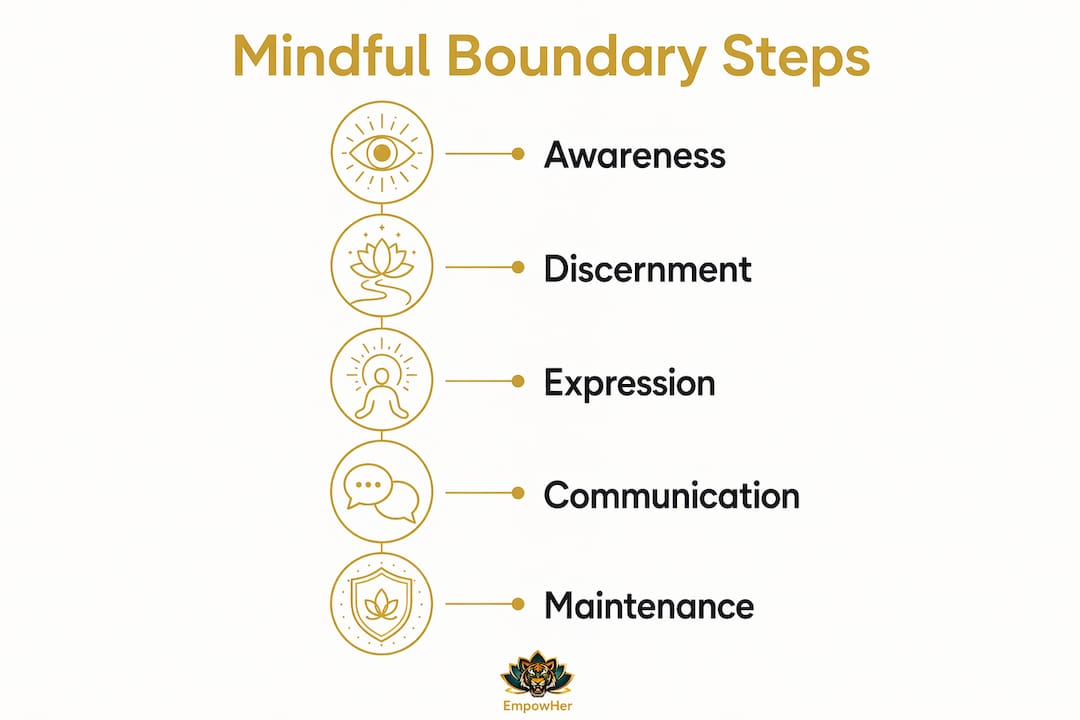
Mindful boundary setting follows three distinct stages: awareness, discernment, and expression. Skipping any stage is the most common reason boundaries fail or feel forced.
-
Awareness. This is the internal listening phase. You notice discomfort, resentment, fatigue, or a sense of being violated before you name it or act on it. Physical sensations are reliable data here. A clenched jaw, shallow breathing, or a feeling of dread when someone's name appears on your phone are all signals worth taking seriously.
-
Discernment. Once you notice the signal, you ask: what boundary do I actually need, and why? This stage separates your genuine needs from external expectations, people-pleasing patterns, or fear of conflict. You are not asking "what should I want?" You are asking "what do I actually need to feel safe and respected in this relationship?"
-
Expression. This is where you communicate your limit clearly, firmly, and kindly. The most effective boundary statements are clear, brief, and kind, naming what you need without attacking or over-explaining. "I can't take calls after 7 p.m." is more powerful than a five-minute justification that invites negotiation.
The reason people struggle is almost always stage-skipping. Jumping straight to expression without internal awareness means you often end up arguing from fear or obligation rather than from a grounded understanding of your own needs. The mindful method is to notice, decide, then deliver.
Pro Tip: Journal through all three stages before a high-stakes conversation. Write what you noticed, what you need, and the exact sentence you will use. This rehearsal builds confidence and reduces the chance of backing down under pressure.
Mindful vs. traditional boundary setting: what actually changes?
The contrast between mindful and traditional boundary setting is not just philosophical. It shows up in how you communicate, how you feel afterward, and whether the boundary actually holds.
| Aspect | Traditional boundary setting | Mindful boundary setting |
|---|---|---|
| Trigger | Reaction to conflict or overwhelm | Proactive awareness of internal signals |
| Communication style | Defensive, over-explained, or aggressive | Clear, brief, and grounded in "I" statements |
| Emotional state | Guilt, fear, or anger-driven | Calm, self-compassionate, and intentional |
| Flexibility | Rigid or easily collapsed under pressure | Firm but adaptable to context |
| Relationship outcome | Often creates distance or resentment | Builds trust and honest connection |
Psychologists view boundaries as necessary relationship shifts when needs are not being met, not as personal faults or punishments. That reframe is central to the mindful approach. When you stop treating a boundary as an attack and start treating it as honest communication, the entire dynamic changes.
The emotional clarity that comes from mindful boundary setting also makes the practice sustainable. Reactive boundaries exhaust you. Intentional ones restore you.
What practical tools help you set mindful limits effectively?
The most evidence-based tool for mindful boundary communication is DBT's DEAR MAN method, developed within Dialectical Behavior Therapy by Marsha Linehan. Each letter represents a step in assertive interpersonal communication.
- D (Describe): State the facts of the situation without judgment.
- E (Express): Share how you feel using "I" statements.
- A (Assert): Ask clearly for what you need or say no directly.
- R (Reinforce): Explain the positive outcome of respecting your boundary.
- M (Mindful): Stay focused on your goal and avoid getting pulled into side arguments or distractions.
- A (Appear confident): Use calm body language and a steady tone even if you feel nervous.
- N (Negotiate): Be willing to find a workable middle ground without abandoning your core need.
The Mindful step inside DEAR MAN is particularly powerful. It functions as an anchor. When someone gets defensive or tries to redirect the conversation, the Mindful step reminds you to return to your original request without escalating. Rehearsing DEAR MAN scripts before difficult conversations helps you stay calm and repeat your core boundary when faced with pushback.
The Cleveland Clinic recommends using clear, firm "I" statements to keep the focus on your needs and reduce defensiveness in the other person. "I need quiet time after work" lands very differently than "You always drain me." One opens a conversation. The other closes it.
Common pitfalls to avoid:
- Over-explaining. Long justifications invite negotiation and signal that you are not confident in your limit.
- Apologizing for the boundary itself. You can be kind without being sorry for having needs.
- Setting a boundary and then softening it immediately. Inconsistency teaches others that your limits are optional.
- Waiting until you are furious. Boundaries set in anger rarely communicate what you actually need.
Pro Tip: Practice saying no to low-stakes requests first. Declining a social invitation you genuinely do not want to attend is excellent training for the harder conversations ahead.
How to apply mindful limits to grow personally and improve relationships
Mindful boundary setting is not a one-time act. It is an ongoing practice that evolves as you do. The signs that you need to set or reset a boundary are often subtle: chronic fatigue around a specific person, resentment that builds without a clear cause, or a pattern of emotional detachment as a self-protection strategy.
Examples of mindful limits in real relationships include:
- Family: "I love you and I am not available to discuss my relationship choices. I am happy to talk about other things."
- Work: "I do not respond to messages after 6 p.m. I will get back to you first thing tomorrow."
- Friendships: "I need to step back from conversations that consistently leave me feeling worse. I care about you and I need this for my own health."
Each of these examples follows the same structure: a clear statement of the limit, delivered without hostility or excessive explanation. They also reflect the understanding that boundaries replace resentment with honesty and support sustainable, genuine connection rather than obligatory giving.
Maintaining limits with self-compassion means accepting that you will not always get it right. You will sometimes over-explain, back down, or set a boundary too late. That is not failure. It is practice. The goal is not perfection. It is a growing capacity to notice, decide, and speak from a grounded place. Exploring emotional dependency patterns in your relationships can also reveal where your boundaries have historically been most porous and why.
Boundaries are also an act of self-care, not selfishness. When you protect your energy, you show up more fully for the people and work that matter most to you.
Key takeaways
Mindful boundary setting works because it sequences awareness, discernment, and expression in that order, ensuring every limit you communicate comes from genuine self-knowledge rather than fear or obligation.
| Point | Details |
|---|---|
| Three-stage sequence | Awareness, discernment, and expression must happen in order for boundaries to hold. |
| Mindfulness as a pause | A 10-second pause or body check-in before responding prevents reactive, guilt-driven communication. |
| DEAR MAN method | DBT's structured script keeps you focused on your boundary goal even when others get defensive. |
| "I" statements reduce conflict | Clear, brief "I" statements communicate needs without triggering defensiveness in others. |
| Boundaries are ongoing practice | Limits evolve with your relationships and require consistent, self-compassionate reinforcement. |
What I have learned from working with women on this practice
The most common thing I hear from women beginning this work is: "I know I need boundaries, but I feel like a terrible person every time I try to set one." That guilt is not a character flaw. It is a trained response, often rooted in early experiences where expressing needs was unsafe or unwelcome.
What I have found, working within the Sanctuary Symbolic Integration Method™, is that the guilt usually peaks right before the boundary lands. It is the nervous system's last attempt to pull you back into familiar patterns. When you learn to recognize that spike as a signal of growth rather than evidence of wrongdoing, everything shifts.
I have also noticed that women who skip the discernment stage tend to set boundaries that are either too rigid or too easily collapsed. They go from zero to a hard wall because they have not taken the time to ask what they actually need. The middle ground, a clear and flexible limit rooted in genuine self-knowledge, only becomes available when you slow down enough to listen inward first.
Mindful boundary setting is not about becoming someone who says no to everything. It is about becoming someone who says yes with full presence and no with full dignity. That is a profound shift in self-leadership, and it changes every relationship you are in.
— RachelMHarrison
Ready to build boundaries that actually hold?
If you recognize yourself in this article, whether you are exhausted from over-giving, stuck in guilt every time you try to say no, or simply ready to communicate your needs with more clarity and confidence, trauma-informed coaching can help you move from understanding to embodied practice.
At Rachel-m-harrison, the work goes deeper than scripts and strategies. Using the Sanctuary Symbolic Integration Method™, coaching sessions help you identify the emotional patterns underneath your boundary struggles, stabilize your nervous system, and build the self-trust that makes clear communication feel natural rather than terrifying. If you are wondering whether coaching or therapy is the right fit for where you are right now, the coach vs. therapist guide breaks it down honestly. You can also explore the full range of coaching offerings to find the support that fits your life.
FAQ
What is mindful boundary setting in simple terms?
Mindful boundary setting is the practice of noticing your internal signals, deciding what limit you need, and communicating it clearly and kindly. It combines present-moment awareness with assertive communication to protect your well-being without damaging your relationships.
Why set boundaries mindfully instead of just saying no?
Saying no without internal awareness often comes from fear or obligation rather than genuine self-knowledge. The mindful approach sequences awareness and discernment before expression, which makes boundaries more grounded, consistent, and sustainable over time.
What are some examples of mindful limits in everyday life?
Examples include telling a family member you are not available to discuss certain topics, setting a firm end time for work communications, or letting a friend know that certain conversations affect your mental health. Each example states the limit clearly without over-explaining or apologizing.
How does DBT's DEAR MAN method support boundary communication?
DEAR MAN is a structured DBT skill that guides you through describing a situation, expressing your feelings, asserting your need, and staying mindfully focused on your goal even when the other person gets defensive. It is one of the most practical tools available for setting limits in high-pressure conversations.
How do you maintain a boundary without guilt?
Guilt often peaks right as you set a limit, which many people misread as a sign they are doing something wrong. Practicing self-compassion, keeping your boundary statement brief, and avoiding over-justification all reduce guilt over time. Consistency is the most powerful antidote: the more you hold your limits, the more natural they feel.