TL;DR:
- The Sanctuary Symbolic Integration Method combines trauma-informed safety principles with embodied symbolic practices to foster emotional healing. It emphasizes creating a safe environment first, then installing meaningful symbols that activate the nervous system for real-time regulation. Practicing this approach requires intentional grounding, somatic verification, and working with trained practitioners for deeper transformation.
If you've come across the term "what is the sanctuary symbolic integration method" and felt more confused than enlightened, you're not alone. The phrase draws from two distinct but complementary worlds: the structured, trauma-informed Sanctuary Model developed in clinical settings, and the emerging somatic-symbolic practices used in psychotherapy and personal development. Each has its own language, purpose, and depth. This article cuts through the overlap, defines each approach clearly, and shows you exactly how both can serve your emotional healing and self-awareness.
Table of Contents
- Key takeaways
- What is the Sanctuary Symbolic Integration Method?
- Foundations of the Sanctuary Model in trauma-informed care
- Symbolic integration as an embodied healing practice
- Comparing the two frameworks side by side
- Practical applications for personal healing
- Pitfalls to avoid and what to look for in a practitioner
- My perspective: what actually works in healing practice
- How Rachel M. Harrison supports your healing journey
- FAQ
Key takeaways
| Point | Details |
|---|---|
| Two distinct frameworks | The Sanctuary Model (trauma-informed care) and symbolic integration (somatic therapy) are related but not interchangeable. |
| SELF framework as a guide | Safety, Emotion, Loss, and Future provide a structured lens for personal reflection and healing planning. |
| Symbols as tools, not metaphors | Symbolic integration installs symbols as active emotional regulators, confirmed through somatic markers. |
| Practical personal application | You can apply both frameworks in self-led practices and professional coaching without clinical credentials. |
| Terminology matters | Vague "sanctuary" language in self-help can signal a lack of measurable structure. Look for defined commitments. |
What is the Sanctuary Symbolic Integration Method?
The term itself points to a rich intersection of ideas. At its core, the Sanctuary Symbolic Integration Method describes a trauma-informed approach that combines environmental and relational safety principles with the use of symbols as living, embodied tools for healing. Understanding it fully requires knowing both halves of the phrase.
The word "sanctuary" carries significant weight. Sanctuary ranges from ethical safe haven to a structured trauma care model, and this ambiguity is part of why the term trips people up. In the clinical world, Sanctuary refers specifically to a framework built around protecting emotional, physical, social, and moral safety. In personal development spaces, the word is often used more loosely, sometimes to mean a quiet inner space, a retreat, or a healing environment. Both uses are valid. Neither is complete on its own.
"Symbolic integration" adds another layer entirely. In psychotherapy, it refers to the practice of embedding symbols into the nervous system as functional tools, not simply understanding what a symbol means intellectually. The combination of these two concepts produces a framework where safety and symbolic healing work together to support trauma recovery, emotional regulation, and identity repair.
Foundations of the Sanctuary Model in trauma-informed care
The Sanctuary Model was developed by Dr. Sandra Bloom in the 1980s as a response to the pervasive but underrecognized impact of trauma on individuals, families, and organizations. Rather than focusing solely on individual pathology, the model treats the environment itself as a vehicle for healing.
The backbone of the Sanctuary Model is the SELF framework. SELF guides reflective practice across four key domains:
- Safety: Physical, emotional, social, and moral safety form the non-negotiable foundation.
- Emotion: Recognizing and managing emotional responses with intelligence and compassion.
- Loss: Acknowledging grief and change as part of recovery, rather than bypassing them.
- Future: Building hope, purpose, and forward orientation even within pain.
These four pillars structure conversations, care planning, and supervision in any setting that applies the model, whether that's a residential facility, a school, or a personal coaching relationship.
The model also rests on eight core commitments: Non-Violence, Emotional Intelligence, Social Responsibility, and Cultural Humility, along with Democracy, Open Communication, Growth and Change, and Shared Governance. These commitments shape how people interact and make decisions. They create a culture, not just a protocol.
Organizations using SELF language develop consistent, trauma-sensitive responses that replace punitive or exclusionary practices with empathy and trust. In the Australian adaptation, this framework includes 29 standards that operationalize safety across emotional, cultural, and physical dimensions.
Pro Tip: If you want to apply the Sanctuary Model to your own life, try using SELF as a weekly reflection tool. Ask yourself: "Where do I feel safe this week? What emotions need attention? What have I lost or am still grieving? What future am I actively building?"
Symbolic integration as an embodied healing practice
Symbolic integration in psychotherapy is something genuinely different from what most people expect. It is not about analyzing what a dream symbol might mean, or journaling about what a particular image represents to you. It is about making a symbol functionally active in your body and nervous system.
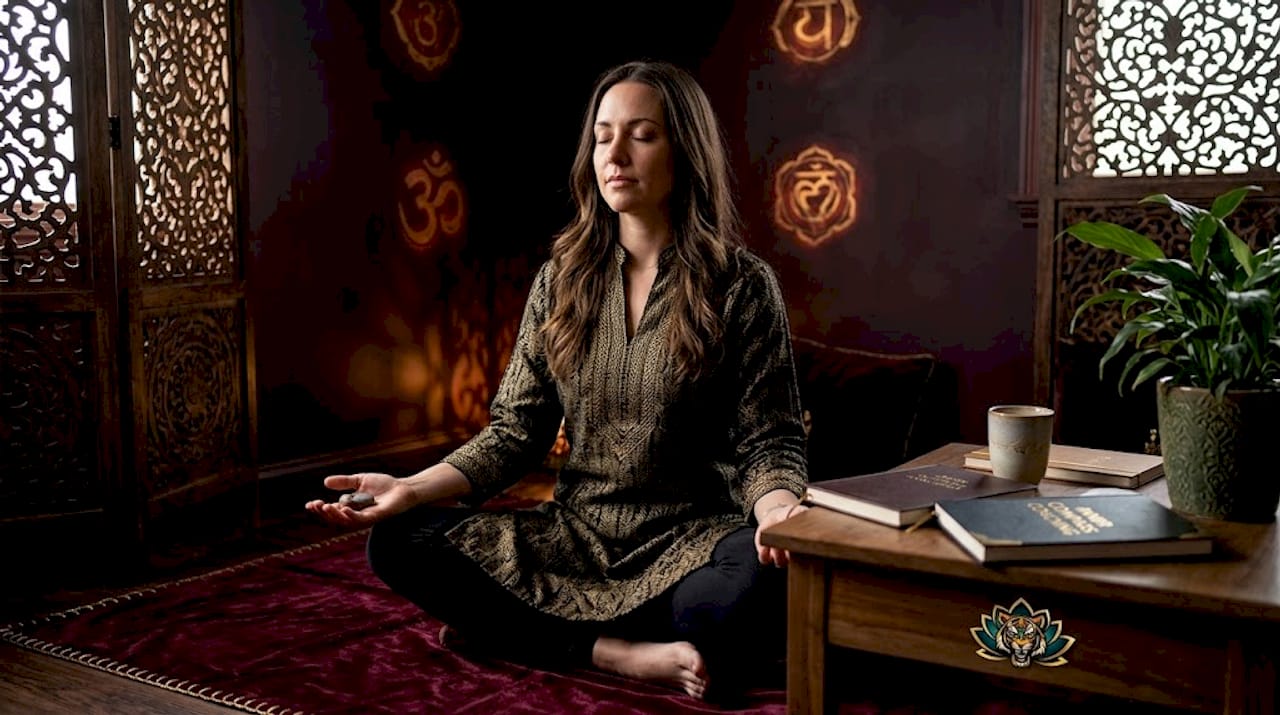
Research describes this as symbol installation, where symbols become somatically anchored tools for emotional regulation and identity repair rather than interpreted metaphors. The difference matters more than it might sound.
When you interpret a symbol, you gain cognitive insight. When you install one, you gain an emotional technology you can access under stress, in real time, without having to think your way through it. The symbol reroutes affect and restores narrative coherence at the level of the body, not just the mind.
"The symbol does the work. When properly installed, it functions as an operator: a ritualized enactment that shifts internal state before the thinking mind has time to intervene." — Symbolic intervention and emotional recursion in therapy
Key concepts in symbolic integration include:
- Operators: Symbolic roles or objects that the person enacts or embodies rather than observes.
- Recursion: The symbol is returned to repeatedly, deepening its emotional effect over time.
- Functional activation: The symbol must be triggered and active, not just remembered.
- Somatic verification: Activation is confirmed by somatic markers such as breath shifts, posture changes, or physical settling.
This last point is critical. If you use a symbol and nothing shifts in your body, the installation hasn't occurred. You are still in the cognitive layer. Effective symbolic integration requires the body to register the change.
Pro Tip: Try pairing a meaningful object or image with a slow exhale and a grounded posture. Repeat this pairing over several days. You are beginning to install the symbol as a regulation tool, not just admire its meaning.
Comparing the two frameworks side by side
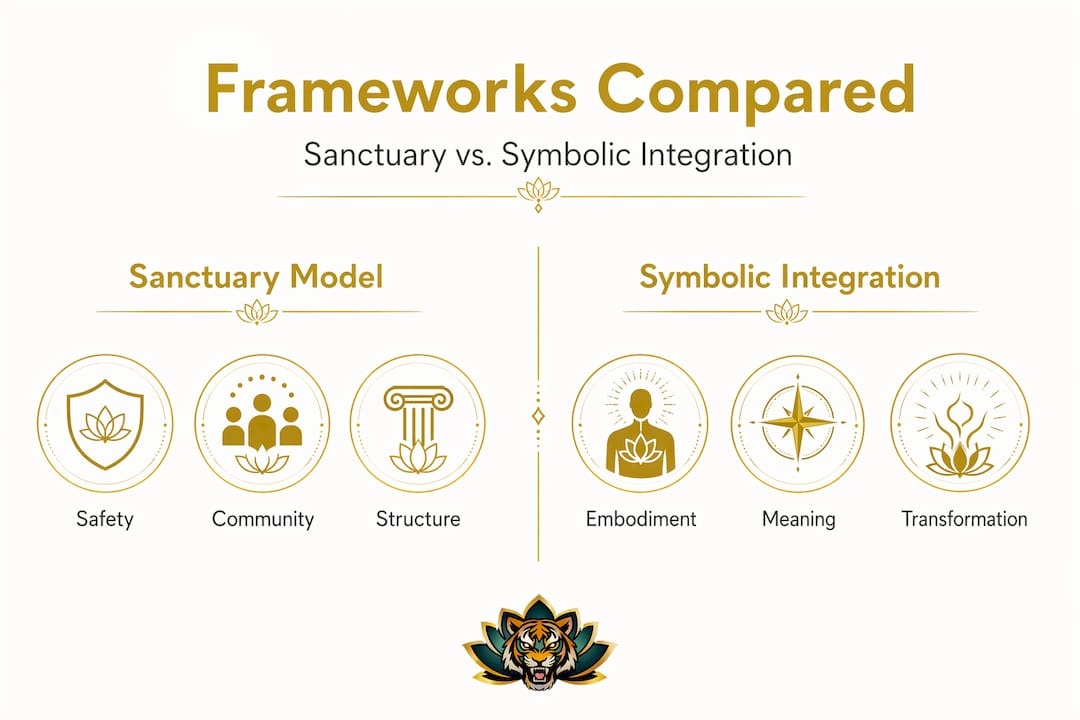
Both the Sanctuary Model and symbolic integration methods aim to support trauma healing and emotional safety. But their focus, structure, and methods are quite different.
| Component | Sanctuary Model | Symbolic Integration |
|---|---|---|
| Primary focus | Environmental and relational safety | Individual somatic and emotional regulation |
| Core tool | SELF framework and 8 commitments | Ritualized symbol enactment and somatic verification |
| Setting | Organizations, communities, therapeutic environments | Individual therapy, personal practice, coaching |
| Goal | Cultural and moral safety for groups and individuals | Emotional pattern repair, identity coherence, nervous system regulation |
| Entry point | Shared language and relational commitments | Embodied ritual and symbol activation |
Where these two frameworks converge is exactly where the Sanctuary Symbolic Integration Method lives. It uses the structural safety and values of the Sanctuary Model as the container, and symbolic installation as the active healing mechanism within that container. Safety creates the conditions. Symbols do the repair work.
Somatic-symbolic installation fills a vital gap that purely cognitive approaches leave open. Understanding your trauma is not the same as regulating it. Having insight is not the same as having access to your nervous system when you are overwhelmed. This is why the integration of both frameworks is more powerful than either alone.
Practical applications for personal healing
Applying these methods in your own life does not require a clinical setting. What it does require is intentionality, structure, and some willingness to work at the body level rather than just the thinking level.
Here is a practical sequence you can use right now:
-
Establish your inner sanctuary. Using the Sanctuary Model's Safety pillar, identify at least one physical space, relationship, or daily practice where you genuinely feel safe. This is your anchor. Without this, symbolic work has nowhere to land.
-
Name your emotional landscape. Use the Emotion pillar from SELF to track what you're actually feeling each day without judgment. A simple three-word check-in morning and evening builds emotional fluency over time.
-
Choose a symbol that holds meaning for you. It might be an image, an object, a word, or a gesture. Symbolic integration principles suggest the symbol should resonate at a felt, intuitive level rather than a purely logical one.
-
Install the symbol through repetition and somatic grounding. Pair your symbol with a slow breath, a grounded physical posture, and a clear intention. Repeat daily. The goal is that over time, contact with the symbol produces a physical settling response.
-
Map your healing through the SELF lens. Periodically check your progress using all four SELF pillars: safety, emotion, loss, and future. This keeps your process structured and prevents the vague, circular loops that often stall self-led healing.
-
Seek guidance for deeper work. For trauma with significant activation or complexity, working with a trained practitioner in trauma-informed or symbolic integration methods makes the process safer and more effective. You can explore what nervous system support looks like within a structured coaching context.
Pro Tip: The biggest mistake in self-led symbolic work is skipping somatic verification. After working with your symbol, pause and scan your body. If nothing has shifted physically, try again with more grounding before moving forward.
Pitfalls to avoid and what to look for in a practitioner
As interest in trauma-informed healing grows, the word "sanctuary" appears more and more in personal development content, often without the structural backing the term deserves.
Here is what to watch for:
- Vague sanctuary language. Personal-development uses of "sanctuary" often lack explicit commitments or measurable safety standards. If a framework claims sanctuary values but cannot describe what those look like in practice, treat that as a signal to ask more questions.
- Symbol work without somatic grounding. Symbolic interpretation alone, without body-level verification, stays in the cognitive layer. This has value, but it is not symbolic integration.
- Trauma work without safety infrastructure. Engaging with trauma content before establishing relational and environmental safety can increase dysregulation rather than reduce it. The Sanctuary Model's emphasis on safety-first is not optional.
- Unlicensed claims of clinical practice. Coaching and therapeutic facilitation are distinct. Look for practitioners who are transparent about their training, their scope, and the evidence base behind their methods.
When you find a practitioner or program that can clearly define their approach, name their safety structures, and explain how they verify change at the body level, that is a strong signal you are in good hands.
My perspective: what actually works in healing practice
I've worked closely with frameworks that carry the Sanctuary name, and I'll tell you honestly: the word alone solves nothing. What makes these methods genuinely transformative is when safety is built structurally, not just promised rhetorically, and when symbolic work reaches the body instead of staying in the mind.
The thing most people miss is that healing is not primarily a cognitive event. You can understand your patterns in extraordinary detail and still feel emotionally hijacked in the same old situations. What changes things is when your nervous system learns something new through repeated, embodied experience. Symbols, when installed properly, give the nervous system a new route to take.
What I find most powerful in combining the Sanctuary Model with symbolic integration is the sequencing. Safety first. Then emotion. Then symbolic work within that container. Trying to install symbols in an unsafe environment is like planting seeds in concrete. The environment must be prepared.
I've also seen how quickly "sanctuary" becomes marketing language without real teeth behind it. If a method cannot tell you what safety actually looks like in practice, what you will do when you feel dysregulated, and how you will know when something has changed in your body, it is not yet a method. It is an aspiration. Aspiration has its place. But when you are healing, you need a map.
— RachelMHarrison
How Rachel M. Harrison supports your healing journey
At rachel-m-harrison.com, the Sanctuary Symbolic Integration Method™ is not a borrowed phrase. It is a living framework built into every layer of the coaching work offered to women, creatives, and leaders who are ready to rebuild emotional clarity and self-trust.
The approach combines trauma-informed safety structures with somatic-symbolic practices that help you understand your emotional patterns, regulate your nervous system, and move from insight into embodied change. Whether you are new to this work or deepening a practice you have already begun, the coaching services at Rachel M. Harrison are designed to meet you where you are. You can also book a session directly to explore what working together looks like, or visit the start here page if you are just beginning to find your footing.
FAQ
What is the Sanctuary Model in trauma-informed care?
The Sanctuary Model is a trauma-informed framework developed by Dr. Sandra Bloom in the 1980s that uses the SELF framework and eight core commitments to create emotionally and culturally safe environments for healing.
How does symbolic integration differ from symbolic interpretation?
Symbolic integration installs symbols as embodied tools that shift emotional state in real time, while symbolic interpretation is a cognitive process of understanding what a symbol means. Integration requires somatic verification. Interpretation does not.
Can I practice Sanctuary Symbolic Integration methods on my own?
Yes, to a meaningful degree. You can use the SELF framework for personal reflection and begin symbol installation through grounded, repetitive practice. For trauma with significant activation, working with a trained practitioner produces safer and deeper results.
How do I know if a symbol has been successfully installed?
Somatic markers such as breath shifts and physical settling confirm that a symbol has been activated beyond the cognitive layer. If your body does not register a change, the installation process is still in progress.
What should I look for in a trauma-informed symbolic integration practitioner?
Look for someone who can clearly define their safety structures, explain how they verify somatic change, and is transparent about their training and scope of practice. Practitioners who cannot name measurable safety standards are offering aspiration, not a method.