TL;DR:
- Self-trust involves relying on one’s judgment and learning from outcomes without external permission. Restoring it requires nervous system regulation through small, consistent micro-promises and trauma-informed practices. Building genuine self-trust strengthens decision-making, reduces anxiety, and establishes internal safety over time.
Self-trust is the ability to rely on your own judgment, act on your own decisions, and learn from outcomes without needing external permission. When that internal reliability breaks down, every choice feels harder than it should. Reclaiming self-trust, what psychologists also call internal locus of control, is not a motivation challenge. It is a nervous system regulation process. This article explains why that distinction matters, what actually erodes self-trust, and which evidence-based practices restore it. You will find concrete tools here, including micro-promises, weekly self-trust reviews, and trauma-informed reframes that work even when self-doubt feels permanent.
Why reclaim self-trust before anything else changes
Self-trust is the foundation every other personal skill rests on. Without it, better habits, clearer goals, and stronger boundaries all collapse under the weight of second-guessing. The importance of self-trust shows up in the smallest moments: choosing a meal, sending an email, setting a limit with someone you love. When you cannot trust your own read on those moments, decision fatigue sets in fast.

The brain tracks behavioral evidence, not intentions. Reliable follow-through is what the nervous system uses to decide whether you are safe to lead yourself. That means every time you override your own instinct or outsource a decision to someone else, you are quietly teaching your brain that your voice does not count. Over time, that pattern becomes identity.
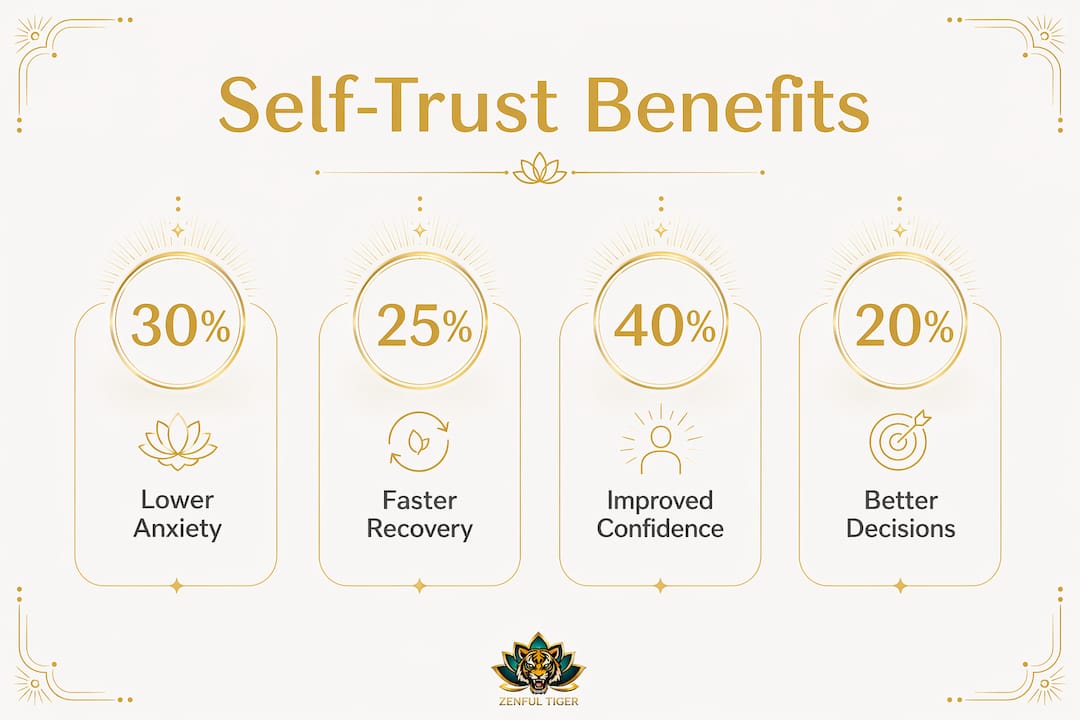
The benefits of trusting yourself extend well beyond confidence. Research links strong self-trust to lower anxiety, faster decision-making, and a reduced need for external validation. These are not soft outcomes. They are measurable shifts in how you move through daily life.
What causes self-trust to collapse?
Self-trust erodes through a combination of chronic stress, trauma, and the ordinary grind of modern decision-making. Understanding the causes removes the shame from the experience.
The most common drivers include:
- Chronic stress and trauma. Prolonged stress activates survival responses in the nervous system. When the body is in a threat state, the brain prioritizes speed over accuracy, which means gut instincts get overridden by fear. Self-doubt after trauma is not weakness. It is the nervous system doing exactly what it was designed to do.
- Analysis paralysis and decision fatigue. Neural pathways for decision-making exhaust under pressure, leading to over-research, circular thinking, and eventually outsourcing choices to others. Each outsourced decision weakens self-reliance a little more.
- Seeking external validation. Constantly checking with others before acting signals to the brain that your own voice is less valid. The 24-Hour Solitude Rule, a practice of delaying external input on big decisions by one full day, directly addresses this pattern.
- Perfectionism. Holding every decision to an impossible standard means most choices feel wrong before you even make them. This creates a loop where inaction feels safer than action.
- Accumulated broken self-promises. Telling yourself you will do something and then not doing it is not a character flaw. It is data. But without repair, those small breaks stack up into a belief that you cannot be counted on, even by yourself.
Recognizing these patterns is the first step. Fighting them is not. The goal is to understand what affected your self-trust so you can address it at the root.
How to rebuild self-trust through micro-promises
The most effective way to rebuild self-trust is through small, consistent commitments, not grand gestures. This approach is grounded in how the nervous system actually processes reliability.
- Start with micro-promises. A micro-promise is a commitment so small it is almost impossible to break. Examples include drinking a glass of water before checking your phone, writing three sentences in a journal, or pausing for one breath before responding to a stressful message. Completing 100% of small commitments sends a safety signal to the brain. That signal accumulates into trust.
- Regulate your nervous system first. You cannot build self-trust from a dysregulated state. Practices like box breathing, grounding exercises, or even a short walk before a difficult decision create the physiological conditions for clearer judgment. The Sanctuary Symbolic Integration Method™ used at Rachel-m-harrison specifically addresses nervous system stabilization as a prerequisite for self-leadership work.
- Repair, do not punish. When you break a micro-promise, the response that matters is repair, not self-criticism. Acknowledge what happened, understand why, and make a smaller version of the same commitment. Perfectionism kills momentum. Repair builds it.
- Reduce decision volume. Decision fatigue from modern life worsens self-trust loss. Simplify recurring choices wherever possible. Fewer low-stakes decisions means more cognitive energy for the ones that matter.
- Track behavior, not feelings. Your feelings about how you are doing are unreliable when self-trust is low. Write down what you actually did each day, not what you intended to do. That behavioral record becomes the evidence your brain needs.
Pro Tip: Start with one micro-promise per day for two weeks before adding more. Consistency across a narrow commitment beats inconsistency across many.
What does a self-trust review actually look like?
A self-trust review is a structured, shame-free audit of your actions versus your intentions. It is a maintenance practice, not a crisis tool. The goal is data, not judgment.
Here is a simple 15-minute weekly format:
| Review prompt | What to look for |
|---|---|
| What did I commit to this week? | List specific promises made to yourself |
| What did I follow through on? | Note completions without minimizing them |
| Where did I override my instinct? | Identify moments of external outsourcing |
| What would I do differently? | One small adjustment, not a full overhaul |
Viewing outcomes as experiments rather than character tests is what makes this practice sustainable. When you treat a missed commitment as data rather than proof of failure, your brain stops avoiding the review process. Avoidance is what keeps self-trust stuck.
Monthly reviews follow the same structure but zoom out. Look for patterns across four weeks. Are you consistently overriding your instincts in one area of life? Are your micro-promises getting easier? That upward trend is evidence of progress, even when it does not feel dramatic.
Consistent reflection practices are what shift self-trust from effortful to natural. The review is not about being hard on yourself. It is about being honest with yourself, which is a different thing entirely.
Pro Tip: Do your weekly review at the same time each week. Consistency in the review itself is a micro-promise that reinforces the habit.
How a trauma-informed perspective changes everything
Self-doubt is not a personal failure. It is a protective nervous system response, and treating it like a flaw makes it worse. This reframe is central to trauma-informed approaches to rebuilding self-trust.
Key shifts that a trauma-informed lens provides:
- Doubt is protective, not defective. Acknowledging protective hesitation helps healing. Fighting self-doubt as if it were an enemy activates more threat responses. Naming it as a protective pattern allows the nervous system to soften.
- Compassionate internal dialogue replaces self-criticism. The voice you use toward yourself when you make a mistake directly affects your ability to try again. Harsh self-talk narrows thinking. Compassionate self-talk opens it.
- Boundaries are acts of self-trust. Setting achievable boundaries signals internal safety to the nervous system. Every time you honor a limit you set, you prove to yourself that your needs are worth protecting. That proof accumulates.
- Healing is not linear. Trauma-informed work at Rachel-m-harrison recognizes that progress in rebuilding self-trust looks like two steps forward and one step back. That is not failure. That is the actual shape of nervous system healing.
The goal is not to eliminate self-doubt. The goal is to stop letting it make all your decisions. When you can hear doubt, acknowledge it, and still act from your own values, that is self-trust in practice.
Key Takeaways
Rebuilding self-trust is a nervous system process driven by consistent small actions, compassionate reflection, and trauma-informed understanding, not willpower or motivation.
| Point | Details |
|---|---|
| Self-trust is physiological | The brain tracks behavioral evidence, not intentions, so consistent follow-through is the mechanism of change. |
| Micro-promises rebuild reliability | Small, completable commitments signal safety to the nervous system and accumulate into genuine trust. |
| Reviews must be shame-free | Treating self-trust audits as neutral data gathering prevents avoidance and supports steady progress. |
| Doubt is protective, not defective | Acknowledging self-doubt as a nervous system response, rather than fighting it, accelerates healing. |
| Boundaries reinforce self-trust | Every honored boundary proves to your nervous system that your needs are valid and worth protecting. |
The part most people skip
Most articles on how to build self-trust focus on mindset. They tell you to believe in yourself, stop overthinking, and take bold action. That advice is not wrong. It is just incomplete.
What I have seen consistently, both in my own experience and in working with women through Rachel-m-harrison, is that self-trust does not collapse because of weak thinking. It collapses because the nervous system learned that the world was not safe enough to trust your own read on it. That is a physiological pattern, not a character flaw. And it requires a physiological response, not just a cognitive one.
The women who make the most lasting progress are not the ones who push hardest. They are the ones who get honest about where they are, start with something genuinely small, and repair without drama when they miss. They treat themselves the way a good coach would: with clear expectations and real compassion.
The other thing I want to name directly: waiting until you feel ready is a trap. Self-trust identity shifts happen through action, not through preparation. You do not think your way into trusting yourself. You act your way there, one kept promise at a time.
If you are in a season of deep self-doubt, please know this: the doubt is not evidence that you cannot be trusted. It is evidence that something happened that made trust feel dangerous. That is a very different story, and it has a very different ending.
— RachelMHarrison
Ready to rebuild self-trust with real support?
Reading about self-trust is a start. Working through it with a trauma-informed framework is where lasting change happens.

Rachel-m-harrison offers one-on-one trauma-informed coaching sessions designed specifically for women navigating self-doubt, emotional instability, and the slow work of reclaiming inner authority. The approach is grounded in nervous system regulation and the Sanctuary Symbolic Integration Method™, which means you are not just learning new habits. You are rebuilding the internal foundation those habits need to hold. If you are ready to understand what this work looks like in practice, the next step is one click away.
FAQ
What is self-trust and why does it matter?
Self-trust is the ability to rely on your own judgment and follow through on your own commitments consistently. It matters because without it, decision-making becomes exhausting and every choice requires external validation to feel safe.
How do micro-promises help rebuild self-trust?
Micro-promises are small, completable commitments that signal reliability to the nervous system. Completing 100% of these small actions builds the behavioral evidence the brain needs to recognize you as trustworthy.
Why does trauma cause self-trust to break down?
Trauma activates survival responses that override internal instincts in favor of threat detection. Self-doubt after trauma is a protective nervous system pattern, not a personal failure, and healing it requires compassionate acknowledgment rather than resistance.
How often should I do a self-trust review?
A 15-minute weekly review is the most effective starting point. Viewing outcomes as experiments rather than moral tests keeps the process sustainable and prevents the avoidance that shame-based reflection creates.
What is the difference between self-trust and self-confidence?
Self-confidence is belief in your ability to perform a specific task. Self-trust is the deeper belief that your judgment, instincts, and decisions are reliable across all areas of life, regardless of outcome.