TL;DR:
- Reflective practice involves deliberately examining thoughts, emotions, and actions to foster personal growth and learning. Frameworks like the 5R and 5 C's guide deeper reflection, moving beyond surface-level descriptions to meaningful insights. Consistent, honest reflection enhances emotional clarity, self-awareness, and adaptive decision-making.
Reflective practice is the deliberate process of examining your thoughts, emotions, and actions to learn from experience and create meaningful personal change. Most people review their days passively, replaying events without drawing conclusions. Reflective practice breaks that cycle. It is the difference between having an experience and actually learning from one. Frameworks like the 5R framework and Donald Schön's reflection models, along with cognitive psychology research, confirm that structured reflection integrates theory with practice and promotes continuous adaptation far beyond automatic reactions.
Why reflective practice is important for learning and growth
Reflection transforms raw experience into transferable knowledge. When you simply live through an event, your brain stores it as an episode, a memory with a beginning and end. When you reflect on that event deliberately, you restructure it into conceptual understanding with causal relationships. You stop asking "what happened?" and start asking "why did it happen, and what does that mean for next time?"

The cognitive mechanism behind this is well documented. Reflection after tasks leads to development of transferable knowledge by turning experience into structured, conceptual understanding. That shift matters because conceptual knowledge generalizes. An episode stays locked to one moment; a concept travels with you into every future decision.
Reflection also activates error detection. When you examine what went wrong or what surprised you, you update your mental models. Error correction through reflection shifts learning from rote memorization to adaptive expertise. That is the difference between someone who has ten years of experience and someone who has repeated one year of experience ten times.
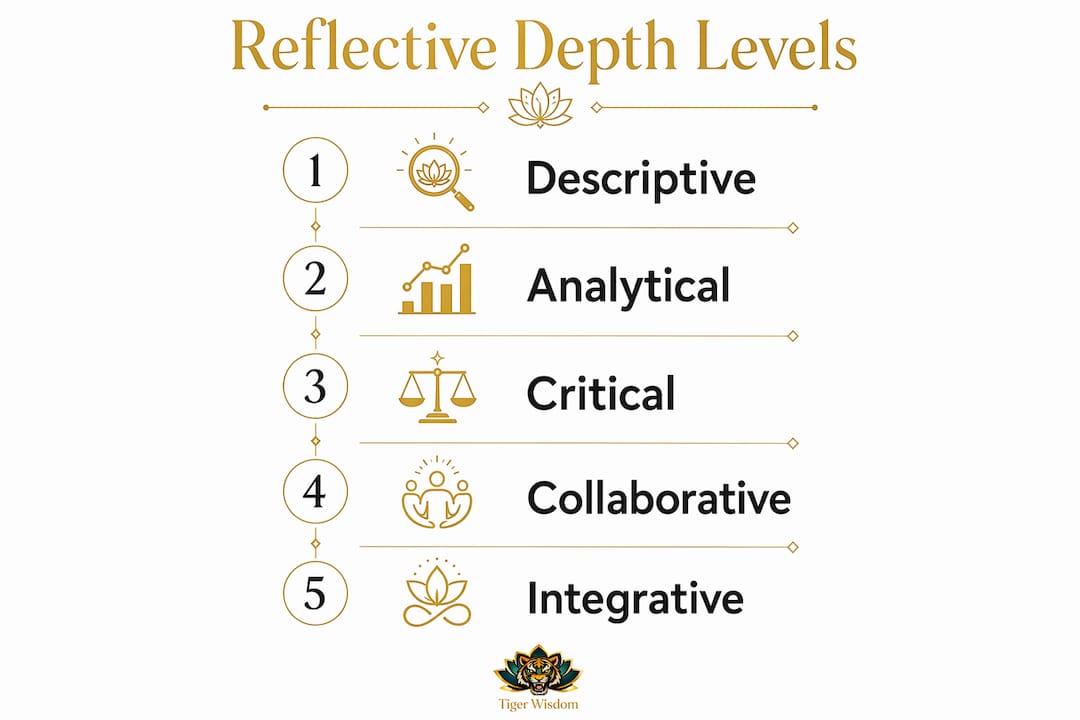
Three levels of reflective depth
Not all reflection produces the same result. Depth matters.
- Descriptive reflection: You describe what happened without analysis. This is the starting point, not the destination.
- Critical reflection: You examine your assumptions, biases, and the wider context shaping your choices. This is where real learning begins.
- Evidence-informed reflection: You bring in external knowledge, feedback, or research to test your conclusions. This level produces the most durable change.
Reflection is multilevel and benefits from collaboration, evidence integration, and critical inquiry to deepen personal learning. Moving from descriptive to evidence-informed reflection is not automatic. It requires deliberate practice and, often, a structured framework to guide you.
Pro Tip: After any significant event, write three sentences: what happened, what assumption you held going in, and whether that assumption proved accurate. This three-sentence habit moves you from descriptive to critical reflection in under two minutes.
What frameworks guide effective reflective practice?
Two frameworks stand out for personal development: the 5R framework and the 5 C's model. Both give structure to a process that can otherwise feel vague or circular.
The 5R framework
The 5R framework moves through five stages: Reporting, Responding, Relating, Reasoning, and Reconstructing. Reporting describes the event. Responding captures your emotional reaction. Relating connects the experience to prior knowledge. Reasoning analyzes why things unfolded as they did. Reconstructing identifies what you would do differently. Each stage builds on the last, preventing the shallow "I'll do better next time" conclusion that changes nothing.
The 5 C's model
The 5 C's model structures reflection around connection, continuity, context, challenge, and complexity. Connection asks how this experience links to others. Continuity asks what patterns repeat across time. Context asks what external forces shaped the situation. Challenge asks what assumptions were tested. Complexity asks what competing factors made the situation difficult. This model works especially well for emotionally charged experiences where a single cause rarely explains the full picture.
| Framework | Best used for | Core strength |
|---|---|---|
| 5R framework | Sequential event analysis | Moves from description to reconstruction |
| 5 C's model | Emotionally complex situations | Surfaces patterns and competing factors |
| Schön's reflection modes | Real-time and post-event learning | Distinguishes timing of reflection |
Pro Tip: Use the 5R framework for professional decisions and the 5 C's model for personal or relational experiences. The two frameworks address different types of complexity.
Structured reflection supports improved awareness of assumptions and actions, which is why frameworks outperform unstructured journaling for producing genuine insight. Without a framework, most people circle back to the same conclusions they already held.
What are the emotional benefits of reflective practice?
Reflection builds emotional clarity by forcing you to name not just what you felt, but why you felt it. That distinction is critical. Most people identify surface emotions: frustration, anxiety, disappointment. Reflection asks you to go one layer deeper and identify the automatic assumption that triggered the feeling. Naming assumptions behind emotions transforms vague feelings into meaningful understanding and guides adaptive responses.
The emotional benefits of this practice are real, but so are the risks. Honest reflection surfaces uncomfortable truths. Deeper reflection requires humility and honesty to overcome cycles of avoidance and fosters meaningful personal change. Without that honesty, reflection becomes self-justification dressed up as self-awareness.
"Reflection often feels uncomfortable, but that discomfort is the signal that something worth examining is present. Avoidance is not rest. It is postponed growth."
The timing of reflection also shapes its emotional value. Donald Schön identified two distinct modes. Reflection-in-action happens in real time, as you adjust your behavior mid-situation based on what you are noticing. Reflection-on-action happens after the event, when you step back to make meaning of what occurred. These two modes serve different practical purposes: reflection-in-action helps immediate course correction, while reflection-on-action supports meaning-making and strategic growth.
The practical implication is that you need both. Real-time awareness catches problems before they compound. Post-event reflection extracts the lesson and stores it as updated knowledge for future use.
- Reflection-in-action: pause mid-conversation to notice your defensive tone and adjust it
- Reflection-on-action: review the conversation afterward to understand what triggered the defensiveness
- Combined practice: use both to close the loop between awareness and lasting change
Avoiding reflection entirely is not neutral. It allows old patterns to repeat unchallenged. The importance of self-reflection lies precisely in its capacity to interrupt those patterns before they calcify into identity.
How do you build a sustainable reflective habit?
Sustainable reflection is a structured, ongoing process, not a once-a-month journaling session. Sustained growth depends on structured and continuous reflective processes rather than isolated introspection. The difference between people who grow consistently and those who plateau is usually the regularity and depth of their reflection, not their intelligence or talent.
Building the habit requires four practical elements:
- A consistent trigger: Tie reflection to an existing routine. Morning coffee, the end of a workday, or a weekly review session all work. The trigger removes the decision of when to reflect.
- A structured prompt: Open-ended journaling produces open-ended results. Use specific prompts: "What assumption did I act on today that I should question?" or "Where did I feel resistance, and what was underneath it?"
- A situational record: Write down specific events, not general impressions. "I avoided the difficult conversation with my sister" is more useful than "I had a hard week."
- Periodic review: Read past entries monthly. Patterns invisible in a single entry become obvious across ten entries. This is where reflection exercises for creatives and structured prompts prove their value most clearly.
The most common pitfall is staying at the descriptive level. Writing "I felt anxious before the meeting" is a start. Stopping there is a missed opportunity. Push every entry toward the reasoning stage: what belief or assumption created that anxiety, and is that belief accurate?
Pro Tip: Set a weekly 15-minute calendar block labeled "reflection review." Treat it with the same commitment as a client call. Reflection scheduled is reflection that actually happens.
A spiritual reflection workflow can also support this habit by adding a values-based layer to your prompts, asking not just what happened but whether your actions aligned with who you want to be.
Key Takeaways
Reflective practice is the most direct path from repeated experience to genuine personal growth, because it converts events into structured knowledge and updates the mental models that drive future decisions.
| Point | Details |
|---|---|
| Reflection builds transferable knowledge | Deliberate reflection restructures episodes into concepts that apply across future situations. |
| Frameworks prevent shallow conclusions | The 5R framework and 5 C's model move reflection from description to meaningful reconstruction. |
| Emotional clarity requires naming assumptions | Identifying the belief behind a feeling produces insight; naming only the feeling does not. |
| Both timing modes matter | Reflection-in-action corrects behavior in real time; reflection-on-action extracts lasting lessons. |
| Consistency outperforms intensity | A structured weekly habit produces more growth than occasional deep-dive sessions. |
What I have learned about reflection that most articles miss
Most writing on reflective practice treats it as a journaling technique. That framing undersells it and, honestly, misleads people who try it and feel nothing shift.
Reflection is not about recording your thoughts. It is about interrogating your assumptions. The journal is just the container. The real work is the moment you write something down and then ask yourself: "Is that actually true, or is that just the story I have been telling myself?" That question is where growth lives.
I have worked with women who were deeply self-aware in the conventional sense. They could describe their feelings with precision and articulate their patterns clearly. But they were still stuck. The missing piece was almost always the same: they were reflecting on their emotions without examining the beliefs underneath them. Awareness without assumption-testing is just sophisticated rumination.
The other thing I have noticed is that people resist reflection most when they need it most. When a situation feels too raw, too complicated, or too shameful, the instinct is to move on quickly. That instinct is worth examining in itself. Avoidance is data. What you refuse to look at tells you as much as what you willingly examine.
The frameworks matter, but they are scaffolding. The real skill is developing the courage to be honest with yourself when the reflection reveals something you would rather not see. That is where the Sanctuary Symbolic Integration Method™ does its deepest work: not just naming what happened, but helping you stay present with what it means without collapsing or deflecting.
Reflection done well is not comfortable. It is clarifying. And clarity, even when it is hard, is always worth more than the comfort of staying confused.
— RachelMHarrison
Guided reflection support for your personal growth
Reflective practice is most powerful when it is held within a structure that accounts for your nervous system, your history, and your emotional patterns. Understanding the frameworks is one thing. Applying them honestly, especially when the material is tender, is another.
Rachel-m-harrison offers trauma-informed coaching built around exactly this kind of deep, structured reflection. The Sanctuary Symbolic Integration Method™ provides a psychologically grounded framework for women and creatives who want to move beyond surface-level insight into genuine emotional clarity. If you are ready to understand not just what you feel but why, and to translate that understanding into aligned action, explore what coaching looks like at Rachel-m-harrison.
FAQ
What is reflective practice, exactly?
Reflective practice is the deliberate examination of your thoughts, emotions, and actions to learn from experience and guide future behavior. It goes beyond passive review by actively challenging assumptions and updating your understanding.
How does reflective practice help with emotional clarity?
Reflection builds emotional clarity by identifying the automatic assumptions behind your feelings, not just the feelings themselves. Naming those assumptions transforms vague emotional reactions into specific, workable insights.
What is the difference between reflection-in-action and reflection-on-action?
Reflection-in-action happens in real time, allowing you to adjust behavior mid-situation. Reflection-on-action happens after an event and supports deeper meaning-making and strategic personal growth.
How often should you practice reflection?
A consistent weekly habit produces more lasting growth than occasional intensive sessions. Structured prompts and a regular time block make reflection sustainable rather than reactive.
Can reflective practice be harmful?
Superficial reflection can reinforce self-deception rather than challenge it. Honest reflection requires humility and a willingness to examine uncomfortable truths, which is why structured frameworks and, when needed, guided support produce better outcomes than unstructured introspection alone.