TL;DR:
- A grounded decision making workflow is a structured process that ensures clear, confident choices through explicit criteria, credible data, and emotional regulation. It involves separating stages like problem framing, constraint definition, option evaluation, and final decision to prevent bias and analysis paralysis, while emphasizing self-trust and transparent reasoning. Regular review and emotional readiness deepen decision quality, making choices more auditable and grounded in rationality.
A grounded decision making workflow is a systematic process that produces clear, confident choices by combining defined criteria, credible data, and emotional regulation rather than guesswork or reactive bias. Most people treat decisions as isolated moments of willpower. The research says otherwise. Effective decision making integrates a 7-step sequence from framing through review, and skipping any stage is where confidence collapses. Frameworks like DecisionSpine-10 and the Cynefin model from the Center for Creative Leadership (CCL) have formalized what high-clarity decision makers do naturally. The result is a repeatable process you can trust, whether you are choosing a career pivot or setting a personal boundary.
What is a grounded decision making workflow?
A grounded decision making workflow is the structured industry practice also called a strategic decision workflow. It differs from ordinary decision making in one critical way: it separates the stages of information gathering, constraint definition, option evaluation, and final choice into distinct steps rather than blending them into one anxious moment of deliberation.
The prerequisites matter as much as the steps themselves. Before you analyze a single option, you need three things in place:
- A clearly framed problem. Clarifying scope and legitimacy prevents wasted effort and ensures you are solving the right problem, not a symptom of it. The Rutgers Six-Step Quality Framework treats this as the non-negotiable first gate.
- Explicit constraints and criteria. The DecisionSpine-10 framework enforces documented constraints and dominant failure modes before any evidence is weighed. Without these, every option looks equally valid.
- A read on your decision context. CCL's Cynefin framework teaches that recognizing ordered versus complex versus chaotic situations is the diagnostic step that determines which decision approach fits. Applying a structured analytical process to a chaotic crisis produces the wrong answer at the wrong speed.
Emotional readiness belongs on this list too. Leaders who fail emotional self-management fall prey to cognitive biases even when data is available. Practices like mindfulness check-ins, body-scan grounding, or a written pre-mortem prepare your nervous system to process information rather than react to it. You can find a structured set of these practices in emotional clarity exercises specifically designed for women and creatives navigating high-stakes choices.
Pro Tip: Write your decision criteria before you look at your options. Once you see the options, your brain starts rationalizing rather than evaluating.

How to execute the step-by-step process
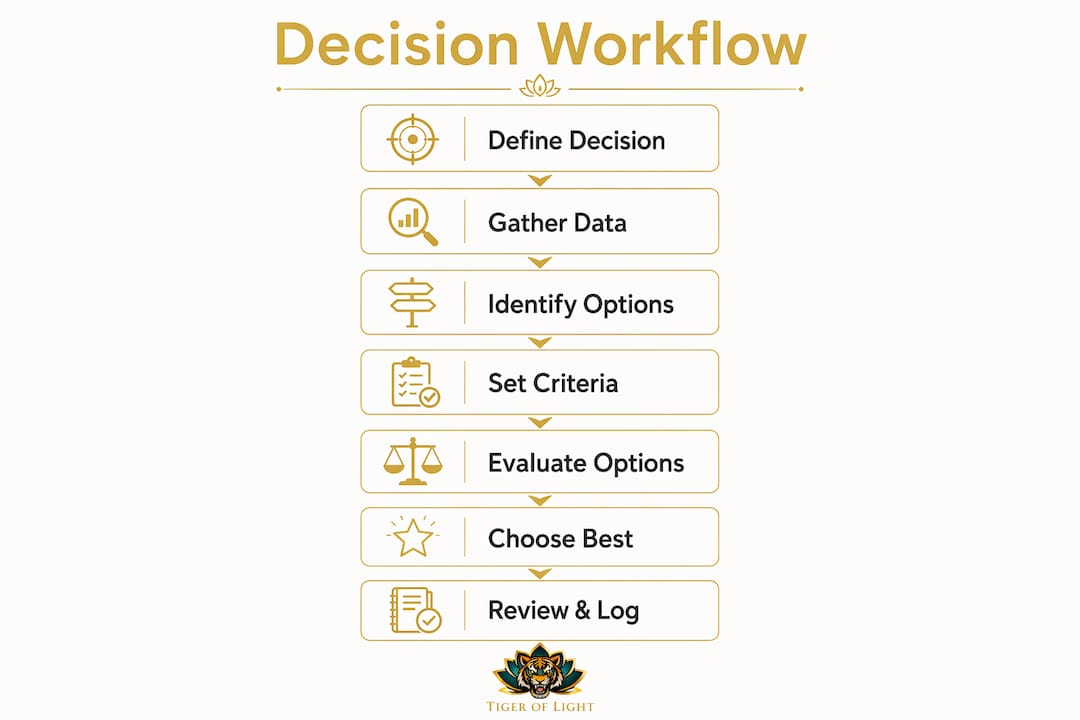
The 7-step decision making process used by leading organizations in 2026 maps directly onto the grounded workflow. Here is how each step works in practice:
- Frame the decision and desired outcome. Write one sentence that names the decision and the result you want. "I need to decide whether to leave my current role by March 31 in order to protect my wellbeing and career trajectory." Vague framing produces vague choices.
- Extract and document explicit constraints. List what is non-negotiable. Budget, timeline, values, relationships, and energy capacity all count. DecisionSpine-10 calls these hard constraints and treats them as filters, not preferences.
- Gather and validate relevant information. The 40-70 rule from IMD research states that optimal decisions occur when you have gathered between 40% and 70% of necessary information before acting. This prevents both premature guessing and analysis paralysis.
- Generate diverse alternatives. Produce at least three options, including one you would not normally consider. Transitioning from collaborative brainstorming to adversarial advocacy with defined constraints minimizes bias and surfaces stronger choices.
- Evaluate options systematically. Score each option against your weighted criteria using a decision matrix or scorecard. The table below shows a simple format.
- Make the decision and commit. Choose the highest-scoring option that clears your hard constraints. Document your reasoning so the decision is auditable later.
- Review results for learning. Reviewing outcomes after decisions forms a crucial iterative cycle that refines future judgment and reinforces accountability.
| Option | Criteria 1: Wellbeing (weight 40%) | Criteria 2: Income (weight 35%) | Criteria 3: Growth (weight 25%) | Weighted Score |
|---|---|---|---|---|
| Stay in current role | 3 | 8 | 4 | 5.0 |
| Accept new offer | 7 | 7 | 8 | 7.2 |
| Freelance transition | 8 | 5 | 9 | 7.2 |
Ties in weighted scores are a signal to revisit your constraints, not to flip a coin. A tie means one of your criteria is underweighted or your framing needs refinement.
Pro Tip: After step 6, write one sentence explaining why you did NOT choose the runner-up option. This single sentence prevents second-guessing for weeks.
How do common pitfalls undermine grounded decision making?
Most decision failures are not failures of intelligence. They are failures of process design. The most common traps look like this:
- Analysis paralysis from undefined boundaries. Most decision paralysis stems from unclear boundaries, not insufficient information. When you have no hard stop rule, gathering more data always feels safer than deciding.
- Bias from skipping emotional regulation. Emotional self-regulation through mindfulness or pre-mortem analysis protects decision makers from cognitive distortions during high-stakes choices. Skipping this step means your nervous system is making the call, not your judgment.
- Failing to document assumptions. Every decision rests on premises that could change. If you do not write them down, you cannot track when they expire.
- Over-relying on a single data source. One conversation, one article, or one mentor's opinion is not a data set. Credible decisions require triangulated evidence.
- Expecting perfect information. Waiting for certainty is itself a decision, and usually the wrong one.
"Making the right choice for the wrong reason is a common fear. Focusing on transparent adjudication processes removes this fear by ensuring decisions are auditable and rational." — Constraint-Driven Arbitrator research
The antidote to most of these pitfalls is the same: define your constraints and kill criteria before you evaluate options. A kill criterion is a condition that, if true, automatically eliminates an option regardless of its score. Identifying kill criteria early preserves rationality and enables timely reconsideration when circumstances change. Write them at the top of your decision document before you open a spreadsheet or talk to anyone.
Therapy-informed approaches to cognitive bias reduction offer additional tools for recognizing when emotional flooding is distorting your process, particularly in personal decisions involving relationships or identity.
How to troubleshoot and improve your workflow over time
A grounded decision making process is not a one-time event. It is a skill that compounds with deliberate practice. Here is how to strengthen it after each decision cycle:
- Recognize fragile decisions early. A decision is fragile when it depends heavily on one assumption. Documenting fragile assumptions and tracking whether they remain true prevents you from defending a choice after its premise has evaporated.
- Run a post-decision review. Within 30 days of a significant decision, write three sentences: what you expected, what actually happened, and what you would weight differently next time. This is the feedback loop that builds real judgment.
- Adjust constraints as context shifts. Constraints are not permanent. A financial constraint that was hard in January may be soft by June. Revisiting your criteria list quarterly keeps your workflow calibrated to your actual life.
- Use emotional clarity practices between decisions. Building a self-leadership workflow that includes regular emotional check-ins means you arrive at each decision with a regulated nervous system rather than accumulated stress.
- Apply iterative approaches to complex contexts. In chaotic or rapidly changing situations, make smaller, reversible decisions first. Gather real feedback before committing to irreversible choices.
Pro Tip: Keep a one-page decision log. Date, decision, key constraints, outcome. After six months, patterns in your judgment become visible in a way that no single reflection can reveal.
The goal is not perfect decisions. The goal is a process you trust enough to act on, even with incomplete information. That trust is what self-leadership actually feels like in practice.
Key takeaways
A grounded decision making workflow produces confident, auditable choices by combining explicit constraints, calibrated data gathering, and emotional regulation into a repeatable sequence.
| Point | Details |
|---|---|
| Frame before you analyze | Write the decision and desired outcome in one sentence before gathering any information. |
| Define constraints first | Document hard constraints and kill criteria before evaluating options to prevent bias and paralysis. |
| Use the 40-70 data rule | Gather between 40% and 70% of needed information before deciding to balance speed and accuracy. |
| Regulate emotions as a step | Emotional self-management is not optional. It directly determines whether data is processed or rationalized. |
| Review every decision | A post-decision review within 30 days is the mechanism that converts experience into better judgment. |
Why structure and self-trust are not opposites
I spent years watching clients treat structure and intuition as enemies. They believed that following a framework meant overriding their inner knowing, and that trusting themselves meant ignoring the data. Both assumptions are wrong, and they cost people months of circular thinking.
What I have found, working with women and creatives through the Sanctuary Symbolic Integration Method™, is that structure is what makes self-trust possible. When you have documented your constraints, named your kill criteria, and scored your options against weighted values, you are not suppressing your instincts. You are giving them a clean surface to land on. The anxiety that masquerades as intuition dissolves when the process is transparent.
The stage that changes everything is separating constraint extraction from option advocacy. Most people collapse these into one conversation and then wonder why they feel confused. When you first define what you cannot compromise on, and only then ask which option best satisfies those constraints, the decision often becomes obvious. The emotional weight lifts because the reasoning is visible.
I have also learned that documenting fragile assumptions is an act of self-compassion, not pessimism. It means you are not betting your confidence on a premise that could quietly change. You are building a decision that can be revisited with dignity rather than defended out of pride.
The workflow does not make you decisive. It makes your decisiveness legible to yourself. That is the difference between a choice you can stand behind and one you keep second-guessing at 2 a.m.
— RachelMHarrison
Ready to make decisions you can trust?
If this framework resonates and you are ready to apply it to the real decisions in your life, Rachel-m-harrison's coaching work goes deeper than any article can.
The coaching services at Rachel-m-harrison combine trauma-informed emotional clarity with structured decision frameworks, specifically designed for women and creatives who are tired of second-guessing themselves. Clients move from analysis paralysis to grounded confidence by working through their actual decisions, not hypothetical ones. If you want to understand how emotional clarity and decision structure work together as a single practice, the clarity integration approach is the place to start. You do not need to have it all figured out before you begin.
FAQ
What is a grounded decision making workflow?
A grounded decision making workflow is a structured process that combines defined criteria, calibrated data gathering, and emotional regulation to produce clear, auditable decisions. It differs from ordinary decision making by separating constraint definition, option evaluation, and final choice into distinct stages.
How many steps are in an effective decision making process?
The standard professional framework uses 7 steps: define the decision, gather information, identify alternatives, weigh evidence, choose, act, and review results. Each stage builds on the previous one, and skipping steps is the primary cause of poor outcomes.
What causes analysis paralysis in decision making?
Analysis paralysis is caused by undefined decision boundaries, not insufficient information. Setting explicit weighted constraints and a hard stop rule prevents endless deliberation and creates confidence even when data is incomplete.
How does emotional regulation affect decision quality?
Leaders who skip emotional self-management fall prey to cognitive biases even when data is available, according to IMD research. Practices like pre-mortem analysis, mindfulness check-ins, and body-scan grounding stabilize the nervous system before high-stakes choices.
What are kill criteria and why do they matter?
Kill criteria are conditions that automatically eliminate an option regardless of its score. Identifying them early in your decision workflow preserves rationality and allows you to reconsider choices cleanly when underlying circumstances change.