TL;DR:
- Personal boundaries are clear limits that protect emotional wellbeing and define acceptable behavior in relationships and daily life. Setting effective boundaries involves self-reflection, clear communication, and consistent enforcement with enforceable consequences; they are living decisions that can be revisited as circumstances evolve. Proper boundary practice fosters genuine connection, self-care, and emotional resilience, especially during life transitions.
A personal boundary is a clear, communicated limit that protects your emotional wellbeing and defines what you will and will not accept in your relationships and daily life. This boundary setting guide is written specifically for women navigating life transitions, whether that means leaving a relationship, shifting careers, or stepping into a new version of yourself. The Cleveland Clinic frames boundaries as tools, not walls, meaning they create clarity and connection rather than distance. Knowing how to set boundaries is one of the most practical skills you can build for lasting emotional wellness. The steps are learnable, and the results are real.

What is a boundary setting guide and why does it matter?
A personal boundary is not a demand you place on someone else. Simply Psychology clarifies that boundaries are unilateral, meaning they define what you will do if a limit is crossed, not what you require others to do. That distinction changes everything. You are not trying to control another person. You are deciding how you will respond.
Boundaries fall into several distinct categories, and recognizing them helps you identify where your own limits need attention:
- Emotional boundaries protect your feelings and mental energy from being dismissed or overridden.
- Physical boundaries define your comfort with personal space and touch.
- Time boundaries guard how you spend your hours and who gets access to them.
- Digital boundaries cover your availability on phones, email, and social media.
- Material boundaries address your possessions, money, and what you lend or share.
- Intellectual boundaries protect your right to hold your own opinions without being ridiculed.
During life transitions, these categories become especially relevant. A woman leaving a long-term relationship may need to rebuild emotional and time boundaries from scratch. A woman returning to the workforce may need to set firm digital and time limits to protect her focus. The Cleveland Clinic notes that healthy boundaries enable self-care while still maintaining meaningful connection. That balance is the goal. Boundaries do not push people away. They define the terms under which you can genuinely show up.
How do you prepare before setting boundaries?
Preparation is the step most people skip, and it is the reason so many boundary conversations go sideways. Before you say a word to anyone else, you need clarity about what you actually need.
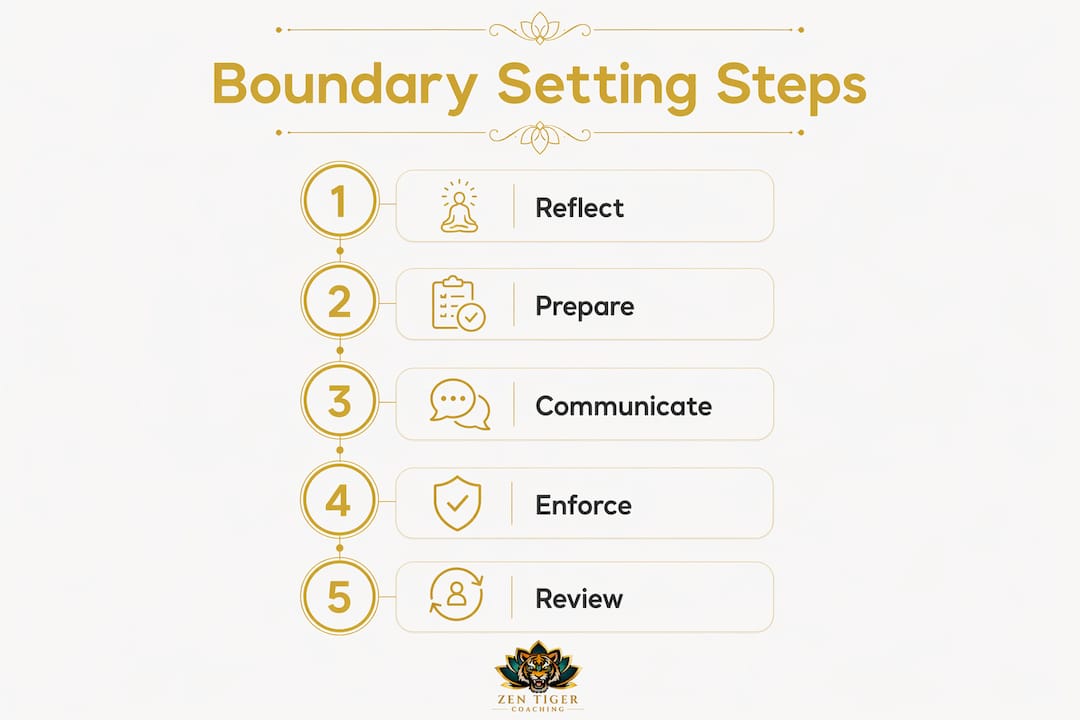
Start with self-reflection. Ask yourself three questions: What situations leave me feeling drained or resentful? What behaviors from others make me feel unsafe or disrespected? What would I need to feel genuinely okay in this relationship or situation? Journaling your answers builds the self-awareness that boundary setting requires before any conversation begins.
Once you know your limits, write them down as concrete actions you will take. UNC Health Talk recommends scripting and rehearsing your boundary language before the actual conversation. This is not about memorizing a speech. It is about preparing your nervous system so you do not freeze or back down under pressure.
- Write the specific behavior that crosses your limit.
- Write how that behavior makes you feel.
- Write what you need instead.
- Write what you will do if the behavior continues.
Pro Tip: Read your written boundary out loud at least three times before the conversation. Your body needs to practice the words as much as your mind does.
Reframing also matters here. UNC Health Talk encourages women to recognize that saying no is saying yes to self-care. That mindset shift reduces the guilt that makes so many women abandon their limits before they even begin. You are not taking something away from someone. You are giving something back to yourself.
How do you communicate boundaries clearly and assertively?
Clear communication is the difference between a boundary that holds and one that dissolves in the first difficult conversation. The Cleveland Clinic advises using direct, firm language that avoids hints, vague requests, or apologies for having needs.
The structure that works best follows four steps. State the specific behavior you are addressing. Share how it affects you using an "I" statement. Name what you need going forward. State what you will do if the behavior continues.
Here is what that looks like in practice. Instead of saying "You always make me feel guilty for spending time alone," you say: "When you call repeatedly after I've said I need space, I feel overwhelmed and unable to recharge. I need you to respect my request for quiet time. If the calls continue, I will not answer until the next day." That script is specific, personal, and enforceable. It focuses entirely on your experience and your response.
- Use "I feel" instead of "You always" to reduce defensiveness.
- Be specific about the behavior, not the person's character.
- State your need clearly, not as a hint or a hope.
- Name your consequence without threats or drama.
Timing and environment matter too. Choose a calm moment, not the middle of a conflict. A private setting reduces the other person's defensiveness. Simply Psychology confirms that boundaries focused on your behavior are far more effective than those framed as demands. You are not asking permission. You are stating your position.
Pro Tip: If you tend to over-explain or apologize mid-sentence, practice ending your boundary statement with a period. One clear sentence. Then stop talking.
How do you enforce boundaries and handle pushback?
Setting a boundary once is not enough. Enforcement is where most women struggle, and it is the phase that determines whether your limits are real or just words.
The Boundary Playbook states plainly that a boundary without follow-through is just a wish. Consequences are what make boundaries credible. Without them, people learn that your limits are negotiable. With them, they learn you mean what you say.
Effective consequences share four qualities. Use this table to evaluate whether yours will hold:
| Quality | What It Means | Example |
|---|---|---|
| Specific | Tied to one clear behavior | "If you raise your voice, I will leave the room." |
| Enforceable | Something you can actually do | Not "I'll never speak to you again" if that's unrealistic |
| Proportionate | Matches the severity of the violation | A small limit gets a small consequence first |
| Sustainable | You can repeat it consistently | Avoid consequences you will abandon after one use |
The Boundary Playbook recommends planning consequences before conversations, starting with the mildest step you can sustain, and expecting a testing period. People who are used to crossing your limits will push harder before they adjust. That escalation is normal. It does not mean your boundary is wrong. It means it is working.
Guilt is the most common reason women drop their consequences. Recognize that guilt is a feeling, not a fact. Feeling guilty does not mean you have done something wrong. It often means you are doing something new. The boundaries in recovery framework from Rachel-m-harrison addresses this directly: holding your limits is an act of care, not cruelty.
What are the most common boundary setting mistakes?
Even women who understand boundaries intellectually make predictable mistakes when they try to apply them. Knowing these patterns in advance helps you catch yourself before they undermine your progress.
Simply Psychology identifies the most common error: confusing wishes for limits. A wish sounds like "I wish you would stop canceling plans." A boundary sounds like "If you cancel again with less than 24 hours' notice, I will make other plans and not reschedule." The first is a hope. The second is a decision.
Other frequent mistakes include:
- Vague language. "I need more respect" tells no one anything specific. Name the exact behavior.
- Inconsistent application. Enforcing a boundary three times and then letting it slide teaches others to wait you out.
- Apologizing for having needs. Starting a boundary conversation with "I'm sorry, but..." signals that you do not believe your limit is valid.
- Treating all boundaries as negotiable. Some limits are firm. Know which ones are non-negotiable before the conversation starts.
The mindful boundary setting approach from Rachel-m-harrison draws a useful distinction here. Negotiable boundaries are preferences. Non-negotiable boundaries protect your safety, values, or core wellbeing. Knowing the difference prevents you from caving on limits that should never move.
If you find yourself repeatedly abandoning your limits, that is not a character flaw. It is a signal that you need more support, more practice, or both. Seeking guidance from a counselor or trauma-informed coach is a practical next step, not a last resort.
Key takeaways
Effective boundary setting requires self-awareness, clear communication, and consistent follow-through with enforceable consequences.
| Point | Details |
|---|---|
| Boundaries are unilateral | They define your actions and responses, not what others must do. |
| Preparation builds confidence | Script and rehearse your boundary language before any conversation. |
| Consequences make limits real | Without follow-through, a boundary is a wish, not a limit. |
| Guilt is normal, not a stop sign | Feeling guilty when enforcing a boundary means you are doing something new, not something wrong. |
| Vague language erodes limits | Name the specific behavior, your feeling, your need, and your response every time. |
What i've learned about boundaries that most guides won't tell you
Most boundary guides treat this as a communication skill. I see it differently. In my work with women in transition, the hardest part of setting limits is rarely the conversation itself. It is the moment before, when you have to decide that your needs are worth protecting at all.
Women in transition, whether leaving a marriage, rebuilding after loss, or stepping into leadership, often carry years of conditioning that says their comfort matters less than everyone else's. A boundary script does not fix that. What fixes it is the slow, repeated practice of choosing yourself in small moments until it becomes your default.
The setting boundaries workflow I use with clients at Rachel-m-harrison starts not with what to say, but with what you believe about your own worth. That is the foundation. Without it, even the most perfectly worded boundary collapses under the first sign of someone else's displeasure.
One more thing: boundaries are not permanent contracts. They are living decisions that you revisit as you grow. A limit that felt impossible to hold six months ago may feel natural today. A limit you thought was firm may need to be renegotiated as a relationship evolves. Give yourself permission to adjust. The goal is not a perfect boundary. The goal is a life where you feel safe, clear, and genuinely yourself.
— RachelMHarrison
Ready to build boundaries that actually hold?
Understanding the theory is one thing. Applying it when you are in the middle of a difficult relationship, a career pivot, or a personal crisis is another. That is where personalized support makes the difference.

Rachel-m-harrison offers trauma-informed coaching designed specifically for women who want to build emotional clarity and hold their limits without losing themselves in the process. The work goes deeper than communication scripts. It addresses the emotional patterns and nervous system responses that make boundaries hard to keep. If you are ready to move from knowing what you need to actually protecting it, explore what coaching looks like and whether it is the right fit for where you are right now. You can also review coaching versus therapy to understand which type of support matches your needs.
FAQ
What is the difference between a boundary and a rule?
A boundary defines what you will do if a limit is crossed. A rule demands that someone else change their behavior. Boundaries are unilateral and enforceable because they depend only on your actions.
How do you set boundaries without feeling guilty?
Reframe saying no as saying yes to your own wellbeing. UNC Health Talk confirms that this mindset shift reduces guilt by connecting your limit to self-care rather than rejection of others.
What types of boundaries should women focus on first?
Start with the category where you feel the most drained or resentful. Emotional and time boundaries are often the most urgent for women in life transitions because they directly affect energy and mental clarity.
How do you handle someone who keeps violating your boundaries?
Apply your stated consequence consistently and escalate gradually if the behavior continues. The Boundary Playbook notes that testing periods are normal and that consistent follow-through is what builds lasting respect.
Can boundaries damage relationships?
Clearly communicated boundaries protect relationships by creating mutual respect and honest expectations. The Cleveland Clinic confirms that good boundaries enable genuine connection rather than undermining it.