TL;DR:
- Emotional wellness, measured through emotional intelligence, is a crucial predictor of effective leadership and team performance. Leaders who develop self-awareness, self-regulation, empathy, and social skills foster psychologically safe environments and improve organizational outcomes. Building emotional resilience through practices like mindfulness, honest communication, and professional support enhances leadership capacity and team well-being.
Emotional wellness is the foundation of effective leadership, directly shaping how you make decisions, communicate under pressure, and build trust with your team. The industry term for this capacity is emotional intelligence (EQ), and research confirms it correlates with transformational leadership at r ≈ 0.63, one of the strongest predictors in organizational psychology. The role of emotional wellness in leadership goes beyond managing your mood. It determines whether your team feels safe enough to speak up, whether you read conflict accurately, and whether you sustain performance without burning out. Leaders who treat emotional health as a professional discipline consistently outperform those who treat it as a personal matter.
How does emotional wellness shape leadership effectiveness?
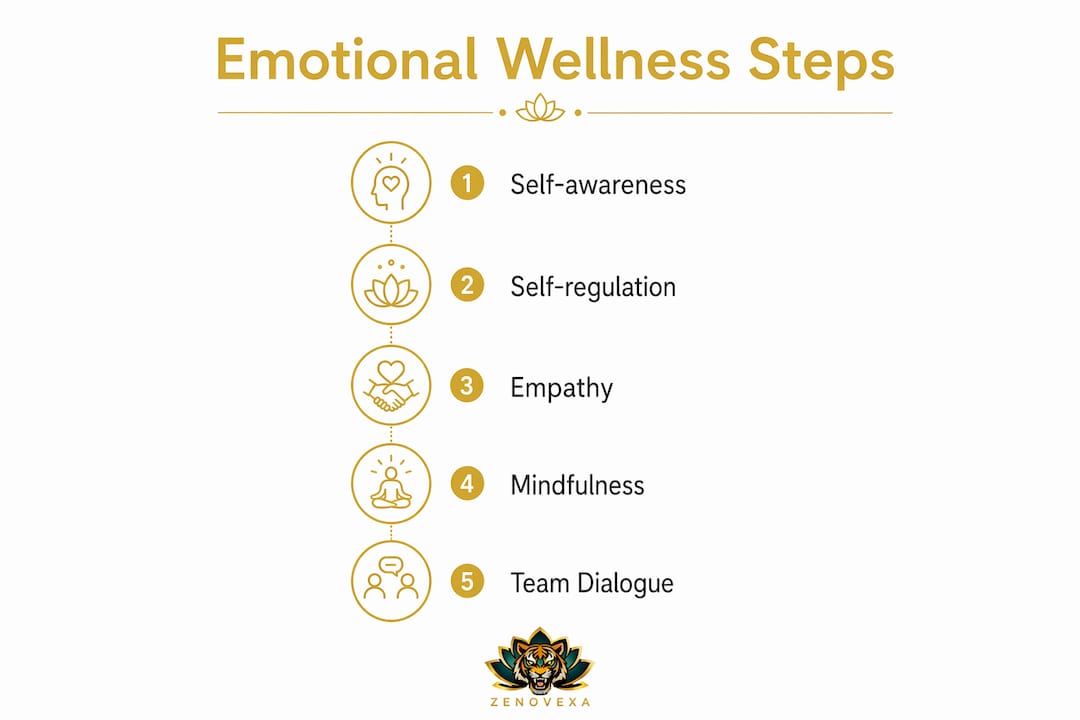
Emotional intelligence in leadership is defined by four core competencies: self-awareness, self-regulation, empathy, and social skill. Each one maps directly to a leadership outcome you can measure.

Self-awareness lets you catch your own bias before it distorts a decision. Self-regulation keeps you from transmitting panic to your team during a crisis. Empathy allows you to read what your people need before they ask. Social skill turns those readings into productive conversations. Leaders with high EQ build stronger teams, make better decisions under pressure, and create psychologically safe environments. That combination is rare, and it is teachable.
A 2026 meta-analysis of 15 studies covering 3,440 participants found that emotional intelligence correlates with team effectiveness at r ≈ 0.41. That number means roughly 17% of the variance in team performance traces back to the leader's emotional competency. For a team of ten people, that is a significant lever.
| EQ Dimension | Leadership Behavior | Measurable Outcome |
|---|---|---|
| Self-awareness | Recognizes personal triggers before reacting | Fewer reactive decisions under stress |
| Self-regulation | Maintains composure during conflict | Higher team psychological safety |
| Empathy | Reads team emotional states accurately | Stronger retention and engagement |
| Social skill | Facilitates open, honest dialogue | Faster conflict resolution |
Pro Tip: Add a five-minute mindfulness check-in before high-stakes meetings. Mindfulness practices measurably strengthen emotional intelligence and social skills, giving you a concrete edge in the room.
Does ethical leadership protect your team's emotional energy?
Ethical leadership does more than set a moral tone. It directly protects the emotional energy of everyone around you. A 2026 study of 520 full-time employees found that ethical leadership boosts employees' affective vitality, which strongly mediates sustainable well-being. When leaders model integrity, people spend less energy managing fear and more energy doing real work.
Benevolent leadership takes this further by changing how leaders express emotion at work. Leaders who lead with genuine care reduce surface acting, the exhausting practice of faking emotions you do not feel. They replace it with deep acting, authentic emotional engagement that improves both the leader's psychological well-being and their effectiveness. That shift matters because surface acting is a direct drain on cognitive resources.
Here is what ethical and benevolent leadership looks like in practice:
- Acknowledging mistakes openly instead of deflecting blame
- Expressing genuine concern for a team member's workload before a deadline
- Setting clear expectations without using fear as a motivator
- Naming your own emotional state when it is relevant ("I'm frustrated by this situation, not by you")
- Protecting team members from unreasonable demands from above
Pro Tip: Authentic expression does not mean sharing every feeling you have. The standard is relevance. Ask yourself: does sharing this emotion help my team understand the situation or feel safer? If yes, share it. If not, regulate it privately first.
What are the biggest emotional wellness challenges for leaders?
The most common emotional wellness failure in leadership is suppression. Leaders are trained to project confidence, so they bury anxiety, frustration, and doubt. The problem is that suppressing emotions distorts decision-making and reduces empathy. You cannot read your team's emotional state accurately when you are disconnected from your own.
Emotional contagion compounds this problem. Leaders' emotions spread to teams through micro-expressions and tone, bypassing conscious awareness entirely. A leader who walks into Monday's all-hands meeting carrying unprocessed stress will shift the team's mood before saying a single word. That is not metaphor. It is documented nonverbal transmission.
The stigma around mental health support is the third major barrier. Many leaders still believe that seeking coaching or therapy signals weakness. The data says the opposite. Therapy and coaching are strategic tools with measurable ROI in leadership performance, improving self-awareness, decision quality, and relationships. Speakers like Pandit Dasa and Laura Naylor have built entire leadership development programs around this premise.
Here are five steps to build emotional resilience as a leader:
- Name your physical stress cues. Tight shoulders, shallow breathing, and jaw tension are your early warning system. Recognizing them stops the cascade before it reaches your team.
- Signal, do not suppress. Share relevant emotions in controlled, purposeful ways. "I want to be honest that this decision is harder than it looks" builds trust faster than a forced smile.
- Schedule recovery time. High-stakes leadership requires deliberate rest. Block thirty minutes after difficult conversations to process, not just move on.
- Seek psychoeducation for leaders. Understanding how your nervous system responds to stress reduces shame and increases your options.
- Work with a coach or therapist. Frame it as a performance investment, not a repair job. The leaders who do this consistently outperform those who do not.
How can leaders build emotional wellness across their teams?
The most direct way to build emotional wellness in your organization is to model it yourself. Leader self-care improves listening skills, sharpens responses during conflict, and raises overall team efficiency. When you take your own emotional health seriously, you give your team permission to do the same.
Open dialogue about mental health reduces stigma faster than any policy document. Name emotional challenges in team meetings. Normalize saying "I don't have the bandwidth for this right now" as a professional statement, not a confession. Psychological safety grows when leaders demonstrate that honesty about limits is rewarded, not punished.
Training programs focused on emotional intelligence and mindfulness give your team a shared language. When everyone understands what self-regulation means and how to practice it, conflict resolution becomes faster and less personal. The self-leadership skills your team builds individually compound into collective resilience.
| Wellness Initiative | Primary Leadership Benefit |
|---|---|
| EQ training programs | Shared emotional vocabulary, faster conflict resolution |
| Mindfulness practice | Reduced reactive decision-making under pressure |
| Coaching for leaders | Improved self-awareness and strategic thinking |
| Mental health days policy | Reduced burnout, higher sustained performance |
| Open dialogue forums | Stronger psychological safety and retention |
Pro Tip: Add one emotional wellness goal to your next leadership development plan. Make it specific: "I will practice naming my stress cues before team meetings for 30 days." Specificity turns intention into behavior.
Key takeaways
Emotional wellness is a measurable leadership competency, not a soft skill, and leaders who develop it outperform those who do not on every major team outcome.
| Point | Details |
|---|---|
| EQ drives team results | Emotional intelligence correlates with team effectiveness at r ≈ 0.41 across 3,440 participants. |
| Suppression backfires | Suppressing emotions distorts decisions and reduces empathy; controlled signaling builds team trust. |
| Ethical leadership protects energy | Ethical and benevolent leadership reduces emotional labor and sustains employee well-being. |
| Stigma is the hidden barrier | Coaching and therapy deliver measurable ROI in leadership performance when leaders overcome stigma. |
| Modeling is the fastest culture shift | Leaders who practice self-care visibly give their teams permission to prioritize emotional health too. |
The leadership truth nobody told you about emotional wellness
Most leadership development programs teach you to manage people. Very few teach you to manage yourself first. After years of working with leaders in transition, I have noticed one consistent pattern: the leaders who struggle most are not the ones who lack strategy or vision. They are the ones who have never been taught to recognize what is happening inside them when the pressure hits.
Emotional wellness is not about becoming softer. It is about becoming more accurate. When you know your own emotional patterns, you stop projecting them onto your team. You stop mistaking your anxiety for their incompetence. You stop making decisions from a place of unprocessed stress and calling it instinct.
The leaders I have seen transform most completely are the ones who stopped treating self-awareness as a luxury and started treating it as a discipline. They did the work through coaching, through trauma-informed self-leadership, through honest reflection. And their teams felt it immediately, not because they announced a change, but because the emotional climate around them shifted.
The overlooked pitfall is this: most leaders wait until a crisis to address their emotional health. By then, the cost is already paid in damaged relationships, poor decisions, and team members who have quietly disengaged. Start before the crisis. Your leadership capacity depends on it.
— RachelMHarrison
Ready to lead from a place of emotional clarity?
Understanding the role of emotional wellness in leadership is the first step. Doing something with that understanding is where real change begins.
Rachel-m-harrison offers trauma-informed coaching specifically designed for leaders who want to build emotional clarity, regulate their nervous system under pressure, and lead with grounded authority. Whether you are wondering about the difference between coaching and therapy or ready to explore what a trauma-informed coaching session actually looks like, the resources are here. This is not generic wellness advice. It is a structured, psychologically grounded process built for leaders who are ready to do the real work.
FAQ
What is emotional wellness in leadership?
Emotional wellness in leadership is a leader's capacity to recognize, regulate, and express emotions in ways that support clear decisions and healthy team dynamics. The industry term is emotional intelligence (EQ), and it is one of the strongest predictors of transformational leadership effectiveness.
How does emotional intelligence affect team performance?
A meta-analysis of 15 studies found that emotional intelligence correlates with team effectiveness at r ≈ 0.41. Leaders with high EQ create psychologically safe environments where teams communicate openly and resolve conflict faster.
Why do leaders struggle with emotional wellness?
The most common barriers are emotional suppression, the stigma around seeking support, and a lack of training in self-awareness. Suppressing emotions distorts decision-making and reduces empathy, while stigma prevents leaders from accessing coaching and therapy that deliver measurable performance gains.
Is coaching or therapy better for leader emotional health?
Both serve different purposes. Therapy addresses clinical mental health needs and past trauma. Coaching focuses on present performance, self-awareness, and building specific emotional competencies. Many leaders benefit from both, and neither signals weakness.
How can a leader start building emotional resilience today?
Start by identifying your physical stress cues, the body signals that appear before you react. Then practice naming relevant emotions to your team in controlled, purposeful ways. Adding a mindfulness practice and working with a coach accelerates the process significantly.