TL;DR:
- Authenticity involves aligning your actions and choices with your core values and emotional truth, leading to greater well-being. Developing self-awareness through mindfulness, journaling, and bodily signals is essential for authentic self-expression and gradually building internal safety. Overcoming fear, trauma, and adaptive patterns requires self-compassion, small honest actions, and ongoing practice to live genuinely and resiliently.
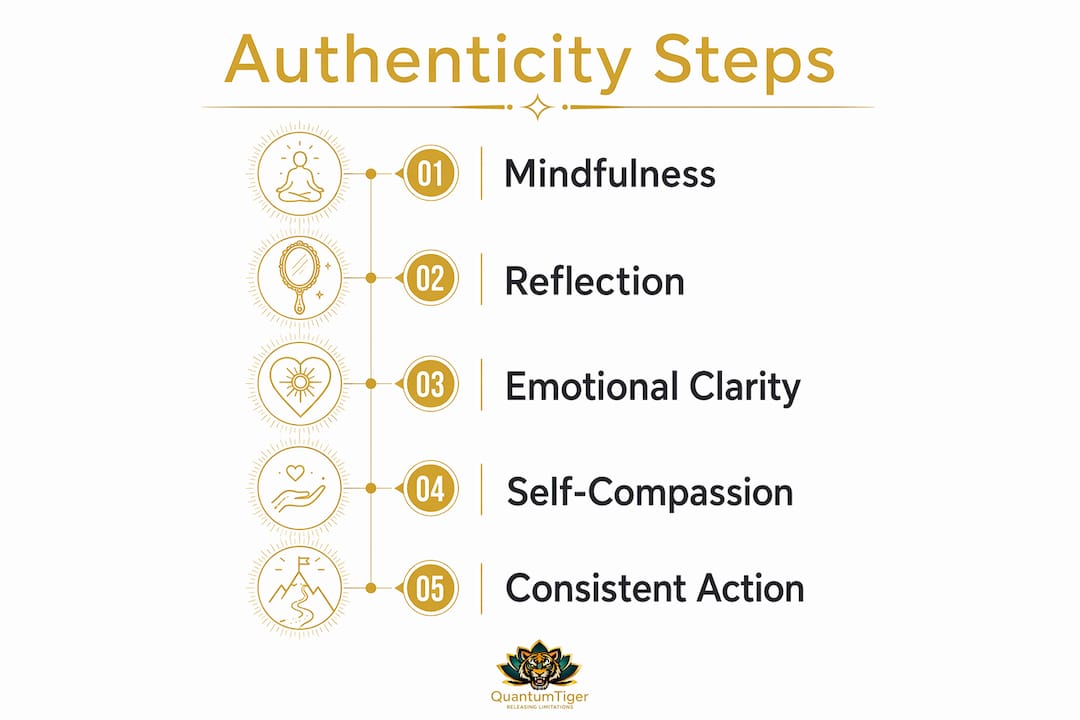
Authenticity is defined as the alignment of your actions, words, and choices with your core values and emotional truth, rather than with external expectations or social performance. Research confirms this internal alignment correlates directly with higher life satisfaction, self-esteem, and well-being. Knowing how to embody authenticity is not about being perfectly consistent or radically transparent in every moment. It is about developing the self-awareness and nervous system safety to recognize your genuine self and act from that place, even when it feels uncomfortable. Mindfulness, emotional clarity, and self-compassion are the three foundational tools that make this possible.
How to build self-awareness as the foundation for authentic living
Self-awareness is the starting point for any genuine self-expression. Without it, you are responding to life from habit, fear, or inherited expectations rather than from your actual values. The good news is that self-awareness is a skill you can train, not a fixed trait you either have or lack.

A 5-minute daily mindfulness practice is one of the most research-supported ways to begin distinguishing your true self from the adaptive persona you may have developed to survive difficult environments. Sit quietly, observe your emotions and physical sensations without judgment, and simply notice what is present. This practice trains your nervous system to pause before reacting, which is where authentic choice lives.
Your body is also a reliable guide. Authenticity is lived in the body and in relationships, not only in the mind. When you feel a tightening in your chest before saying yes to something, or a sense of expansion when you speak your truth, those signals are data. Learning to read them is part of developing personal authenticity.
Journaling accelerates this process significantly. Try these prompts to clarify your emotional truth:
- What did I agree to today that felt misaligned with my values?
- Where did I feel most like myself in the past week?
- What emotion am I avoiding right now, and what is it trying to tell me?
- Which relationships leave me feeling energized versus depleted?
Reflection exercises like these, paired with self-leadership techniques such as managing emotional triggers before they manage you, build the internal clarity that authentic living requires.
Pro Tip: Before reacting to a difficult conversation or decision, pause for three slow breaths. This brief window activates your prefrontal cortex and gives your authentic self a chance to respond rather than your survival patterns.
What does expressing authenticity look like in daily life?
Knowing your values is one thing. Expressing them in real interactions, with real stakes, is another. The gap between the two is where most people get stuck. The solution is not to leap into radical honesty overnight. It is to practice what researchers call "small honesty," which means low-stakes authentic moments that train your nervous system to associate genuine expression with safety rather than threat.
Here is a practical sequence for bringing your genuine self into daily interactions:
- Start with low-stakes honesty. Share a real opinion about something minor, like a restaurant choice or a work preference, instead of defaulting to what you think others want to hear. Notice that the world does not end.
- Practice saying no in small situations. Decline one optional commitment this week that does not align with your energy or values. Setting boundaries is directly linked to improved self-esteem and reduced stress, and it starts with small refusals.
- Align your environment with your values. Your physical space, clothing, and daily routines either support or suppress your authentic self. If your wardrobe is full of clothes you wear to fit in rather than to feel like yourself, that is worth examining.
- Respond rather than react. When someone challenges you or triggers a defensive response, pause before speaking. Responding from your values rather than your wounds is one of the clearest signs of authentic self-expression.
- Balance authenticity with context. Being genuine does not mean saying everything you think in every setting. It means choosing honesty and alignment as your default, while reading the room with wisdom and care.
Pro Tip: Choose one relationship this week where you will practice one degree more honesty than usual. You do not need to overhaul every dynamic at once. Incremental shifts compound over time into a fundamentally different way of showing up.
Aligning your emotional clarity practices with these daily steps creates a feedback loop. The clearer you become internally, the more naturally your external expression follows.
What blocks authenticity, and how do you move through it?
The most common barriers to genuine self-expression are not laziness or lack of desire. They are fear, perfectionism, and the adaptive "false self" that many people developed in childhood to stay safe, loved, or accepted. Understanding where these patterns came from makes them far less powerful.
Adaptive false selves develop from trauma or unmet childhood needs. If you learned early that expressing certain emotions led to rejection or punishment, your nervous system built a protective layer. That layer served you then. It may be costing you now. Recognizing it without shame is the first step toward releasing it.
Dr. Kristin Neff's research on self-compassion is directly relevant here. Self-compassion reduces anxiety, shame, and the perfectionism that makes authentic expression feel too risky. When you treat yourself with the same kindness you would offer a close friend, you lower the internal threat level enough to let your real self surface.
Psychologists also emphasize that embracing internal contradictions is a growth step, not a failure. You can want connection and also need solitude. You can be confident in some areas and deeply uncertain in others. Accepting these contradictions without defensiveness is what genuine self-knowledge actually looks like.
For deeper blocks rooted in trauma, somatic work and EMDR (Eye Movement Desensitization and Reprocessing) are two therapeutic approaches that help release the body-held patterns keeping the false self in place. These are not quick fixes, but they address authenticity at the level where it is actually stored: in the nervous system, not just the mind. Exploring shadow work alongside these approaches can also surface the hidden parts of yourself that have been waiting for permission to exist.
"The most courageous act is still to think for yourself. Aloud." The same principle applies to feeling for yourself, and then living from that feeling, even when it contradicts what others expect of you.
Compassionate self-dialogue is a practical daily tool. Replace "I should be further along by now" with "I am learning to trust myself, and that takes time." The language you use internally shapes the emotional environment in which your authentic self either thrives or hides.
How do you sustain authenticity as a lifelong practice?
Authenticity is not a destination you arrive at after enough self-work. It is a non-linear, daily practice of returning to yourself after life pulls you away. Small, consistent alignment choices rebuild self-trust over time in a way that grand gestures never can. This is the architecture of genuine living.
Sustaining your authentic self over the long term involves several interconnected habits:
- Weekly value check-ins. Ask yourself once a week: "Did my choices this week reflect who I actually am?" This is not about judgment. It is about recalibration.
- Build a community that can hold your real self. Relationships where you must perform or shrink to belong are not sustainable. Seek out people who respond to your honesty with curiosity rather than correction.
- Protect your rest. Authenticity requires energy. When you are depleted, you default to people-pleasing and performance. Rest is not a reward for being productive. It is a prerequisite for being genuine.
- Treat setbacks as data. When you slip back into old patterns, that is information about where you still need support, not evidence that you are failing.
Midlife transitions are particularly powerful moments to reclaim authenticity that has been buried beneath social roles, family expectations, and career identities. Many women find that the discomfort of a major life transition is actually the pressure of their true self pushing through.
Resilience in this context means returning to your values after disruption, not avoiding disruption altogether. Adaptability and authenticity are not opposites. The most genuinely expressed people are often the most flexible, because they are secure enough in who they are to meet change without losing themselves.
Key takeaways
Embodying authenticity requires self-awareness, nervous system safety, and consistent value-aligned choices made daily, not a single transformative moment.
| Point | Details |
|---|---|
| Authenticity is alignment | Living genuinely means matching your actions to your core values, not external expectations. |
| Self-awareness is the foundation | Daily mindfulness and journaling help you distinguish your true self from adaptive patterns. |
| Small honesty builds safety | Low-stakes authentic moments train your nervous system to associate genuine expression with safety. |
| Self-compassion clears the path | Dr. Kristin Neff's research shows self-compassion reduces the shame and perfectionism that block real self-expression. |
| Authenticity is a daily practice | Consistent, small alignment choices rebuild self-trust more effectively than occasional grand gestures. |
Why I think we misunderstand what authenticity actually demands
Most conversations about embracing your true self focus on mindset. Think differently, believe in yourself, stop caring what others think. That advice is not wrong, but it skips the part that actually makes change possible: your nervous system has to feel safe enough to let you be real.
I have worked with women who understood their values perfectly on paper and still found themselves shrinking in rooms, agreeing to things that cost them, and performing versions of themselves that exhausted them. The missing piece was never insight. It was safety. When the body does not feel safe, the authentic self stays protected behind the adaptive one. That is not weakness. That is biology.
What I have found actually works is starting smaller than feels meaningful. Not a values overhaul. Not a difficult conversation with a family member. One honest sentence in a low-stakes moment. One boundary with someone who will not punish you for it. These micro-moments of alignment accumulate into something that feels, over time, like coming home to yourself.
The other thing I want to say plainly: you will not do this perfectly, and that is not the point. Authenticity is not a performance of self-knowledge. It is the willingness to keep returning to yourself, even after you have drifted. The returning is the practice. The reflection work you do between those moments is what makes the returning faster and gentler each time.
— RachelMHarrison
Ready to go deeper into your authentic self?
If this article resonated with you, you are likely at a point where self-reflection alone is not enough. You need a structured, trauma-informed space to do the deeper work.
At Rachel-m-harrison, the Sanctuary Symbolic Integration Method™ is specifically designed to help women rebuild emotional clarity, release adaptive patterns, and express themselves from a grounded, sovereign place. Whether you are navigating a life transition, recovering from burnout, or simply ready to stop performing and start living, one-on-one coaching offers the personalized support that articles cannot. Explore what coaching looks like or book a session to take the first real step toward living as yourself.
FAQ
What does it mean to embody authenticity?
Embodying authenticity means consistently aligning your actions, words, and choices with your core values and emotional truth rather than with social expectations. Research confirms this alignment correlates with higher well-being, self-esteem, and life satisfaction.
How do I start practicing self authenticity if I don't know my values?
Begin with a 5-minute daily mindfulness practice and simple journaling prompts that ask where you felt most like yourself recently. These tools help surface your values through lived experience rather than abstract reflection.
Why is it so hard to be genuine around certain people?
Authenticity requires nervous system safety, and certain relationships or environments trigger survival responses that suppress genuine expression. Practicing small honesty in lower-stakes relationships first builds the internal safety needed for more challenging dynamics.
Can trauma block authentic self-expression?
Yes. Adaptive false selves often develop from trauma or unmet childhood needs, and the body holds these protective patterns even when the mind understands them. Somatic therapy and EMDR are two evidence-supported approaches for releasing these blocks at the nervous system level.
How long does it take to develop personal authenticity?
Authenticity is a lifelong, non-linear practice rather than a fixed goal you reach. Consistent small alignment choices rebuild self-trust over time, and most people notice meaningful shifts within weeks of beginning a daily self-awareness practice.