TL;DR:
- A boundaries workflow is a structured, repeatable process that helps individuals define, communicate, enforce, and adjust their limits to protect well-being. It involves six core steps: identifying needs, drafting clear statements, communicating calmly, establishing controllable consequences, following through, and reviewing regularly. Consistent enforcement and flexibility are key to building sustainable, healthy boundaries that adapt to changing circumstances.
A setting boundaries workflow is the systematic practice of identifying, communicating, enforcing, and maintaining healthy limits to protect your time, energy, and well-being. Most people treat boundary-setting as a single conversation. The real practice is a repeatable process, one that builds emotional clarity, reduces burnout, and gives your personal and professional life a structure that actually holds. This guide breaks down the full personal boundaries process into stages you can apply immediately, with communication templates, enforcement strategies, and tools for adapting your limits as life shifts.
What is a setting boundaries workflow and why does it matter?
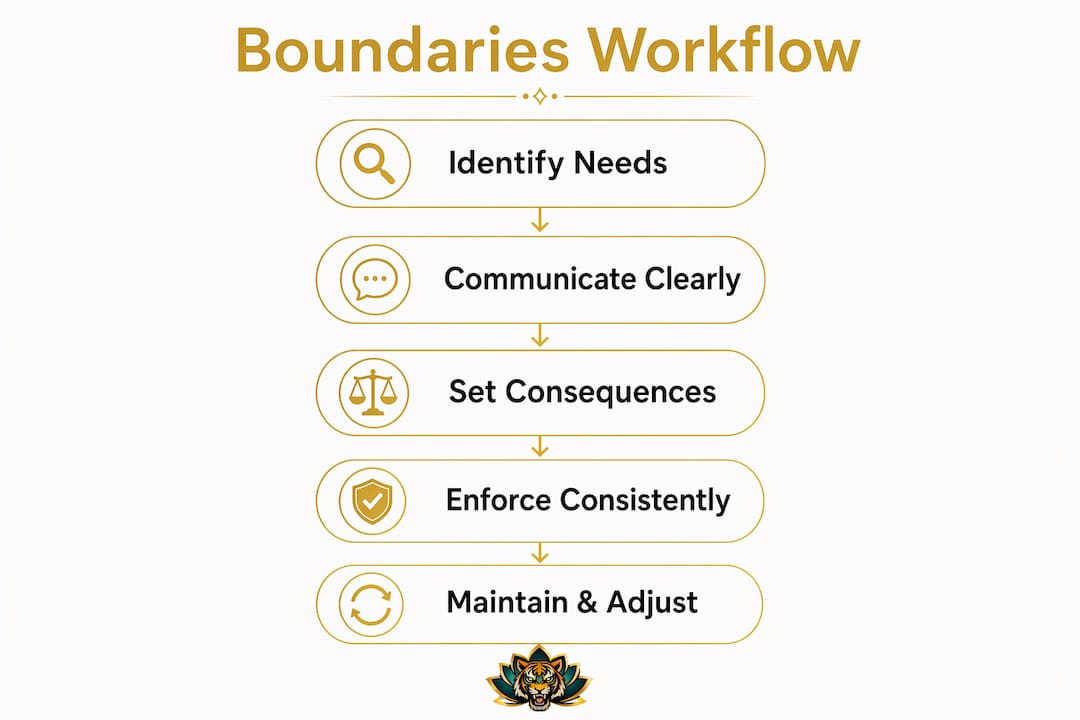
A boundaries workflow is not a one-time declaration. It is a structured sequence of steps you return to whenever your limits need to be defined, communicated, or recalibrated. The Cleveland Clinic outlines six core steps: knowing your needs, communicating clearly, using "I" statements, establishing consequences, following through, and adjusting consistently. That sequence is the backbone of any effective personal limits system.
Why does structuring this as a workflow matter? Because without a repeatable process, boundary-setting collapses under pressure. You state a limit once, someone pushes back, and without a plan for what comes next, the boundary dissolves. A workflow gives you a script for every stage, so you are not improvising when emotions are high.
The stages of an effective workflow look like this:
- Identify what you need and where your limits are being crossed
- Draft a clear, specific boundary statement
- Communicate the boundary using direct, calm language
- Plan a behavioral consequence you control
- Follow through consistently when the boundary is tested
- Review and adjust the boundary as your needs evolve
Boundaries also protect something concrete: your emotional energy. When limits are unclear, every interaction carries the risk of depletion. A defined workflow removes that ambiguity and makes self-care a structural feature of your day, not a reaction to exhaustion.
How do you identify your personal and professional boundary needs?
Self-awareness is the starting point of any effective boundary setting process. Before you can communicate a limit, you need to know where you are being drained, disrespected, or overextended. Most people skip this step and jump straight to the conversation, which is why their boundaries feel reactive rather than grounded.
Start by reflecting across four categories of limits:
- Emotional: Which relationships or interactions leave you feeling depleted, resentful, or anxious?
- Physical: Are your personal space, sleep schedule, or health routines being compromised?
- Digital: Are after-hours messages, social media, or constant availability eroding your focus?
- Time-related: Are you consistently overcommitting, missing your own deadlines, or sacrificing personal time for others?
Practical questions sharpen this reflection. Ask yourself: "Where do I feel resentment building?" and "What do I keep agreeing to that I wish I had declined?" Resentment is one of the most reliable signals that a boundary has been crossed repeatedly without acknowledgment.
A personal boundaries worksheet translates this reflection into specific behavioral limits paired with follow-through plans. Tools like scheduled self-check-ins, journaling prompts, or the writing prompts for emotional truth available through Rachel-m-harrison can surface needs you may not have consciously named yet.

Pro Tip: Set a recurring 10-minute weekly check-in with yourself. Ask: "Which boundary felt tested this week, and what did I do about it?" This single habit builds the self-awareness that makes every other step in the workflow more precise.
How do you communicate boundaries clearly and confidently?
Direct, specific language is the single most important factor in effective boundary communication. Vague statements like "I need more space" leave room for interpretation and give the other person an easy exit. Specific statements close that gap.
The structure that works consistently is: "When you do X, I will do Y." This format keeps the focus on your behavior, not theirs, which removes the accusatory tone that triggers defensiveness. Lyra Health recommends pairing clear communication with a defined understanding of what constitutes an emergency, so that "urgent" requests do not automatically override your limits.
Here is a comparison of weak versus strong boundary language across three common contexts:
| Context | Weak phrasing | Strong phrasing |
|---|---|---|
| Work emails | "I'm pretty busy after 6pm." | "I respond to emails between 9am and 5pm on weekdays." |
| Personal relationships | "You always make me feel bad." | "When plans change last minute, I need 24 hours' notice going forward." |
| Creative projects | "I can't keep doing unlimited revisions." | "This project includes two revision rounds. Additional rounds are billed separately." |
"I" statements are the grammatical backbone of healthy communication practices. They shift the sentence from blame to self-disclosure. "I feel overwhelmed when meetings are scheduled without notice" lands differently than "You never give me time to prepare." Both describe the same situation. Only one invites a productive response.
Managing pushback is part of the process. When someone resists your boundary, the most effective response is calm repetition, not escalation. Restate the limit in the same words without adding justification. Justifying a boundary signals that it is negotiable. It is not.
Pro Tip: Use communication clarity prompts to rehearse your boundary statements before high-stakes conversations. Saying the words out loud, even alone, reduces the emotional charge when the real moment arrives.
How do you enforce boundaries and follow through consistently?
Follow-through is where most boundary workflows fail. Stating a limit without a consequence is a preference, not a boundary. Boundary success is measured by your follow-through, not by whether the other person agrees with or respects your limit. That distinction removes guilt from the equation entirely.
The key principle in enforcement is that consequences must be within your control. Consequences that depend on the other person changing their behavior are not consequences. They are wishes. Behavioral, immediate responses are what make limits credible.
Practical enforcement examples include:
- Pausing a conversation when someone raises their voice, rather than continuing to engage
- Muting notifications after your stated work hours instead of waiting for others to stop messaging
- Revising a project timeline when scope creep occurs, rather than absorbing the extra work silently
- Leaving a situation that violates a physical or emotional limit, without lengthy explanation
The Cleveland Clinic is clear that consistent follow-through is what builds boundary credibility over time. One exception teaches the other person that persistence works. Consistent follow-through teaches them that the limit is real.
Boundaries without consequences are just sentences. The moment you follow through, even once, the dynamic shifts.
Handling violations without guilt requires separating the consequence from punishment. You are not penalizing the other person. You are protecting yourself. That reframe, practiced consistently, is what allows you to enforce limits without the emotional cost of conflict escalation. The boundaries without guilt resource from Rachel-m-harrison addresses exactly this mindset shift for women navigating high-pressure relationships and workplaces.
How do you maintain and adjust your boundaries workflow over time?
Boundaries are not static. A limit that served you well during a high-stress project may be too rigid once the pressure lifts. Dynamic boundary workflows involve stable default rules that are updated regularly based on your current capacity and emotional state. Treating your limits as fixed rules leads to either rigidity or collapse. Treating them as living agreements keeps them functional.
Here is a practical maintenance sequence you can build into your weekly routine:
- Monday morning: Review your current limits. Are they still aligned with your workload and emotional capacity this week?
- Mid-week check-in: Note any moments where a boundary felt tested or unclear. Write down what happened without judgment.
- Friday reflection: Identify one boundary that held and one that needs adjustment. Decide on the specific change before the next week begins.
- Monthly audit: Revisit your core limits across emotional, physical, digital, and time categories. Update any that no longer reflect your actual needs.
Scheduling limits into calendars and reminders is one of the most underused workflow management techniques available. Blocking "no meeting" windows, setting auto-replies for after-hours messages, and adding recurring self-check-in appointments to your calendar transforms boundary maintenance from an intention into a structure.
The balance between firmness and adaptability is what makes a boundary workflow sustainable. Firmness means you follow through on stated consequences. Adaptability means you recognize when a limit needs to evolve because your life has changed, not because someone pressured you. Those two things are not in conflict. They are both expressions of self-respect.
Key takeaways
A setting boundaries workflow succeeds when it combines self-awareness, specific communication, behavioral consequences, and regular review into one repeatable practice.
| Point | Details |
|---|---|
| Workflow over single conversations | Boundaries require a six-step repeatable process, not a one-time statement. |
| Identify needs across four categories | Reflect on emotional, physical, digital, and time limits before communicating anything. |
| Use specific "I" statement language | "When you do X, I will do Y" removes blame and closes interpretive gaps. |
| Consequences must be within your control | Behavioral, immediate responses build credibility. Consequences that depend on others do not. |
| Review and adapt regularly | Dynamic boundaries updated through weekly check-ins stay aligned with changing capacity. |
Why I think most people skip the most important step
The step that gets skipped most often is not the communication. It is the follow-through. I have worked with women who could articulate their limits with precision and warmth, who had practiced the language, who felt genuinely ready. And then the moment came, the boundary was tested, and they absorbed the violation quietly because following through felt too costly in that moment.
What I have observed, again and again, is that the emotional cost of not following through is always higher. It compounds. Every time you override your own limit, you teach yourself that your needs are negotiable. That lesson is far more damaging than any awkward conversation.
The other thing I want to name directly: guilt is not a signal that you did something wrong. Guilt, in the context of boundary enforcement, is almost always a sign that you did something right for yourself and someone else is uncomfortable with it. Those are two separate problems. Yours is solved. Theirs is theirs to work through.
What actually builds confidence in this process is starting with low-stakes limits. Practice following through on a small boundary before you tackle the high-charge ones. The self-leadership workflow I use with clients begins exactly there: one limit, one consequence, one follow-through. That single cycle, completed, changes how you relate to your own authority. Everything else builds from it.
— RachelMHarrison
Ready to build your boundary workflow with support?
Setting limits is one thing. Sustaining them through real relationships, real workloads, and real emotional pressure is another. Rachel-m-harrison offers trauma-informed coaching designed specifically for women and creatives who want to move from knowing their limits to living them with confidence and clarity.

The Sanctuary Symbolic Integration Method™ grounds this work in both psychological tools and nervous system support, so that boundary-setting becomes an embodied practice rather than a mental exercise. If you are ready to stop white-knuckling your limits and start working with a process that actually holds, explore the coaching services at Rachel-m-harrison or book a session to begin.
FAQ
What are the steps in a setting boundaries workflow?
The six core steps are: identify your needs, communicate clearly using "I" statements, establish a behavioral consequence, follow through consistently, and adjust your limits over time. Structuring these as a repeatable workflow is what makes boundary-setting sustainable rather than reactive.
How do you communicate a boundary without sounding aggressive?
Use the "When you do X, I will do Y" format with a calm, neutral tone. Specific language removes ambiguity, and focusing on your own response rather than the other person's behavior keeps the conversation non-accusatory.
What should you do when someone keeps violating your boundary?
Restate the limit in the same words without adding new justification, then apply the consequence you planned. Consistent follow-through is the metric that determines whether a boundary holds. One exception signals that persistence works.
How often should you review your personal boundaries?
Daily self-check-ins and weekly reviews keep your limits aligned with your current emotional capacity and workload. A monthly audit across emotional, physical, digital, and time categories catches any limits that need updating before resentment builds.
Can boundaries change over time?
Yes. Dynamic boundaries are updated regularly based on changing needs and circumstances, not pressure from others. Adapting a limit because your life has shifted is a sign of self-awareness. Dropping a limit because someone pushed back is a sign the workflow needs reinforcement.