TL;DR:
- Psychological frameworks are structured models that shape how individuals interpret emotions, behaviors, and patterns for personal growth and therapy. They serve as flexible lenses, guiding questions and understanding efforts across clinical, coaching, and self-development contexts to foster holistic, long-term change. Recognizing and integrating multiple frameworks enhances adaptability and ensures more effective, personalized healing and growth.
Psychological frameworks are structured explanatory models that define how humans think, feel, and behave, and they form the backbone of both clinical therapy and personal development. The role of psychological frameworks extends far beyond the therapist's office. They shape how you interpret your own emotions, why you repeat certain patterns, and how you can deliberately change them. In 2026, research from Frontiers in Psychology confirms that well-chosen frameworks move personal growth from vague desire to structured, consistent development. Whether you are working through trauma, rebuilding self-trust, or trying to lead your life with more clarity, understanding these models gives you a map instead of a guess.
What is the role of psychological frameworks in understanding behavior?
Psychological frameworks, also called theoretical models or meta-theoretical scaffolds in clinical literature, are organized systems for explaining why people think, feel, and act the way they do. They are not rigid rulebooks. They are lenses that help you see patterns you would otherwise miss. A framework tells a therapist which questions to ask, and it tells you which patterns in your own life deserve closer attention.

The biopsychosocial framework is the dominant modern model in clinical practice, and for good reason. Over 50% of health outcomes for non-communicable diseases are influenced by psychological and social factors, not biology alone. That single statistic dismantles the old assumption that emotional suffering is purely a brain chemistry problem. It means your relationships, your history, your sense of meaning, and your nervous system all interact to produce how you feel on any given day.
Frameworks also serve a structural function in research. They provide an organizing scaffold that bridges theories and empirical work, allowing researchers and practitioners to zoom in on specific symptoms while keeping the whole person in view. For you as someone seeking healing, that means the model your therapist or coach uses determines what gets noticed and what gets missed.
What are the major types of psychological frameworks and how do they differ?
The five major counseling frameworks are psychodynamic, behavioral, cognitive, humanistic, and integrative. Each addresses a different dimension of human experience and uses different methods to create change.
| Framework | Core Focus | Primary Method | Best Applied For |
|---|---|---|---|
| Psychodynamic | Unconscious patterns and early experience | Exploration and insight | Repeated relational patterns, unresolved grief |
| Behavioral | Observable actions and reinforcement | Conditioning and habit change | Phobias, compulsive behaviors |
| Cognitive | Thought patterns and beliefs | Restructuring distorted thinking | Anxiety, depression, self-criticism |
| Humanistic | Meaning, growth, and self-actualization | Client-centered dialogue | Identity crises, life transitions |
| Integrative | Combination of multiple approaches | Flexible, personalized methods | Complex trauma, multi-layered distress |
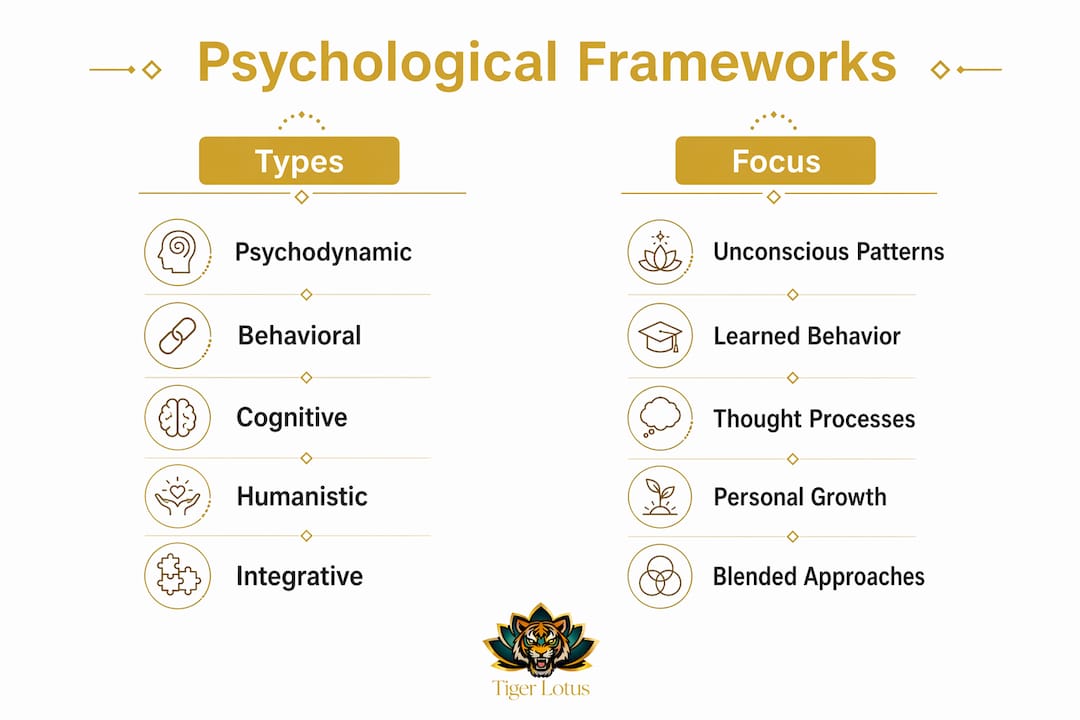
Integrative models blend approaches to address unique individual needs, directly reducing the limitations that come with single-theory reliance. This matters because most people seeking healing do not fit neatly into one category. You might carry cognitive distortions and unresolved childhood grief and a dysregulated nervous system, all at once.
Pro Tip: When evaluating a therapist or coach, ask which framework they primarily use and whether they draw from others. A practitioner who can only name one model may be working with a limited toolkit.
The biopsychosocial model sits above all five as an organizing meta-framework. It does not replace the others. It contextualizes them by insisting that biology, psychology, and social environment are always interacting. No single dimension explains the full picture.
How do psychological frameworks influence therapy and emotional healing?
The impact of psychological models on therapy has shifted significantly in recent years. Research published in 2026 shows that agency-enhancing therapy frameworks improve client outcomes by focusing on client experience and responsiveness rather than fixed theoretical orientation. The therapist's job is no longer to apply a theory to a patient. It is to create conditions where the client actively co-shapes the direction of their own healing.
This shift matters for you in a practical way. Therapeutic change is often holistic, non-linear, and client-driven, which challenges traditional linear symptom-based models. Healing rarely looks like a straight line from broken to fixed. It looks more like a spiral, where you revisit the same territory at deeper levels each time. A framework that accounts for this non-linearity will serve you far better than one that expects you to check off symptoms in sequence.
Frameworks applied in trauma-informed settings do several specific things:
- They give the therapist or coach a structured language for what they observe in your patterns
- They help you understand why a reaction is happening, not just that it is happening
- They create a shared vocabulary between you and your practitioner, reducing misattribution
- They allow for flexible adjustment when one approach stops producing movement
Pro Tip: If your current therapy feels stuck, it may not be a failure of effort. It may be a signal that the framework being used does not match the complexity of what you are carrying. Asking for an integrative approach is a legitimate clinical request.
For trauma-informed coaching specifically, frameworks like the Psychological Architecture model organize psychological life into interacting domains of Mind, Emotion, Identity, and Meaning. Structural integration across these domains sustains coherence and supports understanding of psychological stability or disruption. That is not abstract theory. It is a map of why you feel fragmented after a major loss, or why rebuilding identity after trauma takes longer than rebuilding confidence.
Why is understanding your personal psychological framework important for long-term growth?
Most people already operate under a psychological framework. They just do not know it. Research shows that everyone defaults to some mental model, usually the biomedical one, which frames emotional pain as a malfunction to be fixed rather than a signal to be understood. Recognizing your default model is the first step toward reclaiming agency over your own healing.
Here is how to begin identifying and working with your personal framework:
- Notice your default explanation. When something goes wrong emotionally, what is your first interpretation? "I am broken," "This is my past," or "I need to think differently"? Each answer points to a different underlying model.
- Assess whether that explanation produces movement. A useful framework generates new options. If your current model leaves you feeling stuck or ashamed, it is not serving you.
- Explore integrative alternatives. Modern psychology encourages combining evidence-based perspectives rather than rigid adherence to one brand of therapy. Your healing can be uniquely tailored.
- Apply the framework consistently. A framework only becomes useful when you use it to observe your patterns over time, not just in moments of crisis.
Pro Tip: Journaling through the lens of a specific framework, such as writing about a conflict using cognitive reframing questions, builds the habit of structured self-observation. This is one of the most underused tools in personal development.
The importance of psychological frameworks for long-term growth lies in their ability to turn vague emotional goals into structured paths. "I want to feel better" becomes "I want to identify the belief pattern driving my self-criticism and replace it with evidence-based alternatives." That specificity is what makes change sustainable.
How do psychological frameworks apply to personal development beyond therapy?
Psychological frameworks are not confined to clinical settings. They are equally powerful as tools for self-leadership, creative work, and navigating life transitions. The application of psychological frameworks in personal growth contexts has expanded significantly as trauma-informed approaches move into coaching, education, and leadership development.
Consider how frameworks function across different personal development contexts:
- Mindfulness practices draw from Buddhist psychology and cognitive science, both of which are structured frameworks for observing thought without identification
- Self-leadership development uses cognitive and humanistic frameworks to build the capacity to regulate emotion and make values-aligned decisions under pressure
- Creative work and storytelling benefit from psychodynamic frameworks that help writers and artists understand the unconscious material driving their themes
Rachel-m-harrison's approach to trauma-informed self-leadership draws directly from these integrative principles, helping women and creatives apply psychological insights to real decisions, not just therapeutic insight. The Sanctuary Symbolic Integration Method™ is one example of a proprietary framework that combines nervous system stabilization with meaning-making and identity work.
| Development Area | Framework Applied | Practical Outcome |
|---|---|---|
| Emotional regulation | Cognitive and somatic models | Reduced reactivity, clearer decision-making |
| Identity rebuilding | Humanistic and psychodynamic | Stronger self-concept after loss or transition |
| Boundary setting | Behavioral and cognitive | Consistent, values-based responses to pressure |
| Creative expression | Psychodynamic and narrative | Deeper, more authentic creative output |
For those exploring personal growth practices in 2026, the most effective approaches combine psychological rigor with personal relevance. A framework you understand and trust will always outperform a sophisticated model you cannot apply to your actual life.
What are the common misconceptions about psychological frameworks?
The most damaging misconception is treating a psychological framework as a complete truth system rather than a disciplined language for observing experience. Clinicians who assume psychological distress derives from one single cause produce limited therapeutic outcomes. The same applies to anyone using a self-help framework as a rigid identity rather than a flexible tool.
Theoretical blindness is the clinical term for this problem. It occurs when a practitioner or individual becomes so committed to one model that they stop seeing evidence that contradicts it. A cognitive therapist who only looks for distorted thinking will miss the somatic trauma stored in the body. A somatic practitioner who ignores belief patterns will miss the cognitive loops that reactivate the nervous system.
"Frameworks serve as disciplined languages, not absolute truths. Success comes from using them to map experience rather than force-fitting symptoms to one model." — Structural thinking in psychology
Other common misconceptions worth naming directly:
- That one framework is universally superior to others (none is, context determines fit)
- That frameworks are only relevant in formal therapy (they operate in every coaching, leadership, and self-help context)
- That switching frameworks means starting over (integration is additive, not disruptive)
- That understanding a framework intellectually is the same as applying it (insight without practice produces no lasting change)
If you are exploring integrative therapy options, the key is finding a practitioner or approach that draws from multiple paradigms while remaining responsive to your specific patterns. Flexibility is not a weakness in a framework. It is the feature that makes it work.
Key takeaways
Psychological frameworks are most effective when used as flexible, integrative scaffolds rather than fixed systems, because human experience is always multi-dimensional and non-linear.
| Point | Details |
|---|---|
| Frameworks define your healing map | The model you use determines what gets noticed, what gets missed, and what changes are possible. |
| Integrative approaches outperform single theories | Blending cognitive, somatic, and humanistic frameworks addresses the full complexity of emotional distress. |
| Most people operate with implicit frameworks | Recognizing your default mental model is the first step toward reclaiming agency in your healing. |
| Agency-enhancing therapy produces better outcomes | Frameworks that center client co-shaping of goals yield more sustained and holistic change. |
| Frameworks extend beyond therapy | Self-leadership, creative work, and personal development all benefit from structured psychological models. |
Why I think most people are using frameworks backwards
After years of working with women in emotional transition, I have noticed a consistent pattern. Most people encounter a psychological framework and immediately try to fit themselves into it. They read about attachment theory and spend months cataloging whether they are anxious or avoidant. They learn about the inner critic and start labeling every self-critical thought. The framework becomes another way to judge themselves rather than a tool for observing patterns with curiosity.
The frameworks I find most useful in my own work, and in the Sanctuary Symbolic Integration Method™, are the ones that create distance between you and your patterns rather than new categories to identify with. When you can observe a pattern from the outside, you have already begun to shift it. When you become the pattern, you are stuck inside it.
I also want to name something that most personal development content avoids. Frameworks can become a form of avoidance. Spending years learning about psychology without applying it to your actual relationships, decisions, and nervous system responses is intellectual comfort, not healing. The goal is not to understand yourself perfectly. The goal is to act differently, feel more grounded, and trust yourself more consistently. A framework that does not eventually produce those outcomes in your real life is not working for you, regardless of how sophisticated it sounds.
Explore reflection and meaning-making practices that move psychological insight into embodied change.
— RachelMHarrison
Work with a framework that fits your actual life
Rachel-m-harrison offers trauma-informed coaching that applies integrative psychological principles to the real challenges women and creatives face in transition, identity rebuilding, and emotional clarity. The Sanctuary Symbolic Integration Method™ is not a one-size approach. It draws from cognitive, somatic, humanistic, and psychodynamic frameworks to meet you where you are and help you build from there. If you are ready to move from understanding your patterns to actually changing them, explore what a trauma-informed coaching session looks like in practice. You can also review the coach vs. therapist distinctions to find the right fit for your current needs.
FAQ
What is the role of psychological frameworks in personal development?
Psychological frameworks provide structured models for understanding emotional patterns, belief systems, and behavioral habits, turning vague growth goals into specific, repeatable paths of change. A well-chosen framework gives personal development both direction and rigor.
How do psychological frameworks work in therapy?
Frameworks guide which questions a therapist asks, which patterns they prioritize, and how they structure interventions. Modern evidence-based therapy increasingly draws from multiple frameworks rather than a single theoretical orientation to match the complexity of each client.
What is the biopsychosocial framework and why does it matter?
The biopsychosocial framework holds that biological, psychological, and social factors all interact to produce health and emotional outcomes. It is the dominant modern clinical model because it accounts for the full range of influences on wellbeing, not just brain chemistry or behavior alone.
Can psychological frameworks be used outside of therapy?
Yes. Frameworks apply directly to self-leadership, creative work, boundary setting, and emotional regulation in everyday life. Trauma-informed coaching, mindfulness practices, and personal development programs all rely on structured psychological models to produce consistent results.
What happens when someone relies too heavily on one framework?
Rigid adherence to a single theory is a recognized clinical error called theoretical blindness. It causes practitioners and individuals to miss evidence that does not fit their preferred model, which limits therapeutic change and can reinforce the very patterns they are trying to shift.