TL;DR:
- Trauma-informed guidance is a framework that recognizes the widespread effects of trauma and promotes safety, trust, and healing in every interaction. It emphasizes understanding what happened rather than what is wrong, using principles like Realize, Recognize, Respond, and Resist re-traumatization. Systemic organizational alignment is essential, as individual efforts cannot sustain trauma-informed care without supportive policies, training, and evaluation.
Trauma-informed guidance is defined as a framework that recognizes trauma's widespread impact and integrates that knowledge into every interaction, relationship, and decision to promote safety, trust, and healing. The standard industry term is trauma-informed care (TIC), developed by SAMHSA (the Substance Abuse and Mental Health Services Administration), though its principles apply far beyond clinical settings. Understanding trauma-informed practices means grasping one foundational shift: the question changes from "What's wrong with you?" to "What happened to you?" That reframe is not a slogan. It is the operating logic behind every principle, every pacing decision, and every boundary you set on your path to self-leadership.
What is trauma-informed guidance explained?
Trauma-informed guidance is built on SAMHSA's 4 Rs framework: Realize, Recognize, Respond, and Resist re-traumatization. Each "R" is a commitment, not a step you complete once and move past.
- Realize means accepting that trauma is common and affects mental, physical, social, emotional, and spiritual well-being. SAMHSA defines trauma as any event experienced as harmful or life-threatening with lasting adverse effects across multiple domains of well-being. That scope matters because it means trauma is not reserved for extreme events. Chronic stress, relational wounds, and systemic harm all qualify.
- Recognize means seeing trauma's signs in yourself and others without labeling them as weakness or dysfunction.
- Respond means integrating that knowledge into how you communicate, pace yourself, and make decisions.
- Resist re-traumatization means actively designing your environment, relationships, and routines so they do not recreate the conditions of harm.
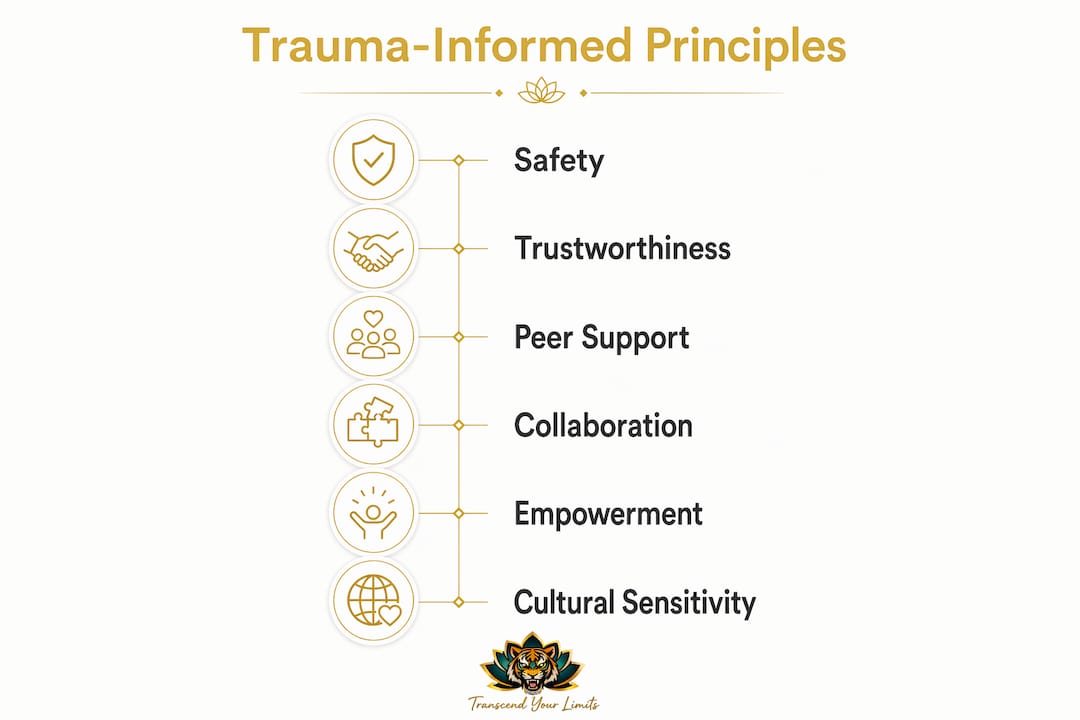
SAMHSA's 6 core principles give the 4 Rs their structure: Safety; Trustworthiness and Transparency; Peer Support; Collaboration and Mutuality; Empowerment, Voice, and Choice; and Cultural, Historical, and Gender Issues. These principles demand ongoing commitment and cultural change. They are not a checklist.
Pro Tip: When you first encounter these principles, resist the urge to apply all six at once. Start with Safety. Nothing else works until you feel safe enough to stay present.

How does trauma-informed guidance shift traditional practices?
Traditional support models ask what is broken and try to fix it. Trauma-informed care asks what happened and tries to understand it. That shift changes everything downstream.
The Rutgers Brandt Center identifies four concrete areas where this shift shows up in practice:
- Documentation. In traditional models, notes and records are written about the client. In trauma-informed practice, the client is actively involved in what gets recorded and how it is framed. This reduces the experience of being observed rather than heard.
- Decision-making. Shared decision-making replaces top-down directives. You are not told what to do next. You are asked what feels manageable, what you need more information about, and what pace works for you.
- Pacing. Trauma-informed guidance treats pacing as a clinical and personal tool. Rushing through difficult material recreates the feeling of being overwhelmed and out of control. Regulated pacing is a protective mechanism, not a delay.
- Environmental design. Physical and relational environments are assessed for potential triggers. Waiting rooms, intake forms, and even the language used in communications are reviewed to reduce unnecessary threat responses.
These changes do not happen through individual goodwill alone. Systemic alignment across policies, leadership, and evaluation is required to avoid recreating threat in routine interactions. One compassionate practitioner inside a rigid, punitive system cannot sustain trauma-informed practice. The system itself must change.
How can you apply trauma-informed methods for self-leadership?
Applying trauma-informed methods to your own growth means treating yourself with the same principles you would want from a skilled, ethical guide. This is where trauma-informed care basics translate directly into daily life.
The PLOS ONE 2026 review of IPV survivors found that high satisfaction in trauma-informed programs is linked to relational safety and agency, not forced disclosures or pushing through distress. That finding applies to self-directed healing too. Forcing yourself to process faster than your nervous system can handle is not discipline. It is re-traumatization.
Here is how to put trauma-sensitive strategies into practice for personal growth:
- Create predictability. Set consistent routines for reflection, rest, and emotional processing. Predictability signals safety to a nervous system that learned to expect chaos.
- Name your choices. Before any significant decision or conversation, identify what choices you actually have. Agency is not just about having options. It is about recognizing them.
- Pace your healing deliberately. Regulated pacing means setting agreements with yourself about how much emotional material you engage with in a given session or day. Treat it like physical training: intensity without recovery creates injury.
- Build trust through transparency with yourself. Journaling, reflection practices, and honest self-assessment build the internal trustworthiness that trauma often erodes.
- Seek collaboration, not correction. Whether working with a coach, a therapist, or a trusted friend, look for relationships where your input shapes the direction. The Sanctuary Symbolic Integration Method™ at Rachel-m-harrison is built on exactly this kind of co-created, paced approach.
Pro Tip: If you notice yourself bracing before a reflection exercise or coaching session, that is data. Pause and ask what would make this feel safer before continuing. Safety is not a luxury. It is the prerequisite.
Embodying self-trust is one of the most concrete outcomes of applying these principles consistently. It is not about confidence in the conventional sense. It is about knowing your own signals and trusting that you will respond to them with care.
Trauma-informed partnership principles create safety through predictable information flow and choice architecture, co-creating plans that reduce distress and promote collaboration. In self-leadership terms, that means building your own internal "choice architecture": knowing your values, your limits, and your next step before you need them.
What organizational domains support trauma-informed care?
Understanding trauma-informed practices at the organizational level matters even for individuals. The systems around you shape your healing environment. SAMHSA's 10 organizational domains define what a genuinely trauma-informed organization looks like from the inside out.
| Domain | Role in Trauma-Informed Practice |
|---|---|
| Governance and Leadership | Sets the tone and commits resources to trauma-informed values across the organization |
| Policy and Procedures | Embeds trauma-sensitive language and protocols into everyday operations |
| Staff Training and Workforce Development | Builds shared understanding of trauma's impact and appropriate responses |
| Quality Assurance and Evaluation | Measures whether trauma-informed practices are actually reducing harm |
| Engagement and Involvement | Centers the voices of those with lived experience in program design |
| Cross-Sector Collaboration | Connects services so individuals do not fall through gaps between systems |
| Financing | Allocates funding to sustain trauma-informed staffing and training |
| Physical Environment | Designs spaces that signal safety rather than surveillance or threat |
| Screening, Assessment, and Treatment | Uses trauma-informed tools that avoid re-traumatizing through intake processes |
| Progress Monitoring | Tracks individual outcomes with attention to safety, trust, and empowerment |
Kindness alone does not sustain trauma-informed care. When these domains are misaligned, even well-meaning organizations send mixed messages. A staff member trained in trauma-informed language working inside a punitive policy structure cannot protect the people they serve. For individuals choosing coaches, therapists, or programs, this table is a practical screening tool. Ask about training, evaluation, and how your input shapes the work.
Key takeaways
Trauma-informed guidance works because it replaces judgment with curiosity, control with collaboration, and urgency with regulated pacing across every level of interaction and system.
| Point | Details |
|---|---|
| The core reframe | Shifting from "What's wrong?" to "What happened?" changes every downstream decision and interaction. |
| SAMHSA's 6 principles | Safety, Trustworthiness, Peer Support, Collaboration, Empowerment, and Cultural Awareness form the non-negotiable foundation. |
| Pacing as protection | Regulated pacing is a trauma-sensitive strategy that prevents re-traumatization during healing. |
| Systems matter | Individual kindness cannot substitute for organizational alignment across policy, training, and evaluation. |
| Self-leadership application | Agency, transparency, and choice architecture translate trauma-informed principles into daily personal growth practice. |
The misunderstanding that costs people the most
Most people who come to me have already tried to heal by pushing harder. They have read the books, done the journaling, attended the workshops. They are not lazy or resistant. They are exhausted from treating their healing like a project with a deadline.
The most common misunderstanding I see about trauma-informed guidance is that it is about being gentle in a soft, indefinite way. It is not. It is about being precise. Pacing is not permission to avoid. Collaboration is not permission to stay comfortable. Safety is not the absence of challenge. It is the presence of enough stability to actually engage with the challenge without your nervous system shutting you down.
What I have found, working with women in transition and creative leaders rebuilding their clarity, is that the moment someone stops asking "Why can't I just get over this?" and starts asking "What do I need to feel safe enough to move forward?", everything changes. That is not a soft question. It is the most rigorous question you can ask yourself.
The other thing I want to name directly: trauma-informed guidance is not therapy, and it is not a substitute for clinical care when clinical care is what someone needs. What it is, in a coaching context, is a framework for how I show up, how I pace our work, how I share information, and how I make sure your voice shapes every step. The difference between coaching and therapy matters, and any practitioner worth working with will be transparent about it.
If you are seeking self-leadership and the tools keep slipping, the framework itself may be the missing piece.
— RachelMHarrison
Ready to experience trauma-informed coaching?
Understanding the principles is the first step. Experiencing them in a structured, paced, and collaborative space is where real change happens.
At Rachel-m-harrison, the Sanctuary Symbolic Integration Method™ is built on every principle covered in this article: safety, transparency, regulated pacing, and your voice at the center of the work. Whether you are new to trauma-informed support or ready to go deeper, the step-by-step self-leadership guide is a strong starting point. For those weighing their options, the coaching vs. therapy breakdown clarifies exactly what each path offers so you can choose with clarity and confidence.
FAQ
What is trauma-informed guidance in simple terms?
Trauma-informed guidance is a framework that recognizes trauma's impact and responds with safety, trust, empowerment, and collaboration rather than judgment or urgency. It applies in clinical, coaching, and personal growth contexts.
How is trauma-informed care different from therapy?
Trauma-informed care is a set of principles that shapes how support is delivered, while therapy is a specific clinical intervention. A coach, educator, or organization can be trauma-informed without providing therapy.
What are samhsa's 6 core principles of trauma-informed care?
SAMHSA's 6 principles are Safety; Trustworthiness and Transparency; Peer Support; Collaboration and Mutuality; Empowerment, Voice, and Choice; and Cultural, Historical, and Gender Issues.
Can i apply trauma-informed principles to my own personal growth?
Yes. Regulated pacing, building internal trust, naming your choices, and creating predictable routines are all trauma-sensitive strategies you can apply to self-directed healing and self-leadership without a clinical setting.
Why does organizational alignment matter for trauma-informed practice?
Without systemic alignment across leadership, policy, training, and evaluation, even compassionate practitioners can inadvertently recreate conditions of harm. Individual goodwill is not enough to sustain trauma-informed care.