TL;DR:
- Editorial guidance coaching is a long-term, personalized partnership that enhances writers’ skills, confidence, and storytelling clarity. It differs from editing by focusing on developing the writer’s process over months or years, fostering independence and inner judgment. This coaching benefits women in transition who seek to articulate their stories authentically and powerfully.
Editorial guidance coaching is a collaborative, ongoing process that strengthens a writer's craft, decision-making, and storytelling confidence over time rather than simply correcting a single manuscript. Unlike a one-time edit, this form of support, often called developmental coaching or writing coaching in professional circles, builds the skills you carry into every future project. For women navigating personal reinvention, career pivots, or the need to tell their stories with clarity and power, understanding what editorial guidance coaching involves can be the difference between staying stuck and finally writing with purpose. Rachel-m-harrison offers this kind of trauma-informed writing support specifically for women who want to tell their stories safely and powerfully.
What is editorial guidance coaching and how does it work?
Editorial guidance coaching is defined as a sustained, dialogue-driven partnership between a writer and a coach focused on improving the writer's process, instincts, and long-term craft. The industry terms you will encounter include writing coaching, developmental coaching, and manuscript coaching. All describe the same core model: the coach teaches, the writer revises, and both reflect together on what is working and why.
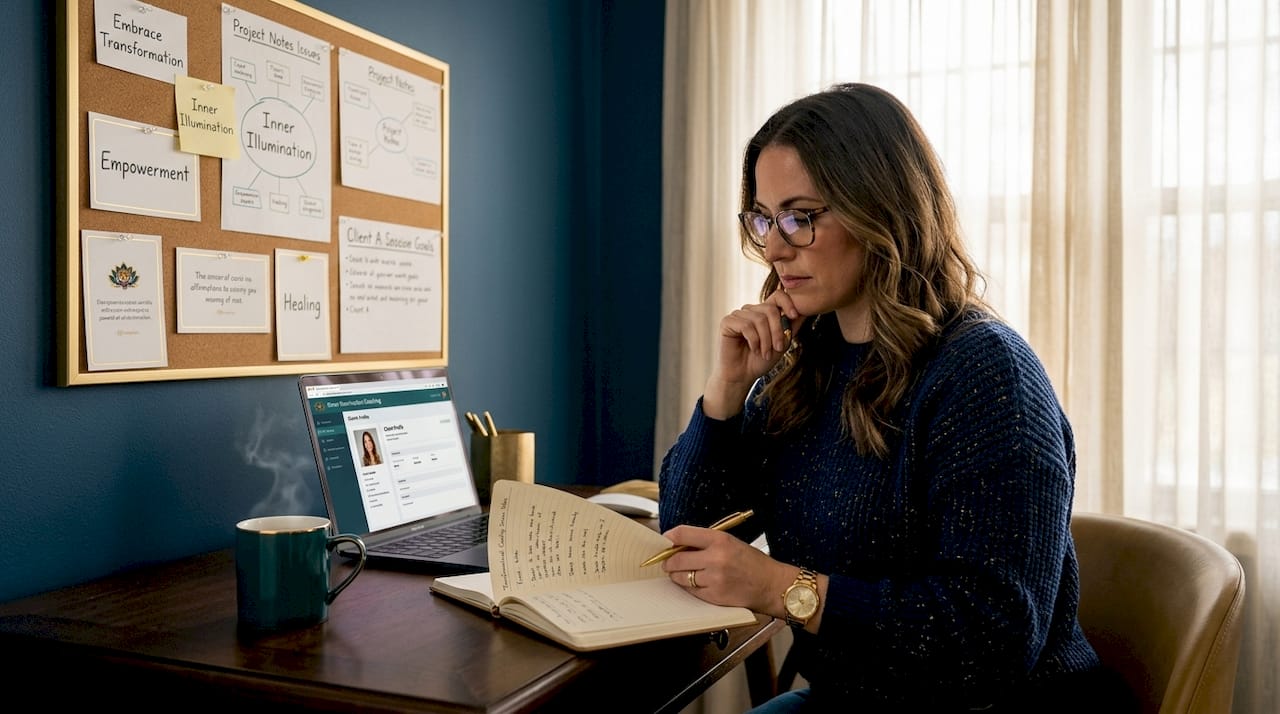
The process is iterative and spans months to years depending on the depth of the project and the writer's goals. This timeline matters because real craft development cannot happen in a single session. A coach who works with you over six months can identify recurring patterns in your writing, name them clearly, and teach you to catch them yourself before the next session.
What makes editorial guidance distinct from a proofreading service or a writing class is the personalization. Your coach responds to your specific manuscript, your specific voice, and your specific blocks. Tools like Grammarly or Hemingway Editor can flag surface-level issues, but they cannot ask you why your protagonist goes silent in chapter three or help you decide whether your memoir's structure is serving your emotional truth.
The importance of editorial advice in this model is not just technical. It is relational. The best coaching builds your ability to make strong creative decisions independently, so you are not returning to a coach forever but growing into a writer who trusts her own judgment.
How does editorial coaching differ from traditional editing?
The clearest way to understand the difference is this: editing fixes the manuscript, coaching fixes the writer. Both serve a purpose, but they operate on different timescales and with different goals.
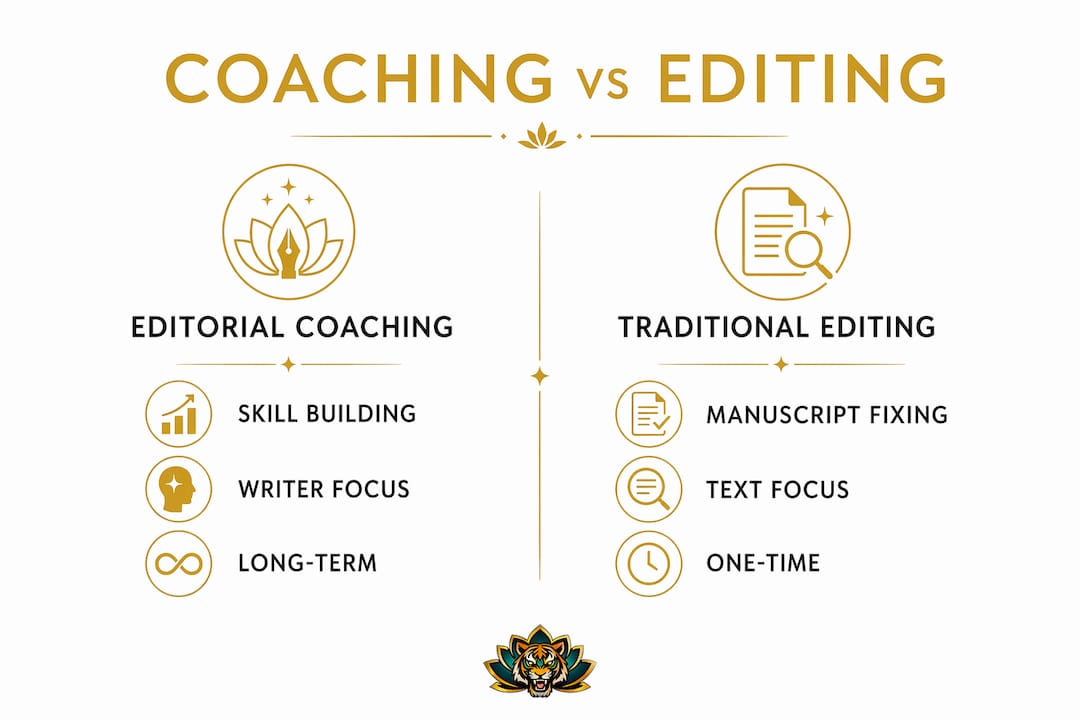
Coaching develops your writer's toolbox over time through pattern recognition and guided revision, while developmental editing delivers a one-time product assessment. A developmental editor reads your full manuscript and returns a detailed letter identifying structural problems. That letter is enormously useful. But it does not teach you how to avoid those problems in your next book.
Copyediting sits even further from coaching. A copyeditor corrects grammar, punctuation, and consistency. The relationship is transactional and document-focused. Coaching is educational and writer-focused.
Here is how the three approaches compare:
| Support type | Focus | Duration | Primary outcome |
|---|---|---|---|
| Editorial coaching | Writer's skills and process | Months to years | Craft independence and confidence |
| Developmental editing | Manuscript structure and story | One-time engagement | Stronger single manuscript |
| Copyediting | Grammar, style, and consistency | One-time engagement | Clean, polished text |
Cost is another meaningful difference. Coaching reduces future editing costs by teaching writers to reach publishable quality themselves. A writer who has worked with a coach for a year typically needs far less developmental editing on her next project because she has already internalized the questions a developmental editor would ask.
Pro Tip: If you are early in your writing practice or working on a long-form project like a memoir or novel, coaching will almost always give you more return than a single developmental edit. Save the developmental edit for when your manuscript is already strong.
What to expect during editorial coaching sessions
The practical structure of editorial guidance coaching is more defined than most writers expect. Sessions typically run 30 to 60 minutes, with writers submitting pages one week in advance so the coach has time to read carefully and prepare feedback. That feedback usually arrives in two forms: in-line comments on the document itself and a summary letter that addresses big-picture patterns.
What happens in the session itself is where the real work lives. Rather than the coach reading her notes aloud, the best sessions are conversations. The coach asks why you made a structural choice. You explain your thinking. The coach reflects back what she heard and offers a different lens. You leave with questions to sit with, not just corrections to apply.
A typical coaching engagement might look like this:
- Week one: Initial consultation where you share your project summary, goals, and timeline
- Ongoing sessions: Bi-weekly or monthly meetings with page submissions one week prior
- Between sessions: Revision exercises, journaling prompts, or structural mapping tasks
- Mid-engagement check-in: A dedicated session to assess progress and recalibrate goals
- Closing session: Reflection on growth, remaining challenges, and next steps as an independent writer
Preparation shapes the quality of every session. Writers who arrive with a clear sense of what they are trying to accomplish in a given chapter get far more targeted feedback than those who submit pages without context.
Pro Tip: Before your first consultation, write a one-page project summary that answers three questions: What is this piece about? Who is it for? What do you want readers to feel or do after reading it? This single document will orient your coach and save you both significant time.
Who benefits most from editorial guidance coaching?
Editorial guidance coaching serves writers at a specific crossroads. The ideal candidate is not a complete beginner who needs foundational writing instruction, nor a polished professional who simply needs a manuscript reviewed. The writers who gain the most are those who have something real to say but are struggling to say it clearly, consistently, or with confidence.
That description fits a large number of women navigating transitions. Career changers writing thought leadership content for the first time. Women processing grief, divorce, or reinvention through memoir. Creatives who have been writing privately for years but cannot seem to finish or share their work. The overlap between editorial coaching and life coaching is real and well-documented. The best coaches hold space for psychological blocks and vulnerability, recognizing that a writer's silence on the page often mirrors something unresolved in her life.
Storytelling is not just a craft skill. For women in transition, it is a tool for making sense of experience, reclaiming agency, and communicating identity on their own terms. A coach who understands this does not just ask "Is this sentence clear?" She asks "Is this the story you actually want to tell?"
"The most powerful editorial work I have witnessed happens when a writer stops trying to write the story she thinks she should tell and starts writing the one she has been carrying for years. That shift does not come from a grammar check. It comes from a conversation with someone who sees both the writer and the work."
Rachel-m-harrison's approach to coaching women through creative and emotional transitions is built on exactly this recognition. Storytelling clarity and emotional clarity are not separate goals. They reinforce each other.
How to find and choose an editorial guidance coach
Finding the right coach requires more than a Google search. The editorial coaching field has no single licensing body, so quality varies widely. Here is a practical process for finding and vetting a coach who is right for your project and your working style.
-
Start with writing communities and associations. Organizations like The Authors Guild, Reedsy, and The OpEd Project maintain directories of vetted writing coaches with verifiable credentials and client histories.
-
Read sample feedback before committing. Ask any prospective coach for a sample editorial letter or anonymized in-line comments. This tells you more about her coaching style than any testimonial.
-
Interview her on her process. Bring clear goals and project summaries to your initial consultation and ask direct questions: How do you structure sessions? What does feedback look like? How do you handle it when a writer disagrees with your assessment?
-
Assess the dialogue dynamic. Effective coaching builds client independence through dialogue, not prescription. If a coach talks at you rather than with you in the consultation, that pattern will continue in sessions.
-
Define your story's intent before you begin. A clear thesis or intent shapes every coaching decision, from tone to structure to revision strategy. Know whether your piece is meant to persuade, educate, or bear witness before your first session.
-
Trust the chemistry, but verify the competence. Warmth matters in a coaching relationship, especially when the work is emotionally charged. But warmth without craft knowledge is not enough. Look for a coach who can name specific techniques, not just offer encouragement.
The psychological dimensions of writing are real, and a coach who acknowledges them creates a safer space for the kind of honest work that produces strong writing. If you feel judged or rushed in a consultation, move on.
Key takeaways
Editorial guidance coaching builds lasting craft skills and storytelling confidence through sustained, personalized dialogue rather than one-time manuscript fixes.
| Point | Details |
|---|---|
| Coaching vs. editing | Coaching develops the writer's skills over time; editing improves a single manuscript. |
| Session structure | Sessions run 30 to 60 minutes with pages submitted one week in advance for review. |
| Ideal candidates | Writers in transition, at a creative plateau, or working on emotionally complex long-form projects benefit most. |
| Finding a coach | Vet coaches through writing associations, sample feedback, and a structured initial consultation. |
| Story intent matters | Defining whether your piece aims to persuade, educate, or witness shapes every coaching decision. |
Why I believe editorial coaching changes more than your writing
I have worked with women at every stage of the writing process, and the pattern I see most consistently is this: the writing problem is rarely just a writing problem. A woman who cannot finish her memoir is not struggling with structure. She is struggling with permission. A woman whose essays feel flat is not missing technique. She is writing around the thing she actually needs to say.
Editorial guidance coaching, done well, creates the conditions for that deeper work to happen. It is not therapy, and a good coach will be clear about that boundary. But the best coaching relationships hold enough psychological safety that a writer can take real risks on the page. That is where the work gets good.
What I find most meaningful about this kind of support is that it is designed to make itself unnecessary. Coaching's iterative method teaches writers to diagnose their own patterns and fix them proactively. A writer who has been coached well for a year does not need the same level of support in year two. She has internalized the questions. She has built the instincts. She owns her craft.
For women navigating transitions, that ownership is not a small thing. It is the difference between telling your story and waiting for someone else to tell it for you. I believe every woman who has a story worth telling, which is every woman, deserves support that respects both her intelligence and her emotional reality. That is what editorial guidance coaching, at its best, provides.
— RachelMHarrison
Ready to tell your story with clarity and power?
If this article has clarified what editorial guidance coaching involves and you are wondering whether it is right for you, Rachel-m-harrison offers coaching designed specifically for women who want to write with emotional honesty and creative confidence.
The approach at Rachel-m-harrison integrates editorial guidance with the Sanctuary Symbolic Integration Method™, a trauma-informed framework that helps you understand the emotional patterns shaping your writing and your life. Whether you are working on a memoir, building a thought leadership voice, or simply trying to finish the piece you have been carrying for years, the support here meets you where you are. Explore the full range of coaching services and packages or book a session to begin.
FAQ
What is editorial guidance coaching in simple terms?
Editorial guidance coaching is an ongoing, personalized partnership where a coach helps you strengthen your writing craft, storytelling instincts, and creative confidence over time. Unlike editing, it focuses on developing your skills rather than fixing a single document.
How long does an editorial coaching engagement typically last?
Coaching engagements range from a few months to several years depending on project complexity and the writer's goals. Most writers see meaningful craft development within three to six months of consistent sessions.
How is editorial coaching different from a writing class?
A writing class teaches general principles to a group. Editorial coaching applies specific, personalized feedback to your actual work and your specific creative challenges, making it far more targeted and immediately applicable.
Who should consider working with an editorial coach?
Writers working on long-form projects like memoirs or essay collections, those facing a creative plateau, and women processing personal transitions through storytelling are the strongest candidates for editorial guidance coaching.
How do I prepare for my first editorial coaching session?
Bring a one-page project summary that describes your project, your intended audience, and your goals for the engagement. Arriving prepared allows your coach to tailor feedback from the very first session.