TL;DR:
- Holistic self-leadership involves intentionally aligning thoughts, emotions, and behaviors with core values across all life areas, not just work or relationships. It emphasizes self-awareness, emotional regulation, and dynamic energy shifting rather than striving for perfect balance, supporting genuine growth and creative expression. Regular reflection, value clarification, and community support help women rebuild inner clarity, especially during transitions and personal development.
Most people assume self-leadership means better habits, tighter schedules, or stronger willpower. That framing is incomplete, and it leaves a lot of women stuck. What is holistic self-leadership, really? It's the intentional practice of directing your thoughts, emotions, and behaviors in alignment with your core values across every domain of your life. Not just at work. Not just in relationships. All of it, at once, as one living system. If you've ever felt like you were doing everything "right" and still felt off, this is the missing piece.
Table of Contents
- Key takeaways
- What holistic self-leadership actually means
- Self-awareness as the engine of clarity
- Dynamic integration, not perfect balance
- How to practice self-leadership every day
- My honest take on holistic self-leadership
- Ready to go deeper?
- FAQ
Key takeaways
| Point | Details |
|---|---|
| More than productivity | Holistic self-leadership integrates emotional, cognitive, behavioral, and spiritual dimensions, not just time management. |
| Self-awareness is the foundation | Non-judgmental observation of your own patterns enables aligned decisions and breaks autopilot behaviors. |
| Balance is a myth | Dynamic integration means intentionally shifting energy across life facets based on values, not splitting time equally. |
| Inner motivation sustains growth | Values-aligned internal drive outlasts any external reward system, especially during life transitions. |
| Practice is daily and personal | Consistent reflection rituals, value clarification, and emotional clarity exercises build lasting self-leadership capacity. |
What holistic self-leadership actually means
The word "self-leadership" gets misused constantly. It ends up filed next to productivity apps and morning routine videos. But holistic self-leadership is about intentionally directing thoughts, emotions, and behaviors aligned with your core values across every facet of your life. That includes how you show up for yourself, your family, your creative work, and your broader community.
Think of those four areas as the four holes in a button. They're separate openings, but one thread runs through all of them. When that thread is your values, every facet holds together with integrity. When the thread is fear, obligation, or external pressure, the whole thing eventually unravels.
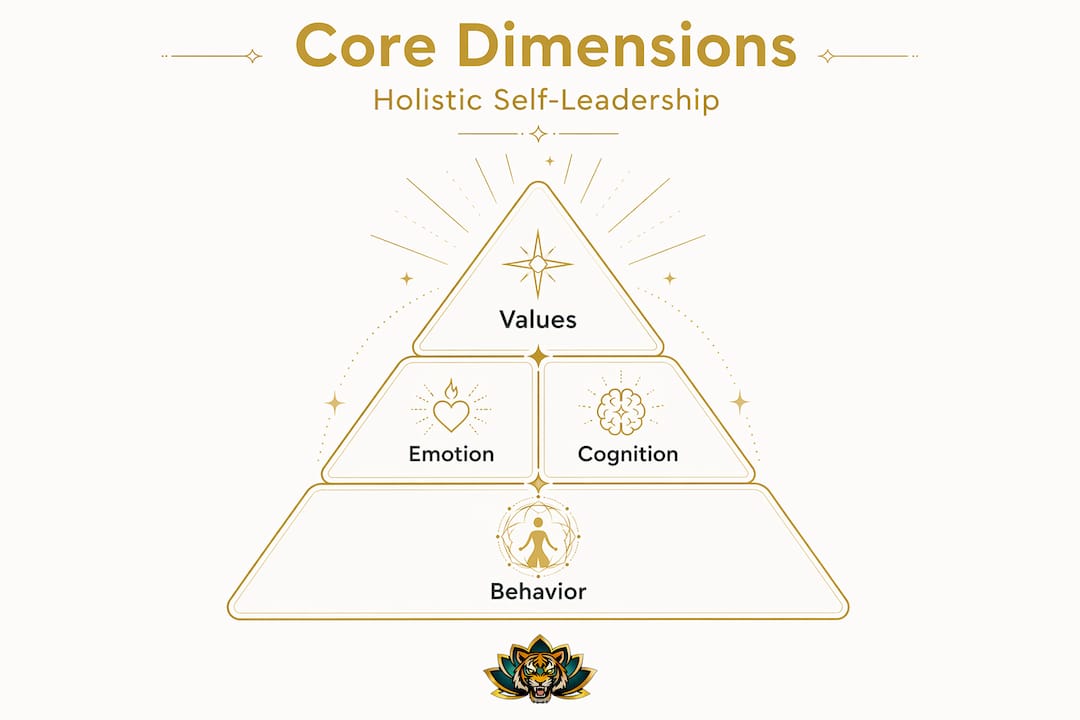
The three core dimensions
Holistic self-leadership operates across three distinct dimensions that work together constantly:
- Cognitive: The beliefs and mental patterns you bring to situations. This includes your inner narrative, your assumptions about what you're capable of, and how you interpret setbacks.
- Emotional: How you recognize, process, and regulate your feelings without suppressing or being overwhelmed by them. Intentional self-regulation is what allows you to stay grounded when circumstances get difficult.
- Behavioral: The daily practices, habits, and choices that either align with your values or slowly erode them.
Many self-improvement approaches target only one of these dimensions. They give you a behavior strategy with no emotional foundation, or they build emotional awareness with no behavioral structure to support it. Holistic self-leadership connects all three.
Pro Tip: Before adopting any new self-improvement practice, ask yourself which dimension it targets. If it only addresses one, build support for the other two before launching in.
How it differs from traditional leadership models
Traditional leadership frameworks focus on managing people, resources, and outcomes. Holistic self-leadership focuses on managing the one variable that actually shapes all of those things: yourself. It's not about authority or external performance. As one framework puts it, the power of holistic leaders comes from inner integrity, not from position or perfection.
| Traditional leadership | Holistic self-leadership |
|---|---|
| Focused on managing others | Focused on understanding yourself first |
| Success defined externally | Success defined by values alignment |
| Behavioral performance metrics | Integration of emotional and cognitive growth |
| Balance as equal time distribution | Dynamic, intentional energy shifting |
| Motivated by outcomes | Motivated by internal meaning |
Self-awareness as the engine of clarity
You cannot lead yourself anywhere useful if you don't know where you are right now. That's what makes self-awareness the true foundation of a holistic approach to leadership. It's not about endless self-analysis or self-criticism. It's about seeing yourself clearly enough to make conscious choices instead of reactive ones.

Research shows that two-thirds of daily behaviors are automatic. You're running on patterns built from past experiences, old beliefs, and nervous system responses that made sense at one point but may no longer serve you. Without awareness, you're mostly on autopilot.
Here's how to start building genuine self-awareness in a way that supports rather than drains you:
- Self-monitoring without judgment. Notice what you're thinking and feeling throughout the day without labeling it as good or bad. Observation is the first act of leadership.
- Ask "what" instead of "why." Research shows that "what am I feeling right now?" leads to clarity, while "why do I always do this?" tends to spiral into rumination. That distinction matters.
- Short daily reflection. Five minutes at the end of each day reviewing your emotional state, your choices, and your energy levels builds a clear picture over time. The reflection-to-clarity connection is well documented.
- Invite feedback. Trusted people in your life see patterns you can't. Creating space to hear them without defensiveness is an advanced self-leadership skill.
"Effective self-leadership requires shifting from reacting to being the deliberate conductor of your internal and external experience." — Psychology Today
One critical distinction: healthy self-awareness is not the same as rumination. Rumination increases anxiety and depression, while reflective self-examination predicts genuine personal growth. The difference is posture. Rumination is stuck and cyclical. Awareness is curious and forward-moving.
Pro Tip: If your self-reflection practice starts to feel heavy or repetitive, add a self-compassion phrase before you begin, such as "I am learning, not failing." People high in self-compassion show 26% lower stress and significantly more resilience over time.
Dynamic integration, not perfect balance
Here's where defining holistic self-management gets more nuanced. Most people chase balance as if it's a destination, a perfect pie chart of time spent equally across life domains. That model sets you up for chronic guilt. You're always failing somewhere.
Dynamic integration replaces that myth with something more honest. At different seasons of your life, different facets will demand more of you. A new creative project might pull more energy for a few months. A health challenge might require you to pull back from professional commitments. A grieving family member might temporarily become the center of everything.
None of that is failure. It's intentional prioritization guided by what your values say matters most right now.
Recognizing when a facet is depleted
The earliest sign that a life facet is out of alignment usually isn't cognitive. It shows up as physical tension, creative paralysis, persistent low-level irritability, or that flat feeling that nothing matters much. Dynamic integration requires recognizing these internal signals before you can name them intellectually.
Signs you may need to realign:
- You're performing well externally but feel hollow inside
- Your creative output has stalled without a clear external reason
- You feel resentful in roles that once felt meaningful
- You're pushing through exhaustion rather than responding to it
- Decisions that once felt clear now feel murky or anxiety-producing
When these signals appear, the self-leadership move is not to push harder. It's to pause, identify which facet is starved of attention, and make a values-based adjustment. Building internal motivation from values alignment produces far more durable energy than any external goal ever will.
How to practice self-leadership every day
Theory only helps if it lands somewhere real. Here's how to build a daily self-leadership practice that actually sticks, especially if you're in the middle of a life transition or creative block.
Start with value clarification. Before you can lead yourself anywhere, you need to know what matters most to you right now, not five years ago, not what you were raised to value. Write down five current values and revisit them monthly.
Build small rituals that signal alignment. A ritual doesn't have to be elaborate. It can be ten minutes of quiet before your phone, a walk without a podcast, or a one-sentence journal entry at night. Self-leadership workflows become reliable when they're small enough to sustain.
- Identify your personal triggers. Notice the specific situations, people, or conditions that pull you out of alignment. When you can name them in advance, you interrupt the autopilot response.
- Set micro-goals anchored to values. Instead of "be more productive," try "spend 20 minutes on my creative project three times this week because creative expression is a core value." The specificity matters.
- Communicate your values to people in your life. This isn't oversharing. It's accountability. When people around you understand what you're orienting toward, they can support it rather than inadvertently undermine it.
- Use emotional clarity exercises regularly. Practices like body scanning, naming emotions with precision, and tracking emotional patterns build the inner literacy that self-leadership depends on. The emotional clarity exercises at rachel-m-harrison.com are specifically designed for women in creative growth and transition.
Pro Tip: If you're navigating a life transition, don't try to rebuild your entire self-leadership practice at once. Aligning empathy with core values reduces stress and moral disengagement significantly. Start with one domain, one ritual, one honest conversation with yourself each day.
For women specifically, mindful self-leadership strategies benefit enormously from community. Finding even one person who understands the practice creates reflection and accountability that solo effort rarely sustains. Consider how a trauma-informed approach adds an additional layer of support when past experiences are part of what's being worked through.
My honest take on holistic self-leadership
I used to think that if I could just get the balance right, everything would settle. I mapped out my time, protected my calendar, told myself I was being intentional. What I was actually doing was managing outputs while completely ignoring what was happening inside.
What shifted for me was realizing that self-leadership isn't something you get right once. It's a practice you return to, over and over, especially after you've drifted. The reconstruction phase after life change is the hardest part for most women I've worked with. It can feel like starting over. It's not. It's building from a truer foundation.
The women I've seen make the most meaningful progress aren't the ones with the most rigorous systems. They're the ones willing to be honest with themselves about where they actually are, without turning that honesty into a weapon against themselves. Self-compassion isn't softness. It's the structural requirement for sustained self-awareness.
And for creative women especially: your creativity is not separate from your self-leadership. It's a direct expression of it. When your inner life is muddy, your creative work reflects that. When you lead yourself with clarity and kindness, something opens. That's not a metaphor. I've watched it happen too many times to call it a coincidence.
— RachelMHarrison
Ready to go deeper?
If this resonated, you're likely ready for more than theory. At rachel-m-harrison.com, there is one-on-one coaching built specifically for women who want to rebuild emotional clarity and practice self-leadership in a grounded, trauma-informed way. The coaching guide walks you through the full framework, including how the Sanctuary Symbolic Integration Method™ helps you understand your emotional patterns and reconnect with your values. If you prefer a more personal starting point, you can also book a session directly. This work meets you wherever you are, especially if you're in transition or rebuilding after a period of disconnection.
FAQ
What is holistic self-leadership?
Holistic self-leadership is the practice of intentionally directing your thoughts, emotions, and behaviors in alignment with your core values across all major life domains: self, family, career, and community. It differs from standard self-improvement by integrating cognitive, emotional, behavioral, and spiritual dimensions into one connected practice.
How does self-awareness support self-leadership?
Self-awareness is the foundation of self-leadership because it allows you to notice autopilot patterns before they override your intentions. Non-judgmental observation of your own thoughts and feelings creates the pause between stimulus and response where real choice lives.
What is the difference between balance and dynamic integration?
Balance implies an equal distribution of time and energy across life areas, which is rarely realistic or even desirable. Dynamic integration means deliberately shifting energy based on what your values say matters most in a given season, without guilt about the shift.
Can holistic self-leadership help with creative blocks?
Yes. Creative blocks often signal a misalignment between your inner emotional state and your external actions. Practicing emotional clarity and rebuilding your connection to core values frequently restores creative flow because your creativity is a direct expression of your inner coherence.
How long does it take to develop self-leadership skills?
Self-leadership develops through consistent daily practice rather than a fixed timeline. Most people begin noticing meaningful shifts in clarity and decision-making within a few weeks of regular reflection, value clarification, and emotional awareness work.