
TL;DR:
- Shadow work involves accepting and owning the unconscious parts of oneself rooted in Carl Jung’s theory of the shadow. It enhances emotional regulation, authentic relationships, and personal growth through techniques like journaling and projection tracking. This lifelong practice requires patience, ethical responsibility, and often professional support to navigate its challenging and transformative process.
Most people stumble across shadow work expecting a spiritual ritual or a self-help shortcut for getting rid of "bad" traits. The reality is far more grounded, far more demanding, and honestly, far more liberating. What is shadow work, really? It's a psychological practice rooted in Carl Jung's theory of the unconscious that asks you to stop fighting the parts of yourself you've hidden away and start owning them instead. This article breaks down the definition, the theory, practical techniques, and what no one tells you about the difficult middle.
Table of Contents
- Key takeaways
- What shadow work actually means
- Why shadow work matters for real growth
- Practical shadow work techniques to start with
- Navigating the hard parts of shadow work
- My honest take on shadow work's real power
- Ready to go deeper with guided support?
- FAQ
Key takeaways
| Point | Details |
|---|---|
| Shadow work is integrative | It's not about fixing flaws but accepting and owning the full range of who you are. |
| It has psychological roots | Carl Jung's theory of the shadow forms the scientific and clinical foundation of this work. |
| Real benefits are measurable | Practicing shadow work improves emotional regulation, boundary setting, and relationship quality. |
| Techniques are learnable | Journaling, active imagination, and shadow mapping are practical starting points for beginners. |
| Professional support matters | Trauma-related shadow work is safer and more effective with a qualified therapist or coach. |
What shadow work actually means
The shadow work definition most people encounter online tends to be vague at best and misleading at worst. So let's be precise. Swiss psychiatrist Carl Jung described the shadow as the unconscious part of the personality containing everything the ego refuses to identify with. This includes traits you learned were "bad," "too much," or socially unacceptable as a child, and it also includes positive qualities you were taught to suppress, like ambition, sensuality, or assertiveness.
Your shadow forms through a completely normal process. As children, we learn which parts of ourselves earn love and which parts get rejected, shamed, or ignored. Over time, you tuck the unwanted pieces into the unconscious. You develop what Jung called the persona, the face you show the world. The gap between your persona and your shadow is where a lot of emotional pain lives.
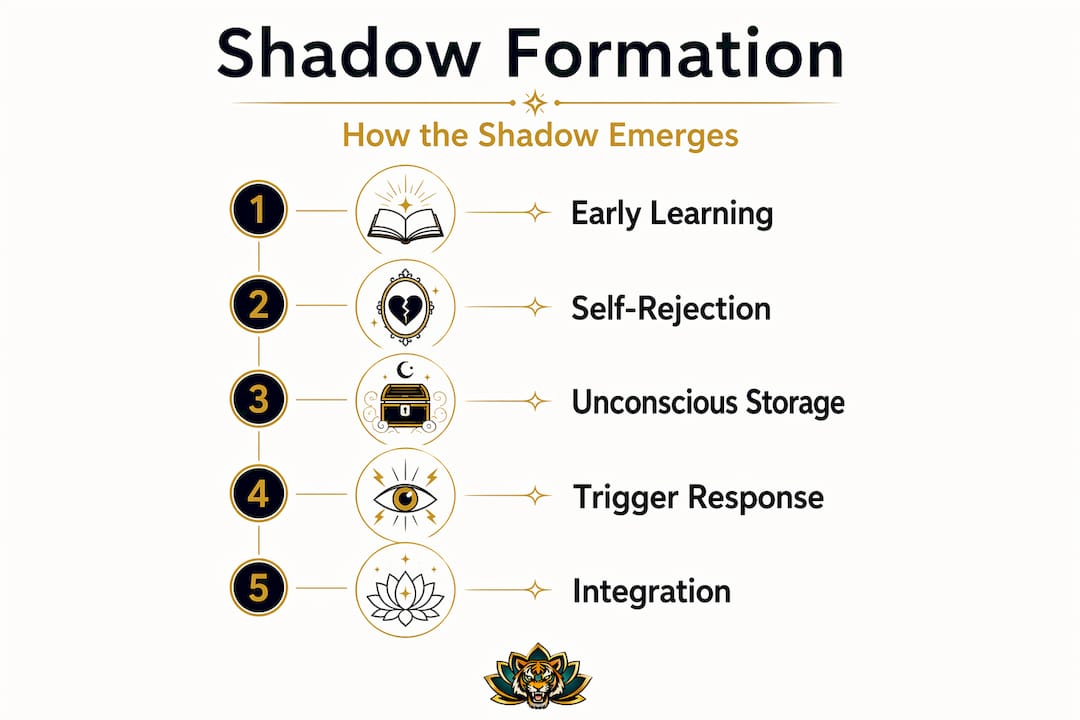
Understanding shadow work means grasping this crucial distinction: the shadow is not the enemy. Shadow work involves identifying and integrating those repressed aspects of personality for emotional regulation and authentic relationships. The goal is integration, not elimination.
Here's what the shadow can contain:
- Denied negative traits: Anger, jealousy, greed, cruelty, laziness — anything you consider "not me"
- Hidden positive traits: Confidence, creativity, desire, assertiveness — qualities you were told to minimize
- Unprocessed emotional wounds: Grief, fear, and shame that never got acknowledged
- Projected identity fragments: Parts of yourself you only recognize when they irritate you in someone else
Pro Tip: If you want a quick window into your shadow, notice what repeatedly triggers strong emotional reactions in other people. That intensity is often a signal, not a coincidence.
Why shadow work matters for real growth
Here's what separates shadow work from general self-improvement: it does not ask you to become a better version of yourself. It asks you to become a more honest one. That shift matters enormously for the kind of growth that actually sticks.

The benefits of shadow work are well-documented in psychological literature. People who practice it report improved emotional regulation, clearer and more confident boundary setting, and stronger relationships built on authenticity rather than performance. When you stop suppressing parts of yourself, you also stop projecting them onto others. That alone changes how you show up in every relationship you have.
Integration increases choice and reduces compulsive, reactive behavior by bringing unconscious material into awareness. You stop being triggered into old patterns because you've seen those patterns clearly and made peace with their origin.
"The shadow is not a problem to be solved. It is a relationship to be built." Owning your shadow does not mean acting out your worst impulses. It means acknowledging them so they no longer control you from underneath.
There is an ethical dimension here that often gets glossed over in social media takes on this subject. Integration means accepting shadow traits with responsibility, not indulging them. Recognizing your capacity for cruelty is not permission to be cruel. It is information that helps you make more conscious choices.
Shadow work also enhances empathy and reduces judgment toward others. When you own your own darkness, you stop needing other people to carry it for you. That is the deeper relational benefit that most "shadow work for beginners" articles miss entirely.
One honest caveat: shadow work is not a substitute for therapy when trauma is involved. If your shadow contains developmental or attachment wounds, working with a qualified professional gives you a far safer container for that material.
Practical shadow work techniques to start with
You do not need to be a therapist or a Jungian analyst to begin. You need willingness, patience, and a few solid practices. Here are four methods to start, organized by accessibility and depth.
-
Shadow journaling. Write from the perspective of a trait you dislike in yourself or others. Ask it questions. "Why are you here? What are you protecting me from?" This is not a creative exercise. It is a structured inquiry that builds self-awareness by giving the shadow a voice rather than a locked door.
-
Active imagination. Jung developed this technique specifically for shadow self exploration. You enter a relaxed state and allow images, figures, or scenes to arise in your mind, then engage with them as if they were real. This works best with guidance from a therapist or trained coach, but even basic forms like guided visualization can open meaningful awareness.
-
Shadow mapping. This five-step process involves listing your core strengths, then identifying the shadow side of each one. The strength "decisive" maps to the shadow "controlling." The strength "caring" maps to "smothering." You then look for which shadow traits show up in your life uninvited and explore what you might be projecting onto others.
-
Projection tracking. Keep a log of strong emotional reactions, especially irritation and contempt. When someone's behavior bothers you intensely, write down what you believe they are doing wrong, then ask honestly whether that trait lives anywhere in you. This is not about self-blame. It's about reclaiming what you have outsourced.
Pro Tip: Start with shadow journaling before attempting active imagination. Journaling externalizes the material enough to keep you grounded while still creating genuine insight. Give yourself at least four weeks before expecting patterns to become visible.
Emotional clarity exercises work naturally alongside these techniques, especially when you are trying to identify the emotional patterns underneath the shadow behaviors.
Navigating the hard parts of shadow work
No honest guide covers shadow work techniques without warning you about what happens when you start digging. The early stages often include disorientation and grief before any sense of relief or healing arrives. That is normal. It does not mean you are doing it wrong.
The biggest pitfall is shadow projection. This is what happens when you cannot tolerate a trait in yourself and unconsciously attribute it to other people instead. Projection is a defense mechanism for managing anxiety, and it is the primary way most people encounter their shadow without realizing it. You see someone being arrogant and feel genuine disgust. The question is always: where is that arrogance in me?
| Challenge | What it looks like | How to respond |
|---|---|---|
| Shadow projection | Intense irritation at specific traits in others | Use projection tracking to identify the mirror |
| Emotional flooding | Feeling overwhelmed or suddenly tearful | Slow down, ground yourself, take a break |
| Self-judgment spirals | Criticizing yourself harshly for "bad" traits | Shift to curiosity instead of condemnation |
| Avoidance | Stopping the work when it gets uncomfortable | Acknowledge resistance as shadow material itself |
The importance of shadow work is matched equally by its difficulty. This is not a weekend workshop transformation. Shadow work is a lifelong practice of self-honesty requiring ethical commitment and gradual deepening of self-awareness. Anyone who tells you otherwise is selling something that won't hold.
Seek professional support if you notice persistent emotional destabilization, intrusive memories, or a worsening of anxiety or depression during this work. A trauma-informed coach or therapist is not a luxury here. It is appropriate care.
My honest take on shadow work's real power
I have worked with women at the intersection of emotional healing and self-leadership for years, and the pattern I see most often is this: people begin shadow work hoping to become less of something. Less reactive. Less controlling. Less needy. They want to sand down the difficult edges.
What the work actually delivers, when you stay with it, is more. More self-knowledge, more emotional range, more capacity to hold complexity without collapsing. The women I have seen grow the most through this process are not the ones who completed it. They are the ones who stopped expecting to complete it.
There is a version of shadow work that gets sold as a healing arc with a clear ending. That version keeps people looking for a finish line instead of building a relationship with themselves. The shadow as a hidden ally is not a metaphor I use lightly. Some of my most grounded self-leadership has come directly from the anger and grief I spent years trying to manage away.
The real courage in this work is not facing your darkness. It is tolerating the ambiguity of discovering you are more complicated than you thought, and choosing to stay curious rather than judgmental about that. That shift, practiced consistently, is what I see translate into emotional clarity and genuine self-trust over time.
— RachelMHarrison
Ready to go deeper with guided support?
Shadow work is powerful on your own, and even more so when you have a skilled, trauma-informed guide holding the space. At Rachel-m-harrison, the Sanctuary Symbolic Integration Method™ was built specifically for women doing this kind of deep, non-linear inner work. It combines psychological grounding with spiritually reflective frameworks to help you understand your emotional patterns and stop reacting from the shadow.

If you are new to this work and not sure where to begin, the start here page walks you through the approach clearly and without pressure. If you are ready to work one-on-one, you can book a session directly. And if you want to explore what a coaching relationship looks like first, the coaching guide gives you everything you need to make an informed decision.
FAQ
What is the shadow work definition in psychology?
Shadow work refers to the process of identifying, confronting, and integrating the unconscious aspects of personality that the ego has repressed or denied. The concept originates with Carl Jung, who described the shadow as everything a person refuses to acknowledge about themselves.
How do you start shadow work as a beginner?
Shadow journaling and projection tracking are the most accessible entry points for beginners. Begin by writing about traits you react to strongly in others, then honestly explore whether those traits appear anywhere in your own behavior or emotional patterns.
What are the benefits of shadow work?
Practicing shadow work improves emotional regulation, supports healthier boundary setting, and leads to more authentic relationships. Over time, it also reduces compulsive and reactive behavior by bringing unconscious patterns into conscious awareness.
Is shadow work dangerous?
Shadow work can cause emotional discomfort, disorientation, and grief, especially in the early stages. For individuals with developmental trauma or attachment wounds, working with a trauma-informed therapist or coach is strongly recommended to avoid overwhelm.
How long does shadow work take?
Shadow work is not a linear process with a defined end point. It is a long-term discipline that deepens over time. Most practitioners describe it as a lifelong commitment to self-honesty rather than a program with a clear finish line.