TL;DR:
- Spiritual alignment involves living in coherence with your authentic values, thoughts, and emotions. It supports emotional and mental well-being by fostering inner harmony, reducing anxiety, and promoting self-trust. Unlike positive thinking, it emphasizes honesty, acceptance, and integrating your inner and outer worlds for lasting healing and purpose.
Spiritual alignment is one of those phrases people hear often but struggle to define with any real precision. You might have come across it in a meditation circle, a personal development book, or a conversation about living with purpose. And yet, for many people, it floats somewhere between inspiring and vague. What does it actually mean to be spiritually aligned? More importantly, why does it matter for your emotional clarity, your mental health, and the quality of your everyday life? This article answers those questions directly, with both psychological research and practical grounding to back it up.
Table of Contents
- Key Takeaways
- What is spiritual alignment, really?
- How spiritual alignment supports emotional and mental well-being
- Spiritual alignment vs. positive thinking and manifestation
- How to achieve spiritual alignment through daily practice
- Spiritual alignment and your sense of life purpose
- My take on what alignment actually feels like
- Ready to explore alignment with support?
- FAQ
Key Takeaways
| Point | Details |
|---|---|
| Spiritual alignment has a clear meaning | It is the coherence between your inner values, thoughts, emotions, and the actions you take in daily life. |
| It is backed by research | Studies link goal alignment with authentic values to lower anxiety, reduced depression, and greater vitality. |
| It differs from positive thinking | Alignment is about inner honesty and allowing, not forcing outcomes through optimism or willpower. |
| You can practice it daily | Meditation, journaling, and values-based goal setting are proven tools for deepening alignment. |
| It supports healing | Spiritual alignment calms the nervous system, making space for suppressed emotions and genuine recovery. |
What is spiritual alignment, really?
Spiritual alignment meaning starts with one core idea: coherence. It is the state in which your inner world, your values, your sense of purpose, and your authentic self, is reflected in your outer world, meaning your choices, relationships, and daily actions. When those two dimensions are in sync, you feel grounded. When they are not, something feels off even if you cannot name it.
Spirituality here does not require religion, although it can include it. Spiritual alignment is about your relationship with your own depths. It is the experience of living in ways that feel genuinely true to who you are, not who you think you should be.
Several principles form the foundation of spiritual alignment:
- Authentic values: Your choices are driven by what genuinely matters to you, not external pressure or approval.
- Conscious presence: You notice your inner state rather than running on autopilot.
- Inner harmony: Your thoughts, emotions, and actions are not working against each other.
- Connection to purpose: You have at least a felt sense of why you are here, even if it is evolving.
The role of spiritual alignment in wellness becomes visible the moment you notice the gap between these principles and how you are actually living. That gap creates friction. Closing it creates relief, direction, and clarity.
How spiritual alignment supports emotional and mental well-being
The connection between spiritual alignment and mental health is not just philosophical. Research is increasingly clear on this.

A 2025 study found that anxiety decreased significantly after an eight-week mind-body spiritual intervention, and those improvements held at a three-month follow-up. That is not a small finding. Sustained relief from anxiety through spiritual practice challenges the assumption that spirituality is a soft add-on to real wellness work.
Psychologist Kennon Sheldon's Self-Concordance Model offers another lens. It proposes that goals aligned with your authentic values produce better psychological outcomes than goals driven by external pressure or obligation. Research confirms that self-concordant goals mediate outcomes related to depression, anxiety, and vitality. In plain terms: when you pursue what genuinely matters to you, your mental health improves. That is spiritual alignment at work through a psychological framework.
The table below shows how different spiritual alignment practices connect to specific well-being outcomes, based on available research:
| Practice | Primary benefit | Supporting evidence |
|---|---|---|
| Meditation | Reduced anxiety, nervous system regulation | 8-week spiritual intervention study, 2025 |
| Yoga | Resilience, psychological balance | Spiritual well-being and yoga associations |
| Reflective journaling | Emotional clarity, value recognition | Self-concordance model research |
| Mindful awareness | Reduced inner conflict, presence | Clinical spiritual trust studies |
| Prayer or contemplation | Lower depression, improved psychosomatic health | Spiritual trust and depression findings |
The role of spiritual reflection in wellness is particularly strong when it comes to emotional clarity. Reflection creates the pause between stimulus and response that allows you to ask: is this reaction coming from my authentic self, or from a wound or a conditioned pattern? That question alone is transformative.
Pro Tip: If you feel emotionally reactive or chronically scattered, ask yourself before acting: "Does this choice reflect what I actually value, or what I fear?" That single question is a form of alignment practice.
Spiritual alignment vs. positive thinking and manifestation
There is a significant difference between spiritual alignment and the version of manifestation culture that tells you to think positively hard enough and good things will come. This distinction matters because confusing the two can leave you feeling like a failure when alignment does not equal instant results.
Here is a direct comparison:
| Concept | Core mechanism | What it requires |
|---|---|---|
| Positive thinking | Cognitive reframing toward optimism | Belief and mental effort |
| Law of attraction | Energetic matching through thought | Focus and visualization |
| Spiritual alignment | Inner coherence of values, emotions, and actions | Self-honesty and authentic integration |
Spiritual alignment does not ask you to suppress doubt or perform happiness. It asks you to get honest. Authentic integration goes deeper than mindset work because it addresses the internal contradictions that surface when your actions do not match your values.
The concept of "allowing" rather than forcing is central here. Many people approach spiritual growth with the same striving energy they bring to career goals: more effort, more discipline, more control. True alignment often requires the opposite. It asks you to reduce the internal noise, not amplify the push. This connects directly to why spiritual reflection supports healing. Reflection creates space. Space allows what is true to surface, without force.
Spiritual alignment as a holistic integration also means your body is involved, not just your mind. Your nervous system responds to coherence. When your inner and outer worlds match, your physiology shifts. That is not mystical. It is physiological.
How to achieve spiritual alignment through daily practice
Spiritual alignment practices do not require a retreat or a radical life change. They require consistency and honesty. Here is a grounded approach to building alignment into your life:
-
Start with a values audit. Write down five things that matter most to you. Then look at how your last two weeks actually looked. Where is the gap? That gap is the work.
-
Build a daily reflection practice. Even ten minutes of honest journaling, asking "How did I feel today? What did I act from? What felt true?" creates the self-clarity and meaning that alignment depends on.
-
Practice mindful awareness during transitions. The moments between tasks, between conversations, between commitments are where you can check in. Breathe. Notice. Are you acting from choice or from habit?
-
Set self-concordant goals. Research confirms that personal growth and meaning increase when goals reflect your genuine values rather than what you think you should want. Before setting a goal, ask: whose voice is driving this?
-
Notice and name internal contradictions. If you value rest but schedule yourself to exhaustion, that is a contradiction. Naming it without judgment is the first step toward resolution.
-
Release the need for perfect alignment. Alignment is dynamic, not a destination. Life disrupts it. The practice is returning, not arriving.
Pro Tip: Try a short body scan before any major decision. Notice where you feel tension or ease. Your body often recognizes misalignment before your mind does.
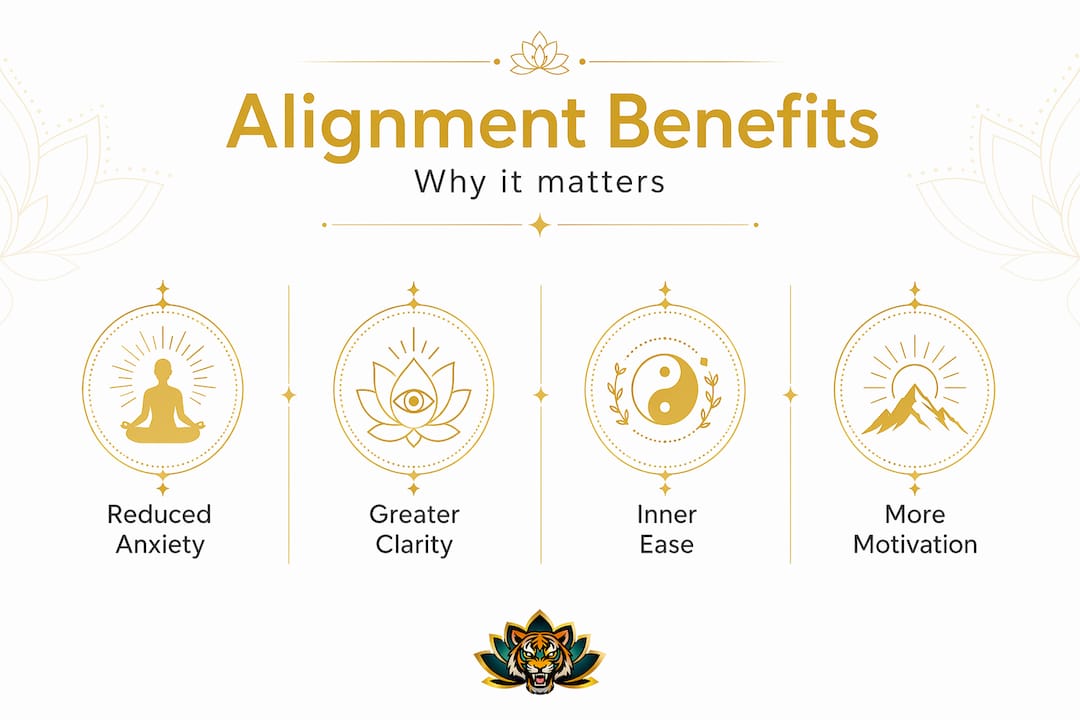
Signs of spiritual alignment include a felt sense of ease in your decisions, reduced internal conflict, greater motivation that does not rely on external pressure, and a quality of presence that others often notice in you before you notice it yourself.
Spiritual alignment and your sense of life purpose
One of the most underappreciated effects of spiritual alignment is what it does to your relationship with meaning. When your daily actions reflect your authentic values, the search for purpose becomes less urgent because you are already living it in small, consistent ways.
Research on eudaimonic well-being, which focuses on flourishing rather than just feeling good, supports this directly. Self-concordant goal pursuit enhances personal growth and reduces psychological distress. That is not abstract philosophy. It means that people who live in alignment with what genuinely matters to them report more vitality, more meaning, and less suffering.
The practical effects on personal development include:
- Greater motivation that sustains itself without external validation
- Reduced decision fatigue because your values act as a filter
- Stronger self-trust, which is one of the quieter but most powerful outcomes of aligned self-leadership
- A deeper sense of contribution because your actions are connected to something that matters to you
Spirituality also acts as a protective factor for resilience during difficult periods. When life disrupts your sense of order, alignment with something deeper than circumstances gives you a stable reference point. That is why the role of spiritual alignment in wellness is not just about feeling good. It is about having something to return to when things fall apart.
My take on what alignment actually feels like
I want to be honest with you about something I have noticed both in my own life and in the work I do with clients. Most people come to spiritual alignment looking for a feeling they want to reach and hold. They want to feel settled, purposeful, clear. And when alignment is described as a destination, they strive toward it the same way they strive toward any goal. Harder. Faster. With more effort.
What I have learned is that this gets it exactly backward.
In my experience, the moments of genuine alignment have rarely come through effort. They have come through releasing the effort. Through getting honest enough to admit what I actually valued versus what I had been performing. Through sitting with discomfort long enough to let it tell me something true.
Positive spiritual strategies are linked to better emotion regulation not because they are cheerful but because they create acceptance. And acceptance is what allows the nervous system to stop bracing. That is where healing actually begins.
I have also seen that the women who make the deepest shifts through alignment work are not the ones who immediately embrace it. They are the ones who finally stop arguing with themselves about what they want. That surrender is not weakness. It is precision.
Alignment is not about becoming a better version of yourself through force. It is about removing what was never yours to carry.
— RachelMHarrison
Ready to explore alignment with support?
If this article has brought something into focus for you, you are not alone. Many women arrive at alignment work after years of striving, over-functioning, or feeling out of sync with their own lives. The question of what is spiritual alignment often becomes personal very quickly.
At Rachel-m-harrison, the work is grounded in trauma-informed coaching and the Sanctuary Symbolic Integration Method™, designed to help you understand your emotional patterns, steady your nervous system, and move from clarity into aligned action. You do not need to have everything figured out before you begin. If you are curious, the coaching guide is a strong place to start, and you can book a session whenever you feel ready. There is no pressure here. Only an open door.
FAQ
What does spiritual alignment mean in simple terms?
Spiritual alignment means living in a way that reflects your authentic values, thoughts, and emotions. It is the coherence between who you are inside and how you show up in your daily life.
What are the signs of spiritual alignment?
Common signs include feeling at ease with your decisions, reduced internal conflict, greater self-trust, and a sense of purpose that does not depend on external approval or validation.
How does spiritual alignment support healing?
Spiritual alignment reduces inner conflict and relaxes the nervous system, which creates conditions for suppressed emotions to surface and genuine recovery to begin. Research links spiritual awareness and healing with sustained improvements in anxiety and psychological well-being.
How is spiritual alignment different from positive thinking?
Positive thinking relies on cognitive reframing and optimism. Spiritual alignment requires honest self-examination and authentic integration of your values, emotions, and choices, including the uncomfortable parts.
Can spiritual alignment practices reduce anxiety?
Yes. Studies show that mind-body spiritual practices produce significant anxiety reduction that holds over time, suggesting alignment practices offer real, measurable psychological benefits rather than temporary relief.