
TL;DR:
- Clarity involves knowing what to do next rather than just gathering facts, which is vital for mental health. It helps reduce emotional reactivity, decision paralysis, and supports accurate communication, especially during transitions. Building clarity requires ongoing reflection, grounding practices, and honest self-awareness to foster lasting inner trust.
Most people assume that confusion clears up on its own, given enough time or enough information. It rarely does. Why clarity is crucial becomes painfully obvious when you're standing at a crossroads, drowning in options, yet still unable to move. You're not paralyzed because you lack data. You're paralyzed because you lack clarity. There is a significant difference between knowing facts and knowing what to do next, and that gap is where emotional suffering tends to live. This article explores what clarity actually means, how it shapes your mental health, and the concrete ways you can cultivate it during life's most disorienting chapters.
Table of Contents
- Key Takeaways
- What clarity really means in communication and decision-making
- How clarity affects emotional well-being and mental health
- Clarity's role in decision-making and overcoming hesitation
- Common signs of lacking clarity and how to cultivate it
- My honest take on why clarity changes everything
- Ready to build your clarity with real support?
- FAQ
Key Takeaways
| Point | Details |
|---|---|
| Clarity is not just information | Clarity means knowing what to do next, not simply knowing more facts. |
| Clarity protects mental health | Research links clear mental processing to lower anxiety, less rumination, and improved emotional regulation. |
| Shared clarity unblocks decisions | Stalled decisions almost always stem from misaligned assumptions, not a lack of urgency. |
| Signs of low clarity are recognizable | Chronic indecision, emotional reactivity, and avoidance are all signals that your clarity needs attention. |
| Clarity must be sustained | Gaining insight once is not enough. Building clarity is an ongoing reflective practice. |
What clarity really means in communication and decision-making
Clarity is one of those words everyone nods at and almost no one defines precisely. In communication, it means expressing your priorities, your needs, and the expected next step in a way others can actually act on. True clarity places the responsibility on the communicator, not the listener. If someone misunderstands you consistently, the message is the problem, not the audience.
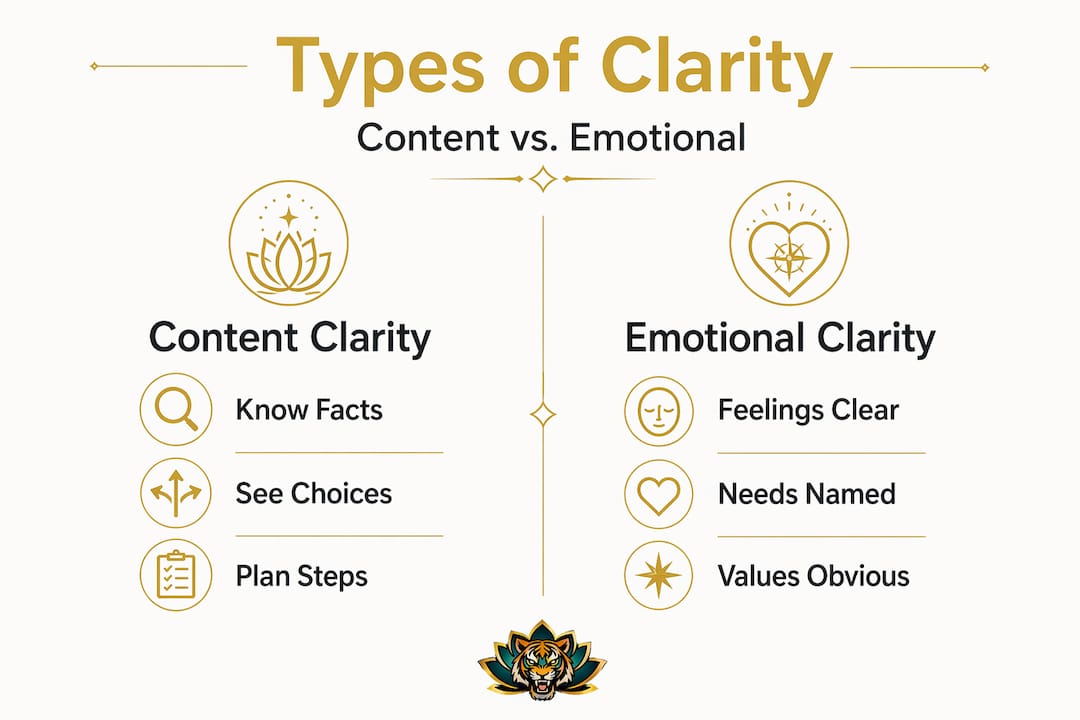
In personal cognition, clarity splits into two distinct types worth understanding. Clarity of content means you know the relevant facts. Clarity of decision means you know what you intend to do next. According to research from Nature Human Behaviour, people rely on detailed episodic memories to make adaptive decisions when the future is uncertain. That means clarity is not just a present-moment awareness. It draws on how you have structured your understanding of past experiences.
The 7 C's of communication (clear, concise, concrete, correct, coherent, complete, and courteous) place clarity at the top for good reason. Without it, the other six attributes lose their traction. You can be concise and completely wrong in what you're conveying if your core message is muddled.
Here is what clarity looks like when it's actually working:
- You can name what you want, not just what you don't want.
- You can articulate why a decision matters to you, not just that it does.
- You communicate boundaries without over-explaining or apologizing for them.
- You know your next step, even when the full path is still unclear.
Pro Tip: When you feel foggy about a decision, write down two lists: what you know for certain, and what you're assuming. The assumptions column will almost always reveal where your clarity is breaking down.
How clarity affects emotional well-being and mental health
The relationship between clarity and mental health is more concrete than most people realize. When your thinking is fragmented or circular, your nervous system stays in a low-grade state of alert. You're not in crisis, but you're not at ease either. Clarity interrupts that loop.

Research shows that repetitive negative thought patterns, including rumination and worry, are closely linked to depression and anxiety. Rumination, in particular, keeps the mind cycling through the same unresolved material without ever reaching resolution. What clarity does is shift how you process that material. Instead of replaying an experience emotionally, you begin to examine it with more distance and specificity.
Therapists working in this area use approaches like rumination-focused cognitive-behavioral therapy, which targets not just what you're thinking but how you're processing it. The goal is to move from abstract, global thinking ("Everything is falling apart") toward concrete mental processing ("I have three specific concerns about this situation, and here's how I can address each one"). That shift is clarity in action.
"Clarity is not a one-time achievement. Sustaining it requires consistent adjustment to how you process and interpret your experiences over time."
This is also why clarity matters enormously for women in life transitions, including leaving a relationship, changing careers, or stepping into a new identity after loss. The emotional upheaval of transition is not only painful. It is disorienting because the familiar mental maps no longer apply. Building emotional clarity during transitions becomes the work of drawing a new map, one that reflects who you are becoming rather than who you were.
The benefits of clear communication extend inward too. When you can articulate what you're feeling with accuracy, your body responds differently. There is growing evidence that emotional granularity, the ability to name emotions precisely, reduces emotional reactivity and supports faster recovery from stress. Clarity is not cold or detached. It is actually one of the most emotionally intelligent things you can practice.
Clarity's role in decision-making and overcoming hesitation
Most people experience decision paralysis and blame themselves for being indecisive. The real problem is usually structural. Stalled decisions almost always stem from misalignment in assumptions and priorities, not from a lack of urgency or willpower. You are not weak. You are unaligned, often with your own values.
Clarity in decision making works through several mechanisms:
- It sets guardrails. When you know what you will not compromise on, the number of viable options shrinks immediately. That reduction feels like relief, not limitation.
- It aligns your stated values with your actual choices. Many people discover through reflective work that they are making decisions based on who they used to be, not who they are now.
- It creates escalation paths. Knowing what triggers a decision point in advance removes the cognitive load of figuring it out in the moment.
- It builds confidence through repetition. Each time you make a decision that aligns with your clarity, you build trust in your own judgment.
Research from Harvard Business Impact confirms that clarity before courage is the framework that actually works. Without a clear sense of boundaries and expected outcomes, even capable people hesitate. Clarity is the infrastructure for confident action.
There's also an important nuance here. Research from the Modern War Institute on the "clarity fallacy" found that too much visibility can sometimes increase hesitation when people feel observed and evaluated. This is why clarity must be internal first. External accountability is useful, but it cannot substitute for genuine inner alignment.
| State | Without clarity | With clarity |
|---|---|---|
| Decision-making | Circular, exhausting, delayed | Grounded, directional, timely |
| Communication | Vague, reactive, misunderstood | Specific, calm, effective |
| Emotional regulation | Overwhelmed, flooded, stuck | Responsive, boundaried, stable |
| Action | Avoidant, scattered, inconsistent | Purposeful, sequential, sustained |
Pro Tip: Before making a major decision, write down the one thing you most need to honor in this choice. That single sentence often reveals more about your clarity, or lack of it, than an hour of analysis.
Common signs of lacking clarity and how to cultivate it
Low clarity rarely announces itself loudly. It shows up quietly, in habits and patterns that feel frustrating but not obviously linked to a lack of vision or direction. Recognizing those signs is the first step toward doing something about them.
Signs that your clarity needs attention:
- You frequently feel overwhelmed by options that should feel manageable.
- You make decisions and then immediately second-guess them, cycling through doubt.
- Your communication with others (at work, in relationships, with yourself) often leads to misunderstanding.
- You feel reactive rather than responsive when emotions arise.
- You avoid making commitments because you're unsure what you actually want.
- You know what you should do but can't seem to do it. That gap is often a values conflict, not a motivation problem.
Once you recognize where your clarity is thin, you can start building it with specific practices. The importance of clarity is not abstract. It is felt in the body as relief, groundedness, and a quieter nervous system.
Here are some ways to achieve clarity that are grounded in both research and lived experience:
Reflective writing. Not journaling in the traditional sense, but structured reflection that asks you to identify decision-relevant details from your experiences. This directly supports the kind of episodic memory processing that research links to adaptive decision-making.
Naming your non-negotiables. Before situations demand a response, write out what you will not compromise on in your relationships, your work, and your sense of self. This is not rigidity. It is a values map.
Slowing communication down. Practice saying "I need a moment to think about that" before responding in high-stakes conversations. Clear communication starts with giving yourself permission to pause.
Somatic grounding. When the mind is racing, the body holds information the mind can't access. Practices that slow the breath and soften the body create the physiological conditions for mental clarity to emerge.
Pro Tip: If you want to explore emotional clarity exercises specifically designed for creative women, the clarity exercises at Rachel-m-harrison offer a strong starting point grounded in trauma-informed practice.
My honest take on why clarity changes everything
I have worked with women at some of the most disorienting crossroads of their lives, and if there is one thing I keep seeing, it's this: clarity is consistently underestimated as a healing tool. People come looking for permission to leave, to stay, to grieve, or to change. What they actually need is a structured encounter with their own truth.
What I've learned through this work is that confusion is almost never random. It's strategic. The psyche keeps things unclear because clarity would require action, and action feels dangerous to a nervous system that has learned to equate safety with stillness. So when I say why clarity is crucial, I don't mean it as a productivity tip. I mean it as a form of care.
The women I work with don't lack intelligence or resilience. They lack a protected space where their own inner voice is treated as credible. The moment that changes, clarity starts to emerge not like a lightning bolt but like morning light. Slow, then undeniable.
I also want to be honest about something most clarity content skips: clarity can be uncomfortable. Seeing your situation clearly sometimes means seeing the parts you've been avoiding. That's not a failure of the process. That's the process working. The goal is not comfortable clarity. It's honest clarity. The kind that actually moves you.
— RachelMHarrison
Ready to build your clarity with real support?
If this article opened something in you, that recognition is worth following. Understanding why clarity matters is the beginning. Actually building it, especially through grief, transition, or long-held confusion, is different work. It takes structure, safety, and a method that respects the whole of who you are.

Rachel-m-harrison offers trauma-informed coaching designed specifically for women and creatives who are ready to move from chronic confusion into grounded self-trust. Whether you're navigating a life transition or simply tired of not knowing what you actually want, the coaching guide is a good place to begin. If you're ready to take a first step, you can book a session directly and begin the work of clarity that actually lasts.
FAQ
What does clarity mean in personal growth?
Clarity in personal growth means knowing what you value, what you need, and what your next step is, not just having general self-awareness. It's the shift from vague intention to specific, embodied direction.
Why is clarity important for emotional well-being?
Clarity reduces rumination and anxiety by giving the mind a concrete framework for processing experience rather than cycling through unresolved feelings. Research links clearer mental processing directly to reduced symptoms of depression and anxiety.
How does clarity help with making decisions?
Clarity removes the paralysis of competing priorities by aligning your values with your choices and defining what you will not compromise on, which dramatically narrows and simplifies your decision space.
Can too much information block clarity?
Yes. Research on the clarity fallacy shows that increased visibility and information volume can increase hesitation when people feel evaluated rather than supported. Internal clarity must come before external input becomes useful.
How can I start building more clarity in my life?
Start with structured reflection, naming your non-negotiables, and slowing down your communication. If those practices feel hard to sustain alone, working with a clarity-focused coach provides the accountability and method that make the change stick.