TL;DR:
- Self-trust in leadership is the stable belief in your own judgment and values, allowing independent decision-making. It is an internal relationship that sustains resilience and authentic presence, unlike confidence, which depends on external validation. Building self-trust involves practicing emotional awareness, micro-commitments, and nervous system regulation to foster reliability from within.
Self-trust in leadership is defined as the internal, consistent belief in your own judgment, values, and intuition that allows you to lead without depending on external approval. Unlike confidence, which often rises and falls with circumstances, self-trust is a stable inner foundation. Brené Brown's research confirms that vulnerability and authenticity increase team trust and overall performance, which means self-trust directly shapes the people around you. Aspiring leaders who understand what self-trust is, and how to build it, gain a decisive edge in both resilience and authentic presence.
What is self-trust in leadership, and why does it matter?
Self-trust in leadership is the reliable, values-aligned relationship you have with your own inner guidance. The formal psychological term for this is interoceptive authority, meaning you recognize and act on your body's and mind's internal signals rather than waiting for outside confirmation. Leadership experts describe self-trust as the core currency of modern leadership, improving team stability and leader resilience in ways that polished confidence cannot replicate.

The distinction matters because most leadership development programs train confidence, not self-trust. Confidence is a skill you perform. Self-trust is a relationship you build with yourself over time. Teams can sense the difference. A leader who performs confidence tends to project certainty while privately seeking reassurance. A leader with genuine self-trust holds uncertainty without collapsing, which is the quality that earns lasting loyalty.
Self-trust also determines how you respond when things go wrong. Leaders with a grounded inner authority orient toward reality without personalizing setbacks or being driven by external chaos. That capacity to stay clear under pressure is what separates sustainable leadership from burnout.
How does self-trust differ from confidence in leadership?
Confidence and self-trust are not the same thing, and confusing them creates fragile leaders. Confidence is situational. It tends to spike after a win and drop after a public failure. Self-trust, by contrast, is internally rooted and consistent, drawing from values and intuition rather than from recent outcomes.
Here is how the two qualities play out differently in practice:
- Confidence depends on external feedback, past successes, and social comparison.
- Self-trust depends on your relationship with your own values, emotional signals, and track record of keeping promises to yourself.
- Confidence can be rehearsed and performed for an audience.
- Self-trust cannot be faked. Teams recognize it through a leader's calm, non-reactive presence.
- Confidence often drives leaders to over-explain decisions or seek group consensus to feel validated.
- Self-trust allows a leader to make a clear call, communicate it directly, and remain open to feedback without needing approval.
The practical implication for decision-making is significant. A confidence-driven leader tends to delay decisions when external signals are unclear. A self-trusting leader can act on incomplete information because the decision is grounded in values, not in the desire to look right.
Pro Tip: When you notice yourself seeking reassurance before making a decision, pause and ask: "What do I actually know to be true here?" That question redirects you from external validation back to your own inner authority.
What are the key dimensions of self-trust in leadership?
Practitioners identify six dimensions of self-trust that leaders can assess and develop: competence, decision-making, promise-keeping, values alignment, emotional handling, and recovery from mistakes. Each dimension is distinct, and a leader can be strong in one while underdeveloped in another.
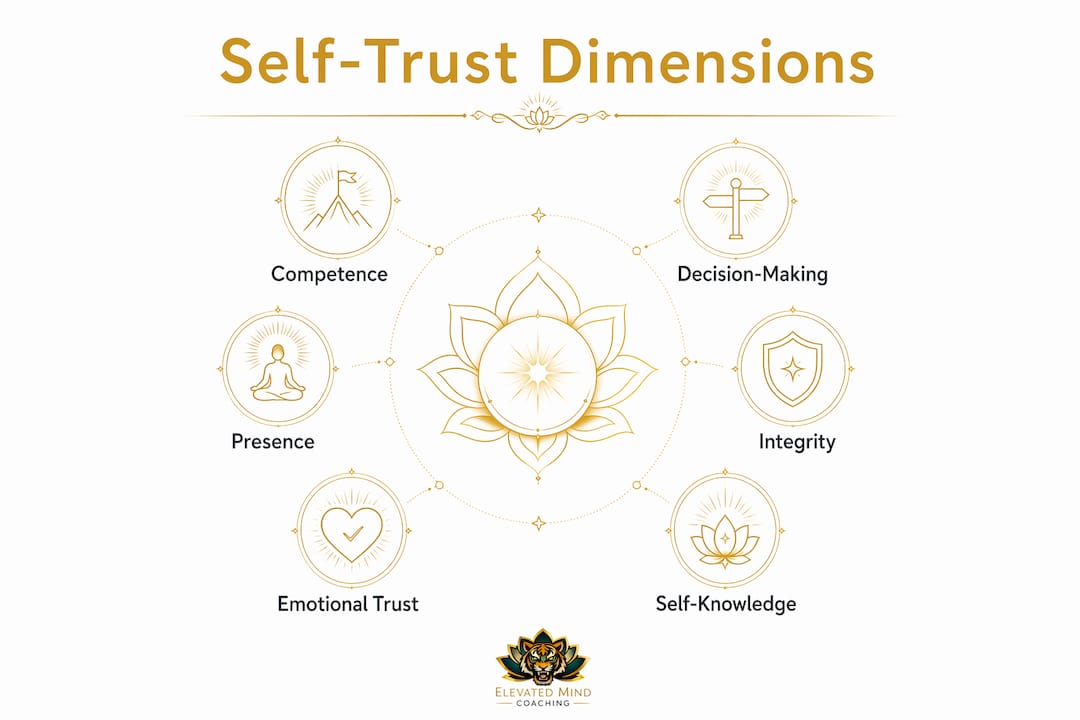
Competence self-trust means believing you have the skills to handle what is in front of you, even when the situation is new. Decision-making self-trust means acting on your judgment without waiting for unanimous agreement. Promise-keeping self-trust is built through following through on commitments you make to yourself, not just to others. Values alignment means your choices consistently reflect what you say matters to you. Emotional handling is the capacity to feel difficult emotions without being controlled by them. Recovery self-trust is the belief that you can make a mistake, learn from it, and return to clarity.
| Dimension | What it looks like in leadership |
|---|---|
| Competence | Taking on new challenges without waiting to feel fully ready |
| Decision-making | Acting on your judgment without needing group consensus |
| Promise-keeping | Following through on commitments you make to yourself |
| Values alignment | Saying no to opportunities that conflict with your stated priorities |
| Emotional handling | Staying present during conflict without shutting down or escalating |
| Recovery | Acknowledging a mistake openly and returning to purposeful action |
What is emotional self-trust, specifically? It is the capacity to treat your feelings as data rather than threats. A leader with emotional self-trust does not suppress anger or perform calm. They notice the signal, interpret it, and choose a response. This is the dimension that most directly affects psychological safety on a team, because psychological safety grows when leaders model honest, non-reactive emotional presence.
Why does self-trust matter for emotional regulation under pressure?
High-pressure leadership contexts, including budget cuts, team conflict, and public scrutiny, are exactly where self-trust is tested and where its absence is most costly. Decision fatigue is a real and measurable drain on leaders who rely on external validation to feel certain. Leaders with self-trust move from reactive theatrics to purposeful response, reducing the cognitive and emotional cost of every decision they make.
The nervous system plays a direct role here. Building self-trust is a nervous system regulation process where the first step is noticing body signals before reacting. A tight chest, a clenched jaw, or a sudden urge to people-please are all information. Leaders who have developed self-trust recognize these signals as cues to slow down, not to speed up and perform.
Trauma-informed leadership frameworks, like the Sanctuary Symbolic Integration Method™ used at Rachel-m-harrison, treat nervous system stability as a prerequisite for clear leadership. The logic is straightforward. A dysregulated nervous system produces reactive decisions. A regulated one produces grounded ones. Self-trust is both the outcome of regulation and the practice that sustains it.
Pro Tip: When you feel pressure to respond immediately, buy yourself 90 seconds. Neuroscience shows that the initial emotional charge of a trigger dissipates within roughly 90 seconds if you do not feed it with more reactive thought. That pause is where self-trust lives.
Signs that self-trust is being depleted under pressure include:
- Constantly second-guessing decisions you already made
- Seeking reassurance from multiple people before acting
- Feeling responsible for managing everyone else's emotional reactions
- Losing sleep over whether you said the right thing
Recognizing these patterns is not a sign of weakness. It is the first step in rebuilding inner authority after it has been eroded by chronic stress or external pressure.
How can aspiring leaders build and strengthen self-trust?
Self-trust is built through practice, not through insight alone. The following methods are grounded in both psychological research and trauma-informed frameworks.
-
Treat emotions as data. Name what you feel without judging it. "I notice I feel anxious about this presentation" is more useful than "I shouldn't feel this way." Adopting a curiosity-first approach restores the inner authority that conditioning and external pressure tend to erode.
-
Make and keep micro-commitments. Small promise-keeping acts build neural pathways of reliability. Commit to a specific walk at a specific time. Follow through. Your brain registers that you are someone who does what you say. Over weeks, that registration becomes self-trust.
-
Make low-stakes autonomous decisions. Choose a restaurant without polling your group. Decide on a project approach without seeking pre-approval. Each small autonomous decision strengthens the decision-making dimension of self-trust.
-
Set and hold one boundary this week. Boundaries are not about control. They are about knowing what you need and communicating it clearly. Each boundary you hold confirms to yourself that your needs are real and worth protecting.
-
Practice mindful noticing. Mindful noticing disrupts habitual thought patterns and cultivates the awareness that grounds reliable self-trust. Five minutes of deliberate observation, noticing what you see, feel, and think without labeling it as good or bad, builds the interoceptive skill that self-trust requires.
-
Extend self-compassion after mistakes. Self-trust development hinges not on the absence of fear but on the capacity to hold difficult emotions while committing to your own process. Recovering from a mistake with honesty and self-compassion builds the recovery dimension of self-trust faster than any success can.
A trauma-informed guide to step-by-step self-leadership can provide structured support for leaders who find these practices difficult to sustain alone. The process is not linear, and that is expected.
Pro Tip: Keep a "decisions I made" log for two weeks. Write down every decision you made independently, including small ones, and note the outcome. Most leaders discover they are far more reliable than their inner critic suggests.
Key Takeaways
Self-trust in leadership is the internally consistent, values-aligned foundation that separates authentic, resilient leaders from those who depend on external validation to feel certain.
| Point | Details |
|---|---|
| Self-trust vs. confidence | Self-trust is internally rooted and consistent; confidence is situational and fragile under pressure. |
| Six core dimensions | Competence, decision-making, promise-keeping, values alignment, emotional handling, and recovery all define self-trust. |
| Nervous system connection | Self-trust requires nervous system regulation; noticing body signals before reacting is the first step. |
| Micro-commitments work | Keeping small promises to yourself rewires the brain to recognize you as reliable. |
| Emotional self-trust | Treating feelings as data, not threats, is the dimension most directly tied to team psychological safety. |
What I've learned about self-trust that most leadership content gets wrong
The most common misconception I see in aspiring leaders is the belief that self-trust means being right most of the time. It does not. Self-trust means you can be wrong, feel the discomfort of that, and return to clarity without needing someone else to rescue you from the feeling. That is a fundamentally different skill set than accuracy.
What I have observed, both in my own practice and in the leaders I work with, is that self-trust is almost always lost through a slow accumulation of small betrayals. You ignore a gut feeling. You override a boundary because it feels easier. You defer to someone else's opinion when you already knew your own answer. None of these feel significant in the moment. Together, they teach your nervous system that your inner signals are not worth listening to.
The recovery is equally gradual. You slow down. You start noticing the physical sensation that arrives before the thought. You get curious about it instead of dismissing it. Modern organizations increasingly value grounded, principled leadership over polished performance, and that shift creates real space for leaders who are willing to do this inner work.
The leaders who show up most powerfully are not the ones who never doubt themselves. They are the ones who have learned to lead from the inside out, staying present with uncertainty while remaining anchored in what they know to be true.
— RachelMHarrison
When trauma-informed coaching supports your leadership self-trust

Nervous system stability is not a soft concept. It is the biological foundation of clear, grounded leadership. When chronic stress, past experiences, or relentless external pressure have eroded your inner authority, standard leadership training rarely reaches the root. Trauma-informed coaching addresses the nervous system patterns that undermine self-trust before they surface as reactive decisions or chronic self-doubt.
Rachel-m-harrison offers one-on-one coaching grounded in the Sanctuary Symbolic Integration Method™, designed specifically for women and leaders ready to rebuild clarity from the inside out. If you are unsure whether coaching or therapy is the right fit for where you are right now, the guide on trauma-informed coaching vs. therapy is a practical starting point.
FAQ
What is self-trust in leadership, simply defined?
Self-trust in leadership is the consistent, internal belief in your own judgment and values that allows you to lead without depending on external validation. It is distinct from confidence because it remains stable even when outcomes are uncertain.
How does emotional self-trust affect a team?
Emotional self-trust allows a leader to stay present during conflict and difficulty without shutting down or escalating. Teams respond to this regulated presence with greater psychological safety, openness, and creative risk-taking.
Can self-trust be rebuilt after it has been lost?
Self-trust can be rebuilt through gradual, consistent practices including micro-commitments, mindful noticing, and self-compassion after mistakes. The process is non-linear and is supported by nervous system regulation work.
How long does it take to build self-trust as a leader?
There is no fixed timeline. Research on micro-commitments and neural pathway formation suggests that consistent small practices over several weeks begin to shift the brain's sense of internal reliability. Depth of change depends on the individual's history and support system.
Is self-trust the same as self-confidence in leadership?
Self-confidence and self-trust are related but not identical. Self-confidence is often situational and performance-based. Self-trust is a deeper, values-rooted relationship with your own inner authority that holds steady regardless of external outcomes.