TL;DR:
- Psychological grounding uses sensory, physical, and cognitive techniques to anchor attention to the present and stabilize the nervous system. It acts mainly through the parasympathetic nervous system, engaging the vagus nerve to reduce stress and interrupt anxiety or dissociation. Regular practice during calm moments builds resilience and expands the window of tolerance for managing emotional transitions effectively.
Psychological grounding is defined as a set of techniques that anchor your attention to the present moment to stabilize your nervous system and interrupt overwhelming emotional states. Clinically, it falls under the broader category of self-regulation skills, and therapists use it as a first-line stabilization tool before any deeper trauma processing begins. The role of psychological grounding becomes most visible during life transitions, when your nervous system loses its sense of safety and your mind spirals into anxiety or dissociation. Techniques like the 5-4-3-2-1 sensory method and vagus nerve activation bring you back into your body and out of the anxiety loop. Understanding how and why grounding works makes it far more effective in practice.
What is the role of psychological grounding in the nervous system?
Psychological grounding anchors attention to the present to interrupt anxiety loops and signal nervous system safety through sensory, physical, and cognitive inputs. This is not a metaphor. When your attention locks onto a concrete sensory experience, your brain receives a signal that the immediate environment is safe.

The mechanism runs through the parasympathetic nervous system. Grounding activates the parasympathetic system primarily through vagus nerve engagement, which lowers cortisol and other stress markers. The vagus nerve is the longest cranial nerve in your body, and it acts as a direct line between your gut, heart, and brain. Stimulating it through slow breathing or sensory focus shifts your body out of fight-or-flight.
Grounding also dampens default mode network activity to stop rumination by anchoring attention to concrete present experience. The default mode network is the brain region most active when you are not focused on anything specific. It is also the region most associated with worry, self-criticism, and anxious thought loops. Grounding pulls you out of that network and into present-moment processing.
The efficacy of grounding depends on bottom-up signals, meaning sensory and physical inputs that engage the vagus nerve, before attempting top-down cognitive regulation. This distinction matters. Trying to think your way calm before your body feels safe rarely works. Sensory engagement first, cognitive reframing second.
Pro Tip: If grounding feels ineffective, check whether you are starting with a cognitive technique before your body has settled. Try placing both feet flat on the floor and naming five physical sensations before attempting any mental reframing.
What are the main types of psychological grounding techniques?
Experts categorize grounding into three main types: sensory-based, physical, and cognitive methods. Each category targets a different entry point into the nervous system, and each works best for specific emotional states.
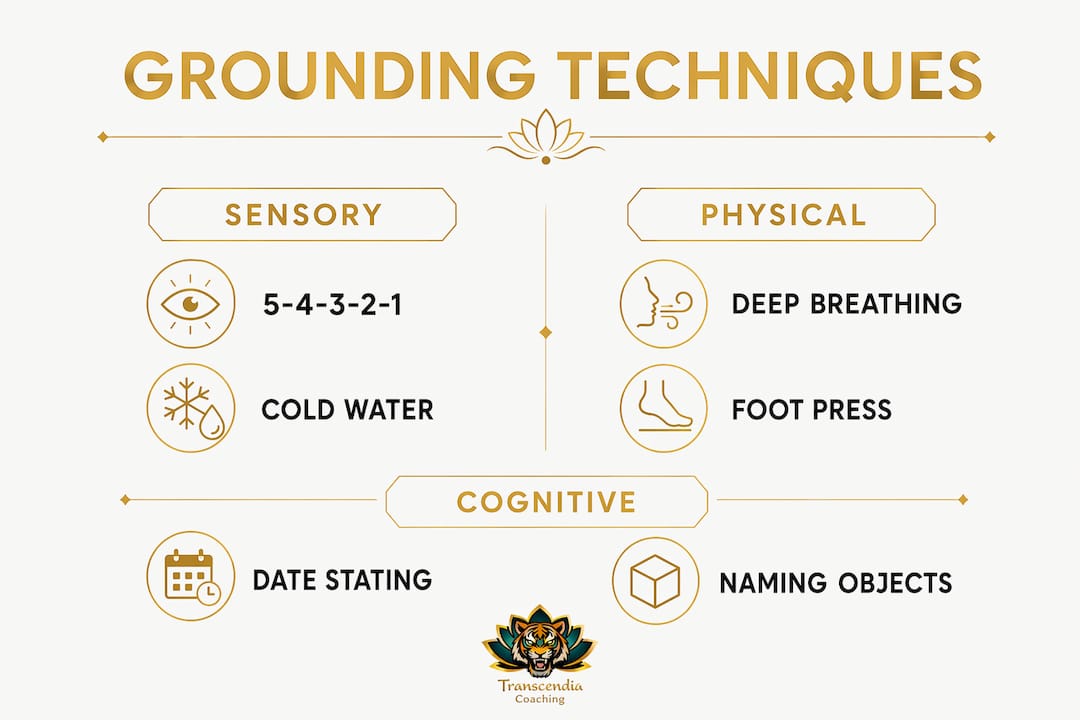
Sensory-based grounding uses your five senses to pull attention into the present. The 5-4-3-2-1 technique is the most widely taught example: name five things you can see, four you can hear, three you can touch, two you can smell, and one you can taste. This method works well for acute anxiety and panic because it requires active attention without demanding complex thought.
Physical grounding uses body movement and physical sensation to interrupt distress. Examples include pressing your feet firmly into the floor, holding a cold glass of water, or doing slow diaphragmatic breathing. Physical grounding is particularly effective for dissociation, where a person feels detached from their body or surroundings.
Cognitive grounding uses mental orientation to restore a sense of reality and context. Examples include stating the date and location out loud, reciting a familiar poem, or naming categories of objects. This approach works best for rumination and intrusive thoughts, where the mind needs a structured redirect rather than a sensory anchor.
| Category | Example techniques | Best for |
|---|---|---|
| Sensory-based | 5-4-3-2-1 method, cold water on wrists | Panic, acute anxiety |
| Physical | Feet on floor, diaphragmatic breathing | Dissociation, emotional flooding |
| Cognitive | Stating date and location, category naming | Rumination, intrusive thoughts |
Grounding is a stabilization tool, not a cure or an emotion eraser. Its job is to create enough stability for you to make a clear choice about what to do next.
Pro Tip: Combine a physical technique with a cognitive one for stronger effect. Press your feet into the floor while naming three things you can see. The dual input gives your nervous system more data that the present moment is safe.
Common misunderstandings about psychological grounding
The biggest misunderstanding is that grounding is a relaxation technique. Grounding is a stabilization intervention, not a relaxation technique. Forcing calm can backfire because the goal is nervous system orientation, not suppression. Relaxation asks your body to slow down. Grounding asks your nervous system to locate itself in the present moment. These are different requests.
A second misunderstanding is that using grounding signals weakness or avoidance. Grounding is not a sign of weakness but a survival pattern that signals safety to the brain, enabling the kind of presence tolerance that healing requires. Choosing to ground yourself during a difficult moment is an act of self-leadership, not retreat.
Several other misconceptions are worth naming directly:
- Grounding does not erase emotions. It creates enough stability to feel them without being overwhelmed.
- Grounding is not the same as trauma processing. It prepares the nervous system for that work but does not replace it.
- Grounding is not only for crisis moments. Using it regularly when you are calm trains your nervous system to recognize safety more quickly.
- Overreliance on grounding alone can become avoidance, preventing the natural habituation needed to process anxiety or trauma safely.
The concept of the window of tolerance, developed by psychiatrist Daniel Siegel, is central here. Grounding builds a window of tolerance by expanding nervous system flexibility. It serves as an early-stage skill in trauma treatment, not the final destination. Trauma-informed care frameworks, including those used in EMDR and somatic therapies, treat grounding as the foundation before any deeper emotional work begins.
How to use grounding techniques to build resilience during transitions
Regular grounding practice is proactive, training your nervous system to treat the present moment as safe and enhancing emotional resilience during transitions. Career changes, relationship endings, grief, and identity shifts all create periods where your nervous system loses its reference points. Grounding gives it new ones.
The key shift is treating grounding as a daily skill rather than an emergency tool. Using grounding regularly even when stable helps train your nervous system to recognize safety, making crisis moments easier to manage. Think of it the way you think of physical fitness. You do not exercise only when you are already injured.
Here is a practical sequence for integrating grounding into your daily life and major transitions:
- Morning anchor practice. Before checking your phone, place both feet on the floor and take three slow breaths. Name two things you can see and one thing you are grateful for. This takes under two minutes and sets a regulated baseline for the day.
- Transition moments. Before a difficult conversation, a job interview, or a medical appointment, use the 5-4-3-2-1 technique. It takes about 90 seconds and brings your prefrontal cortex back online before you need it most.
- Journaling with a grounded body. Before writing in a journal, spend two minutes in physical grounding. Writing from a regulated state produces clearer insight than writing from a flooded one. This pairs well with self-clarity reflection practices.
- Evening wind-down. Use slow diaphragmatic breathing for five minutes before sleep. Inhale for four counts, hold for four, exhale for six. The extended exhale activates the vagus nerve and signals the body to shift into rest.
- During acute distress. Hold a cold object, press your back against a wall, or splash cold water on your face. Physical sensation interrupts the stress response faster than thought alone.
When grounding alone is not enough, that is a signal to seek professional support. A trauma-informed therapist or coach can help you move from stabilization into deeper emotional processing. Grounding is the foundation of trauma-informed self-leadership, not the whole structure.
Key Takeaways
Psychological grounding stabilizes the nervous system through sensory, physical, and cognitive inputs, making it the foundational skill for emotional resilience during life transitions.
| Point | Details |
|---|---|
| Grounding is stabilization, not relaxation | Its goal is nervous system orientation to the present, not forced calm. |
| Three technique categories exist | Sensory, physical, and cognitive grounding each target different emotional states. |
| Daily practice builds resilience | Using grounding when calm trains the nervous system to recognize safety faster. |
| Overreliance is a real risk | Grounding alone can become avoidance if it replaces deeper emotional processing. |
| Window of tolerance expands with practice | Regular grounding increases nervous system flexibility over time. |
What most people miss about grounding and why it matters
What I see most often in my work is that people treat grounding as a panic button. They reach for it only when they are already in crisis, and then they feel frustrated when it does not work as quickly as they hoped. That frustration makes sense. When your nervous system is fully flooded, even the best technique takes time to land.
The shift that changes everything is practicing grounding when you do not need it. When you are calm, when the day is ordinary, when nothing feels urgent. That is when your nervous system actually learns the pattern. By the time a real transition hits, whether it is a job loss, a relationship ending, or a health scare, your body already knows the path back to safety. It has walked it hundreds of times.
What I also want to name is that grounding is not a substitute for feeling. I have worked with women who used grounding so consistently that it became a way to stay above their emotions rather than move through them. Grounding is meant to bring you to the edge of your feelings with enough stability to stay present. It is not meant to keep you permanently at a safe distance from them. That distinction, between stabilization and avoidance, is where emotional clarity becomes the next necessary skill.
Grounding is foundational work. It is not glamorous. It does not produce dramatic breakthroughs. But without it, the deeper work of healing and self-leadership has no stable ground to stand on.
— RachelMHarrison
Trauma-informed coaching and psychological grounding
Grounding techniques are most effective when practiced within a supportive framework that understands the nervous system and trauma. Rachel-m-harrison's coaching work is built on exactly that foundation.

Through the Sanctuary Symbolic Integration Method™, Rachel-m-harrison works with women and creative leaders to stabilize their emotional patterns, build self-trust, and move from reactive survival into grounded self-leadership. If you are navigating a major life transition and grounding techniques are not enough on their own, one-on-one coaching offers a structured, trauma-informed space to go deeper. You can also explore what happens in a coaching session to understand what that support looks like before committing to anything.
FAQ
What is psychological grounding?
Psychological grounding is a set of sensory, physical, and cognitive techniques that anchor attention to the present moment to stabilize the nervous system and interrupt anxiety or dissociation. It is used in trauma-informed therapy and self-regulation practice as a first-line stabilization skill.
Why is psychological grounding vital during life transitions?
Life transitions disrupt your nervous system's sense of safety, triggering anxiety, rumination, and emotional flooding. Grounding restores a sense of present-moment orientation, giving your nervous system enough stability to make clear decisions during change.
How does the 5-4-3-2-1 technique work?
The 5-4-3-2-1 technique directs attention through all five senses in sequence, naming five things you see, four you hear, three you can touch, two you smell, and one you taste. This sensory engagement activates the parasympathetic nervous system and interrupts the anxiety loop.
Is psychological grounding the same as mindfulness?
Grounding and mindfulness overlap but are not identical. Mindfulness involves open, non-judgmental awareness of experience. Grounding is a directed stabilization intervention designed to interrupt acute distress and reorient the nervous system to the present moment.
When should grounding be combined with professional support?
Grounding is an early-stage stabilization skill, not a complete treatment for trauma or chronic anxiety. If grounding alone does not reduce distress or if emotional flooding is frequent, working with a trauma-informed therapist or coach provides the structured support needed for deeper processing.