TL;DR:
- Self-leadership involves consciously guiding thoughts, emotions, and actions toward meaningful personal goals. It greatly enhances wellbeing and resilience by fostering self-awareness, regulation, and accountability. Developing metacognitive skills accelerates growth and improves decision-making, especially under challenging circumstances.
Self-leadership is the practice of consciously directing your thoughts, emotions, and actions toward meaningful personal goals. The role of self-leadership in personal growth is not peripheral. It is the engine. Without it, growth is reactive, accidental, and fragile. With it, you build the internal capacity to sustain change even when circumstances are difficult. Research from Blanchard confirms that individuals who cultivate self-leadership show 70% higher wellbeing and 22% higher organizational citizenship. That is not a soft benefit. That is a measurable shift in how you function and relate to the world around you.
How does self-leadership enhance personal wellbeing and resilience?
Self-leadership is a primary resource that protects against burnout while building creativity, resilience, and adaptability. That finding comes from organizational studies published in early 2026. It means the people who develop self-leadership skills are not just performing better at work. They are fundamentally more equipped to handle stress without collapsing under it.
The mechanism is self-regulation. When you learn to observe your internal state before reacting, you interrupt the automatic stress response. You create a gap between stimulus and action. That gap is where growth lives. Without it, you are at the mercy of every difficult conversation, every setback, and every wave of self-doubt.
Self-leadership also sustains energy over time. People who practice it learn to recognize when they are running on empty and course-correct before they hit a wall. That is not willpower. That is awareness applied in real time.
- Recognize when your nervous system is activated before you speak or decide
- Name the emotional state without judging it
- Choose a response that aligns with your values, not your fear
Pro Tip: When you feel resistance rising, pause and ask yourself: "Is this a real threat, or is this a familiar feeling?" That one question can shift you from reactive to intentional in seconds.
What are the core self-leadership strategies for personal growth?
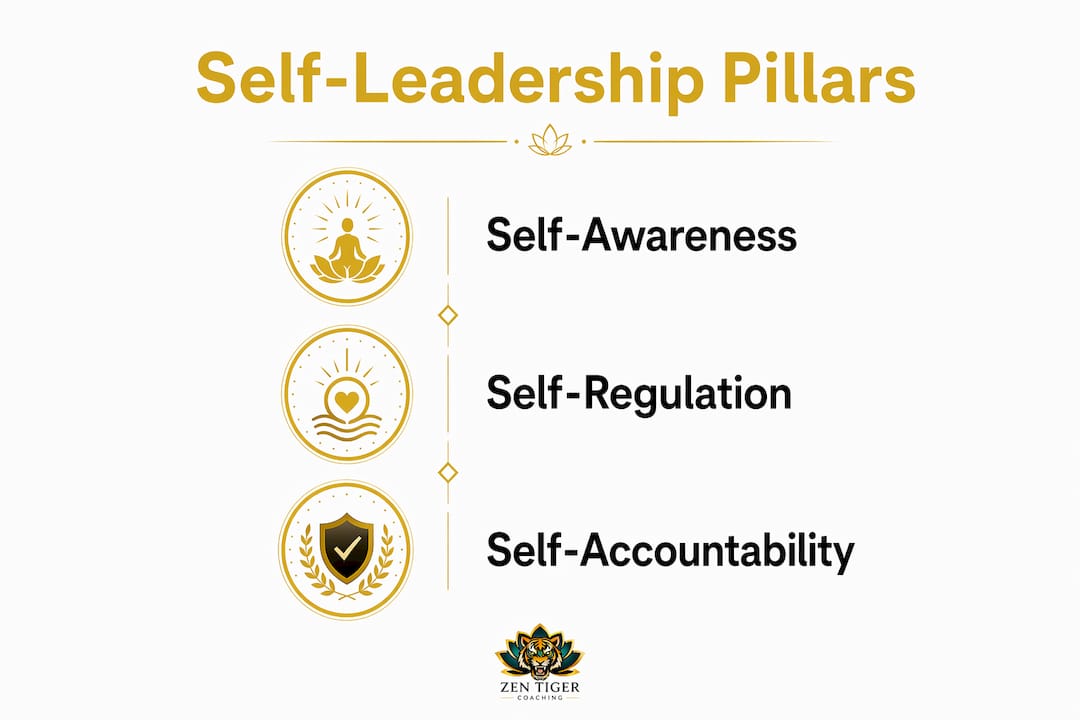
Self-leadership rests on three foundational pillars: self-awareness, self-regulation, and self-accountability. Each one builds on the last. You cannot regulate what you cannot see. You cannot hold yourself accountable without first regulating your emotional state enough to think clearly.
Self-awareness practices
Self-awareness is the starting point. It means knowing your patterns, your triggers, and the stories you tell yourself when things get hard. Journaling, body scanning, and reflective questioning are the most direct ways to build it. The goal is not to analyze yourself into paralysis. The goal is to see yourself clearly enough to make better choices.

Self-regulation techniques
Self-regulation is the ability to manage your internal state without suppressing it. Breathwork, grounding practices, and cognitive reframing all support this. Reframing means replacing a catastrophic thought with a more accurate one. Not a positive one. An accurate one. "I failed at this task" becomes "I did not get the result I wanted. What can I learn from that?"
Self-accountability structures
Self-accountability means owning your outcomes without shame spiraling. A practical structure is a weekly review: three questions, fifteen minutes, every Sunday. What did I commit to? What did I actually do? What will I adjust? That loop, repeated consistently, builds the kind of integrity that makes growth sustainable.
Common pitfalls to avoid:
- Treating self-leadership as a willpower contest. It is a learned set of metacognitive skills, not a character trait you either have or do not.
- Skipping the awareness step and jumping straight to action. Action without awareness is just busy behavior.
- Measuring progress only by external results. Internal shifts count. They often come first.
Pro Tip: Build your self-leadership practice around developing skills that actually work for your specific patterns. Generic advice rarely sticks. Personalized practice does.
Why is metacognition central to accelerating personal growth?
Metacognition is thinking about your thinking. In the context of self-leadership, it means watching how your mind processes experience and deliberately shaping that process. The metacognitive infrastructure built by self-leadership accelerates personal growth by transforming experience into structured learning. Without it, you repeat the same mistakes with slightly different details.
Most people process experience emotionally and then move on. Self-leaders process experience reflectively. They ask: What happened? What did I think and feel? What did I do? What would I do differently? That four-step loop converts every setback into data. It is the difference between a year of experience and a year of the same month repeated twelve times.
One of the most powerful metacognitive skills is separating your identity from your emotional state. Your fear is not you. Your inner critic is not you. Separating your core self from temporary emotional states prevents stress from hijacking your decision-making. You can acknowledge the fear and still choose the courageous action.
| Reactive pattern | Reflective alternative |
|---|---|
| "I always mess this up." | "I struggled here. What specifically went wrong?" |
| "I can't handle this." | "This is hard. What do I need right now?" |
| "They think I'm incompetent." | "I'm interpreting their reaction. What do I actually know?" |
| "I should just quit." | "I'm overwhelmed. What's the smallest next step?" |
Pro Tip: After any significant event, write three sentences: what you observed, what you felt, and what you chose. That practice builds the reflective habit that separates consistent growth from accidental progress.
How does developing self-leadership skills impact performance and decisions?
A meta-analysis confirms that self-leadership positively affects performance, with the strongest results appearing in complex, adaptive, and creative roles. That finding matters because most meaningful personal growth happens in exactly those conditions. You are not growing when things are easy and predictable. You are growing when the path is unclear and the stakes feel high.
Self-leadership improves decision-making by reducing the noise between stimulus and response. When you manage your thinking and emotional state, you access clearer judgment faster. You stop waiting for certainty before acting. High-impact self-leaders ask better questions and act with confidence despite incomplete information. That capacity is not innate. It is built through consistent practice.
For women and creatives especially, self-leadership changes the relationship with uncertainty. Instead of waiting to feel ready, you build the internal trust that allows you to move forward while still learning. That shift is the foundation of self-leadership as a creative woman.
Practical ways to build performance through self-leadership:
- Set a clear intention before any high-stakes conversation or decision
- Debrief after outcomes, not just before them
- Track your energy patterns and protect your peak hours for your most demanding work
- Practice tolerating ambiguity in low-stakes situations so you build the muscle for high-stakes ones
Growth also accelerates when you shift from reactive living to structured reflection on your experiences. That transition is not dramatic. It is a daily choice to pause before you proceed.
Key Takeaways
Self-leadership is the most direct path to sustained personal growth because it builds the internal skills that make every other growth practice more effective.
| Point | Details |
|---|---|
| Self-leadership drives wellbeing | Practitioners show 70% higher wellbeing, making it one of the most research-backed personal growth tools available. |
| Three pillars anchor the practice | Self-awareness, self-regulation, and self-accountability work together. Skipping one weakens the others. |
| Metacognition accelerates learning | Reflecting on your thinking turns every experience into structured growth rather than repeated patterns. |
| Emotional separation reduces stress | Distinguishing your core self from temporary emotional states prevents fear from hijacking your decisions. |
| Better questions beat more answers | High-impact self-leaders act confidently with incomplete information by asking sharper, more honest questions. |
Self-leadership is not what I thought it was
When I first encountered the concept of self-leadership, I assumed it was a productivity framework dressed up in coaching language. I thought it meant discipline, willpower, and getting yourself to do the things you did not want to do. I was wrong about almost all of it.
What I have come to understand, through years of working with women in transition, is that self-leadership is fundamentally about relationship. Specifically, your relationship with yourself. The women I work with who make the most lasting change are not the ones who push hardest. They are the ones who learn to listen to themselves with enough honesty and enough compassion to actually hear what is true.
The biggest misconception I see is that self-leadership requires you to eliminate your inner critic or silence your fear. It does not. Effective self-leaders accept those internal parts without being controlled by them. You observe the critic. You note the fear. You do not hand either of them the steering wheel.
The other thing I want to say plainly is this: imperfect practice beats perfect intention every time. The women who build real self-leadership capacity are not the ones who do it flawlessly. They are the ones who keep showing up, keep reflecting, and keep choosing intentionality over autopilot. Start small. Start honest. The momentum builds faster than you expect.
— RachelMHarrison
Grounded support for your self-leadership path
Self-leadership is not something you figure out once and then have forever. It is a living practice, and sometimes you need a guide who understands both the emotional and the structural dimensions of that work.
Rachel-m-harrison offers trauma-informed coaching designed specifically for women and creatives who are ready to build genuine emotional clarity and grounded self-direction. The work goes deeper than goal-setting. It addresses the nervous system patterns, emotional blocks, and identity stories that keep capable women stuck. If you are unsure whether coaching or therapy is the right fit for where you are right now, the guide on trauma-informed coaching vs. therapy is a clear and honest starting point. You can also explore the full scope of what this work includes to see if it resonates with what you need.
FAQ
What is self-leadership in personal development?
Self-leadership is the practice of intentionally directing your thoughts, emotions, and behaviors toward your personal goals. It is a learned set of metacognitive skills, not a fixed personality trait.
How does self-leadership improve wellbeing?
Research shows that individuals who cultivate self-leadership experience 70% higher wellbeing. The mechanism is self-regulation, which reduces reactive stress responses and builds emotional resilience over time.
What are the most effective self-leadership strategies?
The three most effective strategies are building self-awareness through reflection, practicing self-regulation through techniques like cognitive reframing, and creating self-accountability structures such as weekly reviews.
How does metacognition relate to self-leadership?
Metacognition is the ability to observe and shape your own thinking. Self-leadership uses metacognitive skills to convert experience into structured learning, which accelerates personal growth and prevents repeated mistakes.
Can self-leadership help with burnout?
Organizational studies confirm that self-leadership is a primary resource that mitigates burnout by improving cognitive focus and emotional regulation. It helps you recognize depletion early and respond before it becomes a crisis.