TL;DR:
- Self-leadership is the intentional practice of managing thoughts, emotions, and actions to support healing. It shifts individuals from reactive responses to deliberate, grounded choices, fostering emotional clarity and self-trust. During transitions, it emphasizes nervous system regulation, small consistent actions, and core values to build resilience and promote sustainable growth.
Self-leadership is the intentional practice of directing your own thoughts, emotions, and actions toward healing rather than waiting for circumstances to change. The role of self-leadership in healing is specific: it shifts you from reactive survival mode into deliberate, grounded response. This distinction matters because healing does not happen by accident. It requires a consistent internal structure, what psychologists and trauma-informed coaches call self-directed regulation. Frameworks like Internal Family Systems (IFS) therapy and the trauma-informed coaching work at Rachel-m-harrison both confirm that emotional clarity, nervous system safety, and self-trust are the three outcomes that define genuine healing progress.
How does self-leadership enhance emotional clarity during healing?
Self-leadership improves healing by replacing reactive patterns with intentional responses, and the body is where that shift begins. Trauma-informed coaching advises practices like jaw softening and hand-on-heart placement to create nervous system safety before any high-level decision-making. These are not symbolic gestures. They are physiological signals that tell your nervous system it is safe to think clearly. Without that baseline safety, even the best intentions collapse under stress.

Research in the Journal of Applied Psychology shows strong positive links between self-leadership and decision-making under pressure, creativity, and adaptability. That means self-leadership is not just a mindset concept. It is a measurable cognitive and physiological shift that produces better outcomes under difficult conditions, including the conditions of personal healing.
Self-compassion is the mechanism that makes this shift sustainable. Shame activates the threat response in the brain, which shuts down the prefrontal cortex where clear thinking happens. Self-compassion, as defined by researcher Kristin Neff, counters shame by activating the care system instead. When you respond to your own pain with kindness rather than criticism, your nervous system calms, and emotional clarity becomes accessible.
- Notice physical tension before making decisions (jaw, shoulders, chest)
- Place one hand on your heart when you feel overwhelmed to activate the vagus nerve
- Pause for three slow breaths before responding to an emotional trigger
- Name the emotion you are feeling out loud or in writing to reduce its intensity
- Practice one act of self-compassion daily, even something as small as saying "this is hard, and I am doing my best"
Pro Tip: Create a two-minute body scan practice every morning before checking your phone. Noticing where you hold tension before the day begins gives you a baseline, so you can catch dysregulation earlier and respond rather than react.
What are the core dimensions of self-leadership relevant to healing?
Self-leadership in the context of healing draws from two well-established frameworks: the 8 C's of IFS therapy developed by Dr. Richard Schwartz, and the four foundational pillars used in trauma-informed coaching. Together, they map the full territory of what it means to lead yourself through a healing process.
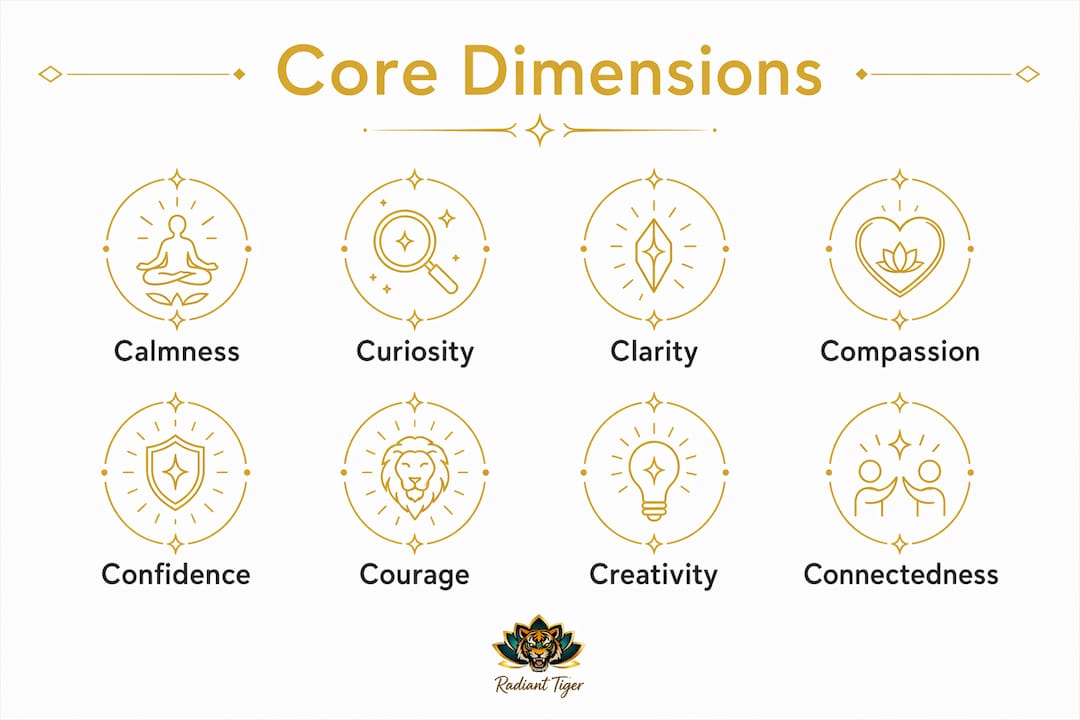
The 8 C's of IFS are Calmness, Curiosity, Clarity, Compassion, Confidence, Courage, Creativity, and Connectedness. These are not personality traits you either have or lack. They are states that become accessible when your nervous system is regulated and your internal parts feel safe. IFS therapy treats these qualities as the natural expression of your core Self, the part of you that can lead your healing without being hijacked by fear or shame.
The four pillars relevant to self-management in healing are cognitive awareness, emotional regulation, behavioral consistency, and values alignment. Cognitive awareness means noticing your thought patterns without being ruled by them. Emotional regulation means responding to feelings rather than being driven by them. Behavioral consistency means taking small repeated actions that build evidence of your own reliability. Values alignment means making choices that reflect who you are becoming, not who you were conditioned to be.
| Dimension | What it means in healing | Practical example |
|---|---|---|
| Cognitive awareness | Observing thoughts without fusing with them | Journaling to separate facts from interpretations |
| Emotional regulation | Responding to feelings with intention | Using breath work before a difficult conversation |
| Behavioral consistency | Small repeated actions that build self-trust | Keeping one daily commitment to yourself |
| Values alignment | Choosing actions that reflect your core identity | Saying no to obligations that contradict your healing |
| Self-compassion | Treating yourself with the care you offer others | Responding to mistakes with curiosity, not criticism |
Healing-centered leadership is about present-moment discernment, not being fully healed. That reframe is significant. It removes the pressure of a fixed destination and replaces it with a practice you can actually sustain.
What challenges arise in self-leadership during healing, and how do you overcome them?
The most common barrier to personal leadership and healing is the ego's attachment to control. Harvard researcher Amy Edmondson's work shows that autonomy-supporting leaders outperform controlling ones, even when the controllers are technically more skilled. The same principle applies internally. When you try to force your healing through willpower and rigid discipline, you create the exact conditions that block it.
Self-trust is the antidote, and it is not built through grand declarations. Self-trust is a nervous system state rebuilt through predictable, repeated small actions. The reliability loop works like this: stability creates choice, choice creates follow-through, follow-through creates evidence, and evidence rebuilds identity. Sleep and nutrition are not optional wellness extras in this model. They are the biological foundation without which the loop cannot function.
Three other challenges show up consistently in self-leadership during healing:
- Identity mismatch: You may intellectually commit to healing while your nervous system still identifies with the person who was wounded. Change feels unsafe even when it is wanted. The solution is gradual exposure to new behaviors, not sudden reinvention.
- Burnout from heroic effort: Treating healing like a performance project leads to exhaustion. Rest is a leadership discipline, not a reward you earn after productivity. Scheduling rest with the same seriousness as tasks is not laziness. It is precision.
- Vague goals that collapse under pressure: Healing goals like "feel better" or "be less anxious" have no traction. Specific, small commitments like "I will sit quietly for five minutes after lunch" create the behavioral evidence your nervous system needs to trust you.
Pro Tip: Designate one non-negotiable daily practice that requires no decision-making. Call it your anchor habit. When everything else feels uncertain, the anchor habit signals to your nervous system that you are still in charge of something real.
How do you apply self-leadership practices during transitional life stages?
Transitional life stages, including divorce, career change, grief, or identity shifts, are the moments when self-leadership matters most and feels hardest. The sequence below is not a rigid program. It is a progression that builds on itself, each step creating the conditions for the next.
- Regulate first. Before any reflection or planning, bring your nervous system to a calm baseline. Use the body-based practices described earlier: breath, touch, movement. You cannot think your way into healing from a dysregulated state.
- Track your emotional patterns. Keep a simple log for two weeks. Note the time of day, the trigger, the emotion, and your response. Patterns become visible quickly. Visibility is the beginning of choice.
- Identify one value that is non-negotiable right now. Not a list of ten. One. Transitions create noise, and noise obscures what matters. A single anchor value cuts through it.
- Make one intentional choice per day that reflects that value. This is behavioral consistency in its simplest form. One choice, repeated daily, builds more self-trust than a complex self-improvement plan executed inconsistently.
- Track restoration alongside output. Sustainable leadership requires frequent internal renewal to restore clarity and refresh judgment. Ask yourself each evening: "Did I restore today?" not just "Did I produce today?" That single question reorients your definition of a successful day.
- Practice self-compassion as a skill, not a feeling. Write one sentence of self-compassion each night. Not affirmations. A direct acknowledgment: "I struggled with X today, and that makes sense given what I am carrying."
- Review and adjust weekly. Self-leadership in healing is not a set-and-forget system. It is a living practice. A ten-minute weekly review of what worked, what did not, and what you want to carry forward keeps the practice honest and adaptive.
Personal healing improves leadership effectiveness by fostering self-awareness, steadier responses, and resilience. That is not a soft claim. It is a documented outcome that shows up in how you navigate stress, conflict, and uncertainty in every area of your life.
The trauma-informed guidance available through Rachel-m-harrison applies these exact principles to women in transition, helping them build the internal structure that makes healing sustainable rather than cyclical.
Key Takeaways
Self-leadership in healing is the practice of regulating your nervous system, building self-trust through consistent small actions, and aligning your daily choices with your values during transitional life stages.
| Point | Details |
|---|---|
| Nervous system first | Regulate your body before making decisions or setting healing goals. |
| Self-trust is built, not declared | Small repeated actions create the evidence your nervous system needs to trust you. |
| Rest is a leadership behavior | Schedule restoration with the same intention as productivity to prevent burnout. |
| Healing has no fixed endpoint | Present-moment discernment, not a fully healed state, is the actual goal. |
| Values alignment drives consistency | One clear anchor value cuts through transitional noise and guides daily choices. |
What I have learned about healing as a leadership practice
Most people come to self-leadership expecting a system that will finally make them disciplined enough to heal. What they find, if they stay with it, is something quieter and more demanding. Healing does not reward effort the way a project does. It rewards presence.
I have worked with women who had every tool, every framework, and every intention, and still felt stuck. The missing piece was almost never information. It was permission. Permission to rest without guilt. Permission to not have it figured out. Permission to count a day as successful because they stayed soft when they wanted to harden.
The empowerment through self-leadership that actually lasts is not the kind that looks impressive from the outside. It is the kind that shows up in how you talk to yourself at 2 a.m. when something falls apart. It is the kind that says, "I have been here before, and I found my way." That is not a feeling you manufacture. It is evidence you accumulate, one small kept promise at a time.
The women I see make the most progress are not the ones who push hardest. They are the ones who learn to read their own signals and respond accordingly. They treat their nervous system as a source of information, not an obstacle to overcome. They understand that healing is an ongoing leadership practice, not a destination you arrive at and then stop working.
If you are in a transitional stage right now, the most powerful thing you can do is not add more to your plate. It is to get honest about what your body is already telling you, and start there.
— RachelMHarrison
Support for your self-leadership and healing path
If this article resonated with you, the next step is understanding what kind of support actually fits where you are right now.
Coaching and therapy serve different functions in a healing process, and choosing the wrong one wastes time and energy you do not have to spare. Rachel-m-harrison offers a clear breakdown of coaching versus therapy for women navigating trauma-informed healing, so you can make that decision with clarity rather than guesswork. For women who want to go deeper into the internal work, the self-leadership skills framework at Rachel-m-harrison provides a grounded, practical starting point built specifically for healing contexts.
FAQ
What is self-leadership in the context of healing?
Self-leadership in healing is the intentional practice of managing your thoughts, emotions, and behaviors to support your own recovery and growth. It draws on frameworks like IFS therapy and trauma-informed coaching to build emotional clarity and self-trust.
How does self-leadership help with nervous system regulation?
Body-based practices like jaw softening, hand-on-heart placement, and slow breathing signal safety to the nervous system, creating the physiological conditions needed for clear thinking and intentional response.
What is the difference between self-leadership and willpower?
Willpower relies on force and discipline, which deplete under stress. Self-leadership relies on nervous system regulation, consistent small actions, and values alignment, which build capacity over time rather than draining it.
How long does it take to rebuild self-trust through self-leadership?
Self-trust rebuilds through repeated small actions rather than time alone. The reliability loop, stability, choice, follow-through, and evidence, can begin producing noticeable results within weeks of consistent practice.
Can self-leadership practices work during major life transitions?
Self-leadership is especially effective during transitions because it provides internal structure when external circumstances are unstable. Tracking emotional patterns, anchoring to one core value, and prioritizing restoration are the three practices most useful in transitional stages.