TL;DR:
- Boundary setting involves clearly communicating personal limits to protect emotional, mental, and physical well-being. It is essential for maintaining identity, reducing burnout, and fostering trustworthy relationships through consistent enforcement and periodic reassessment.
Boundary setting is defined as the conscious act of communicating personal limits to protect your emotional, mental, and physical well-being. The Cleveland Clinic describes a personal boundary as a communicated limit that defines acceptable and unacceptable behavior in any interaction. Boundaries do not control other people. They define what you will do when your limits are crossed. For anyone navigating a life transition, emotional recovery, or a relationship that feels draining, understanding this distinction is the first step toward real change.
Why are boundaries important for your emotional and relational health?
Boundaries protect your sense of self. Without them, identity loss and cynicism become real risks, especially in high-stress environments like caregiving, demanding careers, or emotionally charged relationships. The importance of boundary setting shows up most clearly in what happens when limits are absent.
The consequences of missing boundaries are concrete and measurable:
- Burnout. The APA links burnout rates above 50% in early-career professionals to boundary failures, compared to 18% in those at advanced career stages. That gap reflects the cost of not knowing how to protect your time and energy.
- Resentment. When you consistently give more than you can sustain, resentment builds quietly. It erodes relationships that once felt good.
- Exhaustion. Saying yes when you mean no depletes your emotional reserves faster than almost any other habit.
The advantages of boundary setting are equally specific. People who maintain clear limits report stronger emotional regulation, higher self-confidence, and relationships that feel safer and more honest. Boundaries create predictability. Predictability creates trust. Trust deepens connection. That chain reaction is why the benefits of setting boundaries extend well beyond the individual.
Pro Tip: Start tracking the moments you feel drained after an interaction. Those moments often point directly to an unspoken boundary that needs to be named.

What are the common misconceptions and challenges in setting limits?
The biggest myth about boundaries is that they are selfish. They are not. Boundaries foster deeper connection by creating safety and predictability for everyone involved. A boundary is not a wall. It is a clear signal about how you need to be treated to stay present and engaged in a relationship.
The second most common myth is that boundaries damage relationships. The opposite is true. Relationships without limits tend to collapse under the weight of unmet expectations and unspoken resentment.
Fear and guilt are the two obstacles that stop most people from setting limits at all. Fear of conflict is the most frequently reported barrier. The anticipation of an uncomfortable conversation feels worse than the conversation itself almost every time. Guilt is the other major block. Most people feel guilty the moment they assert a limit, and they interpret that guilt as proof they did something wrong.
That interpretation is incorrect. Guilt during boundary setting is usually a conditioned reflex tied to internalized people-pleasing, not an accurate signal that your limit is unreasonable. Decoupling guilt from boundary validity is one of the most freeing shifts you can make.
Pro Tip: When guilt shows up after you set a limit, ask yourself: "Did I harm someone, or did I just disappoint them?" Harm and disappointment are not the same thing.
How do you effectively set and communicate boundaries?
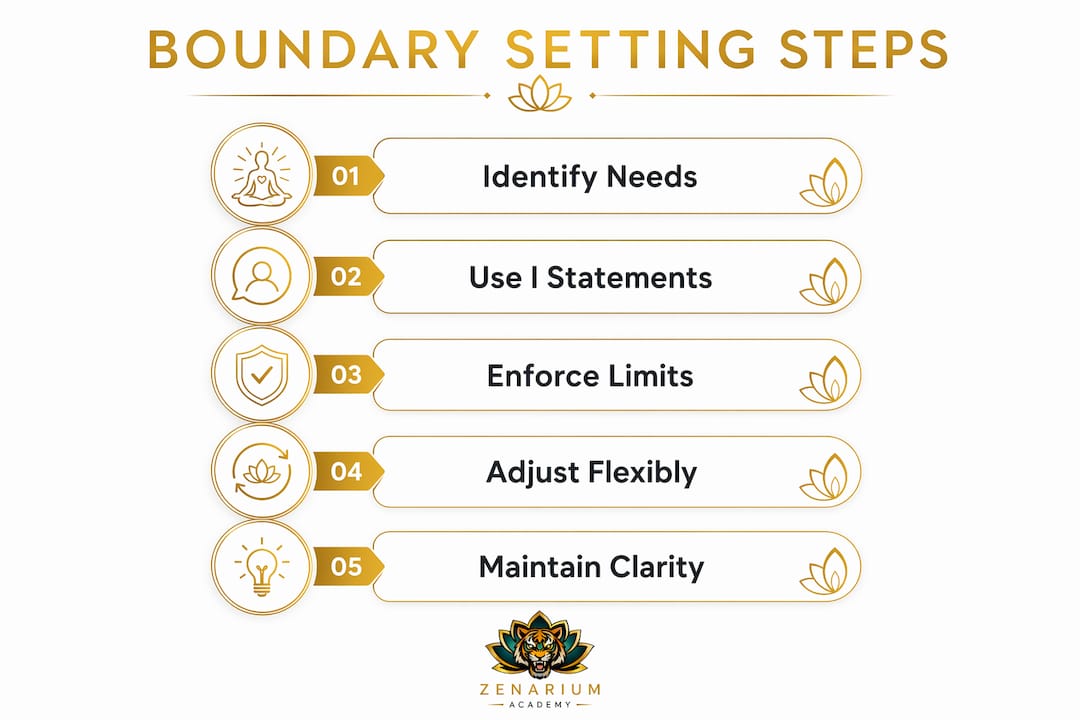
Learning how to set boundaries is a process, not a single conversation. The boundary setting workflow involves three repeating steps: identify your needs, verbalize your limits clearly, and follow through with consistent action. Skipping the third step is where most people lose ground.
Step 1: Identify what you actually need
Start by noticing where you feel overextended, resentful, or anxious. Those feelings are data. They point to a need that is not being met or a limit that is being crossed. Write it down before you try to say it out loud.
Step 2: Communicate with "I" statements
The APA recommends using "I" statements focused on your feelings rather than the other person's behavior. "I feel overwhelmed when calls come in after 9 p.m." lands differently than "You always call too late." One invites dialogue. The other triggers defense.
Pair your words with assertive body language. Standing tall, making eye contact, and speaking in a calm, even tone increases the chance your limit will be heard and respected.
Step 3: Enforce without waiting for permission
Unilateral boundaries require no one else's agreement to work. You communicate what you will do if a limit is crossed, then you do it. Consistency is what makes a boundary real. A limit stated once and never reinforced teaches others it is optional.
The three main boundary types each serve a different purpose:
- Emotional boundaries protect your feelings and mental energy. Example: "I won't continue this conversation if it becomes personal attacks."
- Physical boundaries define your space and body. Example: "I need advance notice before visitors come to my home."
- Time boundaries guard your schedule and capacity. Example: "I don't take work calls on weekends."
Communicating these boundary types clearly reduces misunderstanding and overextension on both sides. Healthy limits also need room to breathe. Rigid boundaries block vulnerability and intimacy over time. Revisit your limits periodically and renegotiate when a relationship has grown or changed. Flexibility is not weakness. It is how boundaries stay alive and relevant.
For concrete examples tailored to real situations, the healthy boundaries for women resource at Rachel-m-harrison offers practical scenarios worth reviewing.
How do boundary needs shift during life transitions?
Life transitions amplify everything. Grief, career changes, caregiving, divorce, and recovery all create conditions where your previous limits may no longer fit. The boundaries that worked when life felt stable often break down under new pressure. That is not failure. That is information.
During transitions, self-awareness becomes your most reliable guide. Reassessing your limits regularly, rather than waiting until you are depleted, keeps you ahead of the drain. A mindful approach to boundary setting during these periods means checking in with yourself before checking in with everyone else.
Specific shifts that commonly occur during transitions:
- Caregiving. Time and emotional limits become critical. Saying no to additional obligations is not abandonment. It is sustainability.
- Career changes. Professional limits around availability and workload need to be renegotiated as roles shift.
- Emotional recovery. During healing, your capacity for certain conversations or relationships may shrink temporarily. Honoring that is self-care, not avoidance.
Flexible boundaries support both safety and intimacy as relationships evolve through these periods. Compassion toward yourself during this process matters as much as the limits you set. You are not building a fortress. You are creating conditions where genuine connection can survive the hard seasons.
The boundary setting guide for women in transition at Rachel-m-harrison offers targeted strategies for exactly these moments.
Key Takeaways
Boundary setting is the single most direct tool for protecting your emotional health, and it works only when communicated clearly and followed through with consistent action.
| Point | Details |
|---|---|
| Boundaries protect identity | Without clear limits, identity loss and burnout become predictable outcomes in high-stress relationships. |
| Guilt is not a signal of wrongdoing | Guilt during boundary setting reflects conditioned people-pleasing, not proof your limit is unreasonable. |
| "I" statements reduce conflict | Framing limits around your feelings rather than others' behavior lowers defensiveness and opens dialogue. |
| Boundaries need periodic review | Rigid limits block intimacy over time; revisiting and renegotiating keeps relationships healthy and adaptive. |
| Transitions require reassessment | Life changes alter your capacity and needs, making regular boundary check-ins a form of active self-care. |
What I have learned about boundaries that most articles won't tell you
Most writing on this topic treats boundary setting like a skill you learn once and then have. That has not matched my experience at all. Boundaries are less like a certificate you earn and more like a conversation you keep having, with yourself first, then with others.
The part that surprised me most was how much my own clarity had to come before any external communication could work. When I did not know what I needed, my limits were vague. Vague limits get ignored, not because people are cruel, but because they genuinely cannot see what is not clearly drawn. The work of getting specific about my own needs was harder than any difficult conversation I eventually had.
I have also seen, both personally and in the women I work with through Rachel-m-harrison, that the fear of conflict is almost always worse than the conflict itself. The anticipation is the real drain. Once a limit is spoken clearly, most relationships either adjust or reveal that they were never safe to begin with. Either outcome is useful information.
The other thing I want to name directly: self-compassion is not optional in this process. You will set a limit imperfectly. You will feel guilty. You will second-guess yourself. None of that means you are doing it wrong. It means you are human and you are learning. The goal is not a perfect boundary. The goal is a life where you feel less depleted and more like yourself.
— RachelMHarrison
Support for your boundary work at Rachel-m-harrison
Setting limits is one thing. Knowing why certain limits feel impossible, and what to do about that, is where real change happens.

Rachel-m-harrison offers trauma-informed coaching built around the Sanctuary Symbolic Integration Method™, a framework designed to help you understand your emotional patterns, stabilize your nervous system, and act from a place of genuine clarity. If you are unsure whether coaching or therapy is the right fit for where you are right now, the trauma-informed coach vs. therapist guide walks through the distinction honestly. For women in transition or recovery, this work goes beyond technique. It addresses the deeper conditioning that makes limits feel dangerous in the first place.
FAQ
What is boundary setting in simple terms?
Boundary setting is the practice of communicating your personal limits to protect your emotional, physical, and mental well-being. It defines what behavior you will accept and what you will do if those limits are crossed.
Are boundaries selfish?
Boundaries are not selfish. They create safety and predictability in relationships, which benefits everyone involved, not just the person setting the limit.
How do I set a boundary without feeling guilty?
Recognize that guilt during boundary setting is usually a conditioned response tied to people-pleasing, not a sign your limit is wrong. Decoupling guilt from boundary validity is key to sustaining healthy limits over time.
What are the main types of personal boundaries?
The three core types are emotional boundaries, which protect your feelings and mental energy; physical boundaries, which define your space and body; and time boundaries, which guard your schedule and capacity.
Why do boundaries matter more during life transitions?
Transitions like grief, caregiving, or career changes alter your emotional capacity and relational needs. Regular reassessment of your limits during these periods prevents depletion and keeps your relationships grounded in your current reality.