TL;DR:
- Conscious self-leadership involves deliberately directing thoughts, emotions, and behaviors with full awareness. It emphasizes integrating cognitive, behavioral, and emotional mastery to lead authentically and adaptively. Practicing this approach fosters resilience, value alignment, and emotional regulation, especially during life transitions.
Most people assume self-leadership is about discipline. Wake up early, push harder, stay consistent. But that framing misses something significant. What is conscious self-leadership, really? It's the practice of directing your thoughts, emotions, and behaviors with full awareness and intention, rather than running on autopilot shaped by old wounds or unexamined habits. For anyone moving through a life transition, this distinction is not subtle. It's the difference between reacting to your circumstances and actually choosing how you respond to them.
Table of Contents
- Key Takeaways
- What conscious self-leadership actually means
- The three dimensions you need to understand
- When self-leadership becomes self-destructive
- How to practice self-leadership with intention
- The real benefits of practicing this way
- My honest take on what this work actually asks of you
- Ready to take this from concept to lived practice?
- FAQ
Key Takeaways
| Point | Details |
|---|---|
| Conscious self-leadership is intentional | It means directing your thoughts, emotions, and behaviors with awareness, not just willpower or discipline. |
| Three dimensions work together | Cognitive, behavioral, and emotional mastery must be coordinated for sustainable self-influence. |
| Pitfalls are real | Excessive self-criticism can make self-leadership self-destructive, so adaptive strategies matter as much as effort. |
| Grounded self-leadership requires values | Rooting your practice in purpose and humility creates authentic, lasting personal leadership. |
| Practice builds real skills | Self-leadership skills develop through consistent education, experience, and reflection, not overnight. |
What conscious self-leadership actually means
The term "self-leadership" has been around in organizational psychology since the 1980s, largely associated with researcher Charles Manz. But conscious self-leadership as most coaches and practitioners use it today adds a layer that the original framework only touched. It's the "awake" version of self-direction.
At its foundation, self-leadership involves intentional direction of thoughts, emotions, and behaviors toward meaningful goals, integrating cognitive, behavioral, and emotional dimensions. The word "intentional" does a lot of work there. It's what separates conscious practice from the ingrained patterns most people never examine.
Conscious self-leadership takes this further by requiring active awareness, what the leadership world calls conscious leadership principles in action. Conscious leadership is defined as expanding self-awareness and leading with alignment and care across people, outcomes, and systems. Applied to yourself, this means you're not just trying to achieve goals. You're awake to how you're trying to achieve them, and whether your methods align with who you actually want to be.
The contrast with unconscious self-management is stark. Unconscious self-management looks like:
- Defaulting to overwork when anxious
- Numbing out to avoid difficult emotions
- Reacting from past conditioning instead of present values
- Seeking external validation as your primary motivator
Conscious self-leadership, by contrast, brings those patterns into the light. It asks you to recognize them, understand their origin, and choose a different response. That's not about being perfect. It's about being present to your own inner life as a leader of it.
The three dimensions you need to understand

Self-leadership is not just one thing. Effective self-leadership requires coordination of cognitive, behavioral, and emotional strategies rather than isolated mindfulness or goal-setting alone. Each dimension feeds the others, and neglecting any one of them creates gaps that undermine the whole practice.
| Dimension | What it involves | Example strategy |
|---|---|---|
| Cognitive | Beliefs, mindset, metacognition | Noticing the story you're telling yourself about a setback |
| Behavioral | Habits, routines, deliberate action | Building morning practices aligned with your values |
| Emotional | Recognition and regulation of feelings | Pausing before reacting to name what you're actually feeling |
The cognitive dimension is where metacognition lives. Metacognition is thinking about your own thinking. It sounds abstract until you realize how rarely most people do it. When you catch yourself catastrophizing and ask, "Is this thought accurate or is it a fear response?" you are practicing metacognition. This is not incidental to conscious self-leadership. It's central.
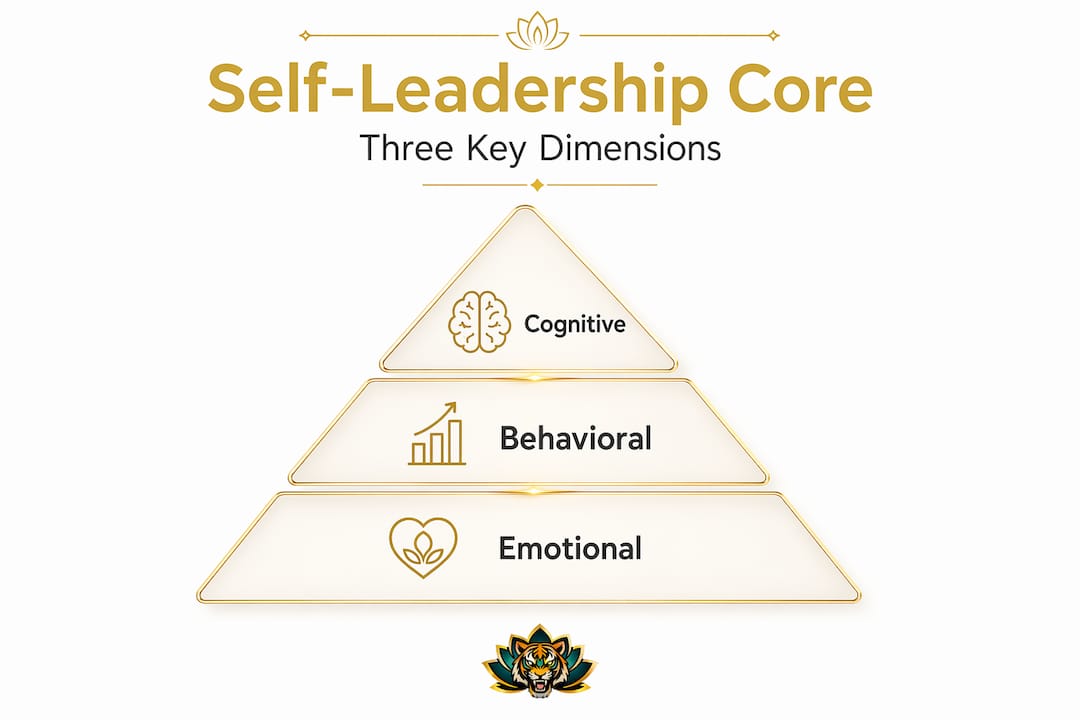
The behavioral dimension is what most people focus on exclusively. Habits, routines, discipline. These matter, but without the cognitive and emotional layers, behavioral strategies become rigid rather than adaptive. You follow the routine even when your body is sending distress signals. That's discipline without consciousness.
The emotional dimension may be the most underrated. Metacognitive monitoring supports flexible, context-appropriate emotion regulation by helping individuals disengage from ineffective strategies like suppression. Put plainly: when you're aware of your emotional patterns, you stop white-knuckling your way through difficult feelings and start choosing responses that actually serve you.
Pro Tip: When you feel emotionally reactive, try naming the specific emotion before taking any action. Research consistently shows that labeling emotions reduces their intensity and gives you more room to choose your response.
You can explore this triad in more depth through this trauma-informed self-leadership guide, which walks through each dimension with particular care for those whose nervous systems carry past experiences.
When self-leadership becomes self-destructive
Here's something most articles on this topic skip entirely. Self-leadership, done wrong, can hurt you. Excessive self-criticism in self-leadership can lead to increased anxiety and maladaptive outcomes, making adaptive strategies and constructive self-influence a requirement, not an option.
The pattern looks like this: you're trying hard to lead yourself better, but your internal voice becomes a harsh critic rather than a supportive coach. You miss a habit and call yourself a failure. You express emotion and immediately label it weakness. You make a mistake during a transition and spin into a shame spiral. That is not conscious self-leadership. That is punitive self-management dressed up as growth.
The antidote is not lowering your standards. It's orienting your self-leadership toward adaptive coping instead of judgment. Here's how to tell the difference:
- Adaptive self-monitoring sounds like: "I noticed I avoided that conversation. What was I afraid of?"
- Destructive self-criticism sounds like: "I'm terrible at conflict. I'll never get this right."
- Adaptive response to setbacks sounds like: "This didn't work. What can I adjust?"
- Maladaptive response to setbacks sounds like: "I failed again. This always happens to me."
Early detection and interruption of reactive certainty loops is especially critical during high-pressure or transitional moments, when your nervous system is already stretched and judgment is quickest to cloud.
Pro Tip: Build a weekly five-minute reflection where you review not just what you did but how you spoke to yourself about it. Your internal language is data. Use it to redirect toward constructive self-influence, not more criticism.
How to practice self-leadership with intention
Knowing what conscious self-leadership is matters far less than knowing how to build it into your actual life. The following framework draws on the triad of cognitive, behavioral, and emotional strategies, adapted for people navigating change and seeking clarity.
-
Anchor to your values. Before anything else, get clear on what you actually stand for. Not the values you think you should have, but the ones that make you feel grounded and whole. Grounded self-leadership, as the meaning of grounded self-leadership implies, is rooted in values and purpose while balancing courage with humility. Write your top three values down. Return to them when decisions feel murky.
-
Expand your self-awareness daily. Self-awareness moves unconscious mental processes into conscious attention, enabling intentional control instead of automatic reaction. A simple daily practice: at the end of each day, ask yourself what you noticed about your thinking, what you felt, and whether your actions aligned with your values. Five minutes. Consistent. Transformative over time.
-
Create behavioral anchors. Choose one or two small, repeatable actions that represent your values in motion. These are not grand gestures. They're the daily deposits that compound. If clarity is a core value, your behavioral anchor might be ten minutes of journaling each morning before checking your phone.
-
Practice emotion naming before emotion reacting. When something activates you, pause. Name the emotion specifically. Not just "stressed" but "afraid of being misunderstood" or "grieving the version of my life that didn't happen." Specificity gives you choice. Vague emotional states keep you stuck.
-
Build feedback loops, not judgment spirals. At the end of each week, review your practice with curiosity. What worked? What pulled you off course? Adjust and continue. This is how self-leadership skills develop sustainably, through consistent reflection and iterative refinement.
You can find a practical workflow for putting this into action on the emotional clarity workflow page, which offers structured exercises for each of these steps.
The real benefits of practicing this way
The benefits of self-leadership are well-documented, but the conscious version produces results that discipline-only approaches rarely achieve. When you practice with awareness across all three dimensions, here's what shifts:
- Emotional regulation under pressure improves. You stop being hijacked by fear, shame, or overwhelm when circumstances get difficult. You develop what researchers describe as the capacity to hold space for emotions without amplifying them.
- Your actions align with your values more consistently. Decisions become cleaner because you're making them from clarity rather than reactivity.
- Resilience becomes a practice, not a personality trait. You develop actual skills for recovering from setbacks rather than hoping you're "tough enough" to bounce back.
- You become a better leader of others. You cannot hold a steady, grounded presence for other people if your own inner world is chaos. Conscious self-management is the infrastructure that leadership of any kind runs on.
- Transitions become less destabilizing. When you know how to orient yourself internally, life's upheavals stop being threats to your identity and start becoming information you can work with.
The importance of self-awareness as the linchpin of all of this cannot be overstated. Without awareness, even your best intentions stay locked inside old patterns.
My honest take on what this work actually asks of you
I've worked with enough women in transition to know that the moment someone hears "self-leadership," they often brace for another list of things to do. Another system. Another way to optimize themselves into adequacy. That framing breaks my heart a little, because it's exactly the opposite of what conscious self-leadership is.
What I've seen again and again is that the hardest part of this work isn't the practices. It's the humility. Being willing to notice that your reactions are running older software than you'd like to admit. Being honest about the ways you've been leading yourself with fear as the engine. That takes courage, and it takes patience with the process.
What conventional leadership advice misses is the emotional complexity sitting underneath every decision, every habit, every "I should be further along by now." In my experience, sustainable self-mastery doesn't come from pushing harder. It comes from getting quieter and more honest, specifically about the places where you've been unkind to yourself in the name of growth.
The people I've watched transform through this work are not the ones who were most disciplined. They're the ones who were most willing to be honest and to stay with themselves through the discomfort. That willingness is the actual practice.
— RachelMHarrison
Ready to take this from concept to lived practice?
If this article left you thinking, "I see what this is, but I'm not sure how to build it inside my real life," that's exactly where coaching comes in. At Rachel-m-harrison, the approach to supporting women in this work is grounded in both trauma-informed psychology and practical clarity tools, including the Sanctuary Symbolic Integration Method™, which helps you understand your emotional patterns and move through them with intention rather than force.

Whether you're early in exploring what conscious self-leadership looks like for you, or you've been at this for a while and want more personalized guidance, you can explore the full range of support available on the coaching services page. If you're ready to begin, you can schedule a session directly. The work is here when you are.
FAQ
What is conscious self-leadership in simple terms?
Conscious self-leadership is the practice of intentionally directing your thoughts, emotions, and behaviors with awareness, rather than reacting from habit or conditioning. It combines cognitive, behavioral, and emotional strategies to help you lead yourself toward meaningful, values-aligned outcomes.
How is self-leadership different from willpower?
Willpower is a single-dimensional force that depletes. Self-leadership, especially in its conscious form, is a coordinated set of cognitive, behavioral, and emotional skills that develop over time through practice and reflection, creating sustainable self-direction rather than white-knuckling through difficulty.
What does grounded self-leadership mean?
The meaning of grounded self-leadership refers to self-direction that is rooted in your core values and purpose, balanced with humility and openness to learning. It keeps you anchored to who you actually are rather than who you think you're supposed to be.
Can self-leadership become harmful?
Yes. Research shows that excessive self-criticism within self-leadership frameworks can increase anxiety and produce maladaptive outcomes. The practice must be oriented toward constructive self-influence and adaptive coping, not perfectionism or punitive self-monitoring.
How long does it take to develop conscious self-leadership skills?
There is no fixed timeline. Self-leadership skills develop through consistent education, experience, and practice over time. Small, repeated practices like daily reflection and emotion naming compound significantly within weeks, while deeper pattern shifts typically unfold over months of intentional work.