TL;DR:
- Feminine leadership emphasizes empathy, collaboration, and emotional intelligence over hierarchy. It is a human-centered approach accessible to all genders that boosts organizational performance. Balancing feminine traits with traditional leadership skills leads to better results and resilient teams.
Feminine leadership is defined as a management style built on emotional intelligence, collaboration, empathy, and inclusivity rather than traditional hierarchical control. The term describes a leadership philosophy, not a gender category. Any leader, regardless of gender, can practice it. Researchers at MindTools describe it as a distinct approach that prioritizes human connection and shared decision-making over top-down authority. Understanding what is feminine leadership matters because organizations that adopt these principles consistently outperform those that do not.
What is feminine leadership, and what defines it?
Feminine leadership is a human-centered leadership philosophy accessible to all genders, designed to remove the rigidity that stifles transparency and well-being in traditional workplace structures. The standard industry term used in organizational psychology is relational leadership, and both terms describe the same core orientation: leading through connection rather than command.
This style does not ask leaders to be less decisive or less results-driven. It asks them to add depth to how they lead. Where traditional models reward authority and control, feminine leadership rewards trust and mutual accountability. The result is a fundamentally different relationship between a leader and the people they lead.
Thrive Global identifies the core traits of feminine leadership as empathy, collaboration, intuition, adaptability, and relational intelligence. These traits enhance innovation and resilience in teams. They are not personality quirks. They are measurable leadership behaviors that produce specific organizational outcomes.

What are the key characteristics of feminine leadership?
The characteristics of female leaders who practice this style cluster around five areas: emotional intelligence, vulnerability, active listening, collaboration, and inclusivity. Each one functions as a practical leadership tool, not a personality trait.
Emotional intelligence is the ability to recognize, understand, and manage emotions in yourself and others. Leaders with high emotional intelligence de-escalate conflict faster, build stronger teams, and make decisions that account for human impact. Vulnerability is the willingness to admit uncertainty and ask for input. Far from being a weakness, Fast Company reports that empathy, vulnerability, and active listening are hard strategic assets that drive engagement and organizational stability.
Collaboration means distributing decision-making rather than centralizing it. Leaders who collaborate create teams where people feel ownership over outcomes. Inclusivity means actively seeking perspectives from people who are typically overlooked. Intuition and adaptability round out the profile, allowing leaders to read situations quickly and shift course without ego getting in the way.
Key feminine leadership traits at a glance:
- Empathy and emotional attunement
- Active listening and open communication
- Collaborative decision-making
- Vulnerability and psychological safety
- Inclusivity and equity-focused thinking
- Intuition and situational adaptability
- Relational intelligence
Pro Tip: Do not try to adopt all seven traits at once. Pick the one that feels most foreign to your current style and practice it deliberately for 30 days. Authentic leadership grows from genuine practice, not performance.
What benefits do feminine leadership styles bring to organizations?
The benefits of feminine leadership are measurable and significant. ESADE research shows that companies embracing parity and collaborative leadership styles improve profits by 5%–20%, alongside gains in innovation and talent retention. That range is wide because the gains compound over time. Organizations that sustain these practices for years see the higher end of that range.
A scoping review published in BMJ Global Health found that women leaders positively influence six core organizational areas: financial stability, innovation, ethics, health, culture, and the advancement of other women. Each area reinforces the others. A culture built on ethics attracts better talent. Better talent drives innovation. Innovation improves financial stability.
The table below summarizes the documented organizational benefits:
| Benefit area | Documented impact |
|---|---|
| Financial performance | 5%–20% profit improvement with collaborative leadership |
| Innovation | Higher rates of new ideas and problem-solving |
| Employee retention | Stronger loyalty and lower turnover |
| Workplace culture | Greater trust, psychological safety, and engagement |
| Ethics and governance | More transparent decision-making and accountability |
| Advancement of women | More equitable promotion and mentorship pipelines |
Emotional wellness in leadership research reinforces these findings. Inclusive and empathetic leadership styles foster trust and psychological safety, which are the two conditions most strongly linked to high-performing teams. Teams that feel psychologically safe take more risks, share more ideas, and recover from setbacks faster.
How does feminine leadership compare to traditional masculine leadership?
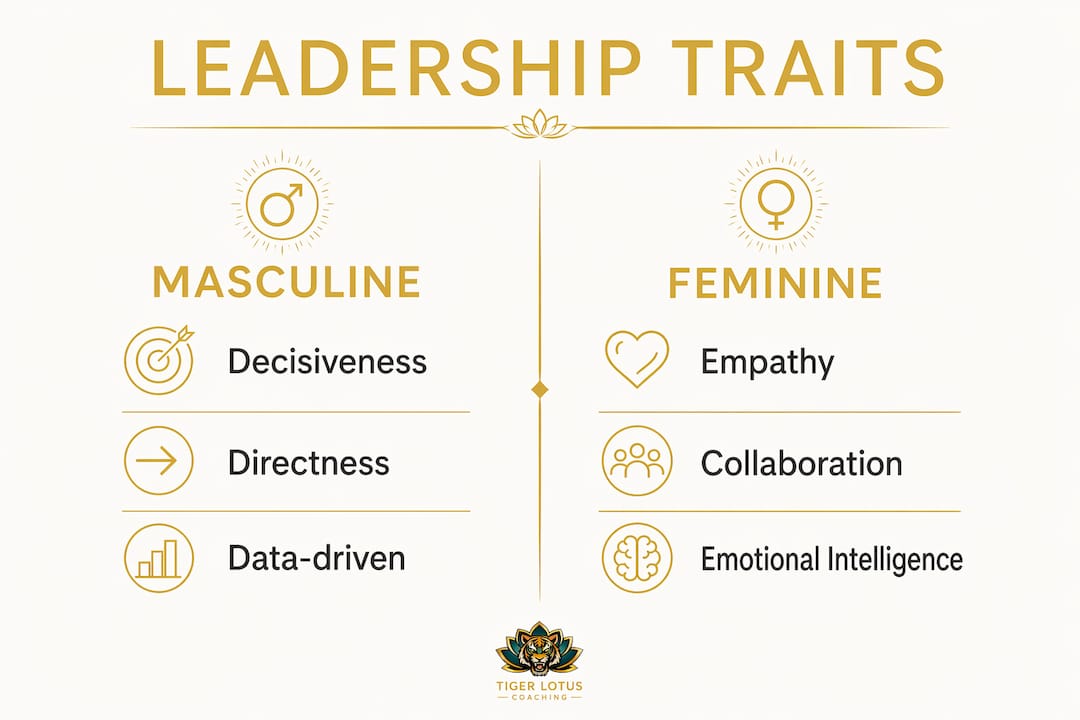
Leadership exists on a spectrum, not as a binary choice. Masculine leadership traits include decisiveness, data-driven analysis, directness, and a focus on hierarchy and results. Feminine leadership traits include sincerity, intuition, collaboration, and relational focus. Neither set is superior on its own.
IE University research confirms that effective leadership blends masculine and feminine traits for the best outcomes. A leader who is decisive but not empathetic burns out their team. A leader who is empathetic but not decisive loses their team's confidence. The goal is integration, not replacement.
| Masculine leadership traits | Feminine leadership traits |
|---|---|
| Decisiveness and directness | Empathy and active listening |
| Data-driven analysis | Intuition and relational intelligence |
| Hierarchical structure | Collaborative decision-making |
| Individual achievement focus | Team and community focus |
| Risk-taking and competition | Trust-building and inclusion |
The most effective leaders draw from both columns. A surgeon needs decisiveness under pressure and empathy in patient communication. A CEO needs data-driven strategy and the relational intelligence to retain top talent. MindTools notes that balanced leadership, which blends both sets of traits, consistently produces stronger organizational outcomes than adopting one style exclusively.
Pro Tip: Audit your last five major decisions. For each one, ask: did I prioritize data or relationship? Speed or consensus? The pattern you find reveals your default style. That awareness is the starting point for intentional balance.
How can you develop and embody feminine leadership traits?
Embodying feminine leadership starts with self-awareness. You cannot lead others with emotional intelligence if you have not developed it in yourself first. The foundation is understanding your own emotional patterns, triggers, and defaults under pressure.
Coaching that supports women leaders shows that psychological resilience and boundary-setting are the two skills most directly tied to sustained feminine leadership. Without them, empathy becomes over-extension and collaboration becomes conflict avoidance. The goal is grounded leadership, not people-pleasing.
Practical steps to develop these traits:
- Practice active listening daily. In your next meeting, speak last. Listen to understand, not to respond. Notice what you learn when you stop preparing your reply.
- Name your emotional state before key decisions. Saying "I'm feeling pressured right now" out loud, even just to yourself, interrupts reactive decision-making.
- Create psychological safety in your team. Ask one open question per meeting that has no wrong answer. Reward honesty over agreement.
- Build vulnerability into your communication. Share one thing you are uncertain about each week with your team. This models the behavior you want from them.
- Actively include overlooked voices. Before finalizing any group decision, ask who has not spoken yet and create space for that input.
- Reflect on your leadership weekly. A 10-minute written reflection on what worked and what did not accelerates growth faster than any training program.
Self-awareness is not a soft skill. It is the infrastructure on which every other leadership behavior is built.
Key Takeaways
Feminine leadership is a results-producing philosophy built on empathy, collaboration, and emotional intelligence, and it is accessible to every leader regardless of gender.
| Point | Details |
|---|---|
| Definition and access | Feminine leadership is a human-centered style available to all genders, not limited to women. |
| Core traits | Empathy, active listening, collaboration, vulnerability, and inclusivity are its defining behaviors. |
| Organizational impact | Companies using collaborative leadership see profit gains of 5%–20% alongside stronger culture and retention. |
| Balance is the goal | Blending feminine and masculine traits produces better outcomes than practicing either style alone. |
| Development starts within | Self-awareness and emotional wellness are the foundation for embodying these leadership qualities. |
Why feminine leadership is the conversation we stopped having too soon
The discourse around feminine leadership peaked around 2015, then got absorbed into broader diversity and inclusion programs. That absorption diluted something important. Diversity initiatives focus on representation. Feminine leadership focuses on how people lead once they are in the room. Those are different problems with different solutions.
What I have observed, working with women leaders and creatives navigating high-stakes transitions, is that the leaders who struggle most are not lacking skills. They are leading from a framework that was never designed for them. They have been trained to suppress the very traits that would make them most effective: their empathy, their relational intelligence, their capacity to hold complexity without forcing premature resolution.
The research from BMJ Global Health and ESADE does not surprise me. It confirms what I see in practice. When women lead from their actual strengths rather than from a borrowed masculine template, their teams stabilize, their cultures shift, and their results improve. The problem is that most professional environments still implicitly penalize those strengths.
Feminine leadership is not a trend or a correction. It is a more complete picture of what leadership actually requires. The leaders who will matter most in the next decade are the ones who can hold both precision and compassion, both decisiveness and deep listening. That is not a compromise. That is mastery.
— RachelMHarrison
Grounded leadership support from Rachel-m-harrison
Knowing the principles of feminine leadership is one thing. Embodying them under real pressure is another. Rachel-m-harrison offers trauma-informed coaching designed specifically for women and leaders who want to lead from clarity rather than from conditioning.

The work goes deeper than skill-building. It addresses the emotional patterns and nervous system responses that shape how you lead when things get hard. If you are unsure whether coaching or therapy is the right fit for where you are right now, the trauma-informed coach vs therapist guide on the Rachel-m-harrison site walks you through the distinction clearly. You can also explore the emotional wellness checklist as a practical starting point for understanding your current leadership foundation.
FAQ
What is feminine leadership in simple terms?
Feminine leadership is a style built on empathy, collaboration, and emotional intelligence rather than hierarchy and control. It is accessible to leaders of any gender.
Are feminine leadership traits only relevant for women?
No. Feminine leadership is a philosophy available to all genders. The traits it emphasizes, such as empathy, active listening, and inclusivity, improve leadership effectiveness regardless of who practices them.
What are the most important feminine leadership traits?
The core traits are emotional intelligence, empathy, active listening, collaborative decision-making, vulnerability, and inclusivity. Thrive Global identifies adaptability and relational intelligence as equally central to this leadership style.
How does feminine leadership affect business performance?
ESADE research shows that companies embracing collaborative leadership styles improve profits by 5%–20%. The gains extend to innovation, talent retention, and workplace culture.
Can feminine and masculine leadership styles work together?
Yes. IE University research confirms that blending masculine traits like decisiveness with feminine traits like empathy produces the strongest leadership outcomes. The goal is integration, not choosing one over the other.