TL;DR:
- Personal mastery involves continuously clarifying your vision, understanding your reality, and using the gap between them for growth. It relies on internal alignment, emotional clarity, and disciplined self-observation to foster consistent self-leadership and high performance. Practicing daily reflection and honest feedback strengthens internal systems, helping you manage reactions and build resilience over time.
Personal mastery is defined as the discipline of continually clarifying and deepening your personal vision, focusing your energies, developing patience, and seeing reality objectively. Popularized by Peter Senge in The Fifth Discipline, it is one of five core disciplines of a learning organization. The gap between where you are now and where you want to be creates what Senge calls "creative tension," and that tension is the engine of real growth. Personal mastery is not a quick fix or a personality upgrade. It is a lifelong orientation toward honest self-knowledge and deliberate, values-aligned action.
What is personal mastery and why does it matter?
Personal mastery is the recognized term in organizational psychology and personal development for what many people loosely call "self-improvement" or "self-mastery." The distinction matters. Self-improvement often targets external outcomes like productivity or status. Personal mastery targets the internal system driving those outcomes: your vision, your values, and your relationship with reality.

The concept rests on three interlocking principles. First, you hold a clear personal vision of what you want your life to look like. Second, you see your current reality honestly, without distortion or denial. Third, you hold both simultaneously, letting the gap between them generate the energy that pulls you forward.
Why self-mastery matters becomes clear when you look at what happens without it. Without a clear internal compass, your behavior becomes reactive. You respond to pressure, other people's expectations, and momentary emotions rather than your own considered direction. Personal mastery replaces that reactivity with a trained, consistent orientation toward what genuinely matters to you.
The importance of personal mastery also shows up in how you relate to discomfort. Most people resolve creative tension by either lowering their goals or distorting their view of reality. Both moves kill growth. Personal mastery teaches you to stay in that uncomfortable gap and let it work for you.
How does personal mastery relate to emotional clarity and self-regulation?
Emotional clarity is the ability to accurately identify what you are feeling and understand why. It is a core component of personal mastery because you cannot align your actions with your values if you cannot read your own internal state.
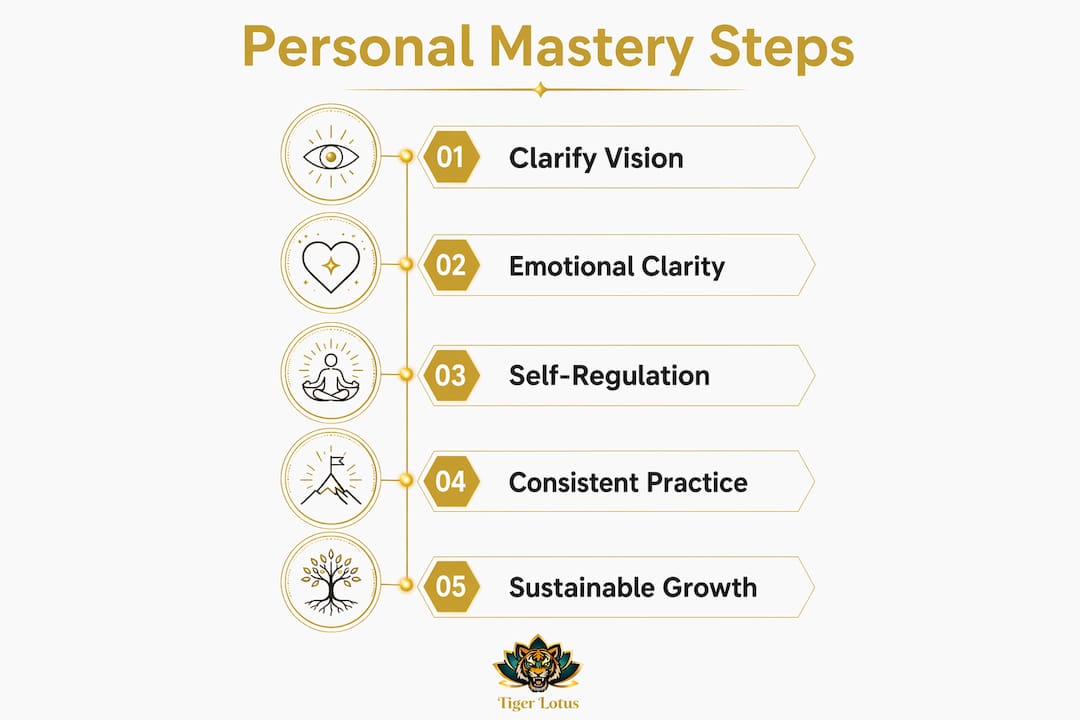
Self-mastery is a trainable competence to regulate emotions and avoid impulsive reactions. That training improves decision-making by reducing cognitive distortions, the mental shortcuts and biases that warp your perception of a situation. When you can name what you are feeling without being controlled by it, you make better choices under pressure.
The practical benefits of this skill are concrete:
- You recognize when fear is driving a decision rather than sound judgment.
- You pause before reacting to criticism, which protects relationships and professional credibility.
- You build emotional resilience by processing difficult feedback rather than deflecting it.
- You distinguish between a feeling that signals a real boundary and one that signals old conditioning.
Self-regulation also buffers stress. A person with trained self-regulation does not eliminate hard emotions. They develop the capacity to feel them without being swept away. That capacity is what makes sustained high performance possible.
Pro Tip: When a strong emotion surfaces, ask yourself two questions before acting: "What am I actually feeling right now?" and "What does this feeling want me to do?" Separating the emotion from the impulse is the first move in self-regulation.
What are common misconceptions about personal mastery?
The biggest misconception is that personal mastery is about willpower. True mastery reduces reliance on conscious effort by aligning values and actions internally. When your behavior is driven by deep alignment rather than strained discipline, you do not need to white-knuckle your way through every challenge. The behavior becomes more natural over time.
A second misconception is that personal mastery is ego-building. This one is subtler and more damaging. When you frame mastery as becoming a better, more impressive version of yourself, you are actually reinforcing the ego structures that block honest self-observation. Personal mastery is a quiet, internal process. It is not self-optimization for external approval.
Three other myths worth naming directly:
- Mastery equals perfection. Personal mastery is not about eliminating flaws. It is about seeing yourself clearly and growing from that clarity.
- Mastery is a destination. Personal mastery is an orientation, not an endpoint. You do not arrive. You calibrate, daily.
- Mastery means self-control. Self-control implies suppression. Personal mastery means understanding your patterns well enough that suppression becomes unnecessary.
"Discomfort from the gap between vision and reality is the place where learning happens." This reframe is central to understanding personal mastery correctly. The tension is not a problem to solve. It is the growth itself.
Personal mastery differs from mental models, another of Senge's five disciplines. Mental models address your assumptions about the world. Personal mastery addresses your alignment with yourself: your vision, your values, and your clarity of purpose. Conflating the two leads people to intellectualize their growth rather than embody it.
How does personal mastery support high performance and self-leadership?
High performance is not about peak moments. It is about consistency under pressure. Personal mastery builds that consistency by replacing luck and motivation with trained internal systems.
Personal mastery reduces performance left to chance by creating internal systems that make desired behaviors automatic under pressure. When your values and actions are aligned, you do not have to decide how to behave in a difficult moment. You already know. That predictability is the foundation of reliable performance.
Four ways personal mastery directly supports self-leadership:
- Early detection of destructive habits. Practitioners identify patterns that degrade results before those patterns cause serious damage. Self-observation is the diagnostic tool.
- Presence over image. Self-leadership built on personal mastery comes from genuine clarity, not from managing how others perceive you. That shift reduces the energy drain of impression management.
- Grounded decision-making. When you accept your current reality without judgment, you make decisions based on what is actually true rather than what you wish were true.
- Reduced dependence on motivation. Mastery of self is the first pillar of high performance frameworks because it makes behavior reliable. Motivation fluctuates. Trained awareness does not.
Self-leadership built on psychological grounding is also more sustainable. Leaders who rely on willpower and external validation burn out. Leaders who operate from internal clarity do not need constant external reinforcement to stay on course.
Pro Tip: At the end of each workday, identify one moment when you acted from clarity and one moment when you acted from reactivity. That daily audit builds the self-observation muscle faster than any weekly review.
What practical steps can individuals take to cultivate personal mastery?
Personal mastery is built through daily practice, not occasional insight. The following habits form the foundation of a sustainable practice.
- Daily self-observation. Spend five minutes each morning noticing your current emotional state without judgment. Name it. Locate it in your body. This builds the awareness that makes self-regulation possible.
- Clarify your personal vision. Write a clear, specific description of the life you want to be living. Not goals. A vision. Goals are milestones. Vision is the direction. Emotional clarity exercises help you access this with honesty rather than performance.
- Practice holding creative tension. When you notice the gap between your vision and your current reality, resist the urge to close it quickly. Sit with it. Let it inform your next step rather than panic you into a shortcut.
- Seek honest feedback. Growth requires accurate data about how you show up. Ask people you trust for specific, behavioral feedback. Then practice receiving it without defending or deflating.
- Build a peer community. Finding a peer or mentor who values presence over performance is critical for sustainable practice. Social systems often reward speed and output over reflection. A community that values depth protects your practice.
The table below maps each practice to its core function in personal mastery development.
| Practice | Core function |
|---|---|
| Daily self-observation | Builds emotional awareness and reduces reactive behavior |
| Clarifying personal vision | Creates the reference point for creative tension |
| Holding creative tension | Develops patience and tolerance for productive discomfort |
| Seeking honest feedback | Accelerates growth by correcting blind spots |
| Peer or mentor community | Sustains practice against social pressure to skip reflection |
Regular reflection and self-observation accelerate growth and align actions with personal vision. The key is consistency over intensity. Ten minutes of honest daily reflection outperforms a weekend retreat you attend once a year.
Your personal growth checklist can serve as a practical companion to these habits, giving you a structured way to track where you are and where you are heading.
Key Takeaways
Personal mastery is the ongoing discipline of aligning your vision, values, and reality to build consistent self-leadership and emotional clarity from the inside out.
| Point | Details |
|---|---|
| Core definition | Personal mastery means clarifying your vision, seeing reality honestly, and holding the gap between them as growth energy. |
| Emotional regulation | Self-regulation is a trainable skill that improves decision-making and reduces reactive behavior under pressure. |
| Common misconception | Mastery is not willpower or ego-building. It is a quiet, internal alignment of values and action. |
| High performance link | Internal systems built through mastery make behavior reliable and reduce dependence on motivation. |
| Daily practice | Consistent self-observation, honest feedback, and peer support sustain a personal mastery practice over time. |
What I have learned about personal mastery that most guides skip
Most articles on personal mastery read like productivity frameworks with a spiritual veneer. They give you a list of habits and send you on your way. What they miss is the ego resistance that shows up the moment you start practicing seriously.
I have worked with women who came to personal mastery expecting it to feel like progress. What they found instead was discomfort. They started seeing their patterns clearly, and that clarity was not flattering. The ego does not like being observed. It reframes honest self-observation as self-criticism, and suddenly the practice feels like punishment rather than growth.
The paradox at the center of real mastery is this: you have to fully accept your current reality before you can change it. Not tolerate it. Not explain it. Accept it. That step is where most people stall. They want to skip straight to the vision and bypass the honest accounting of where they actually are.
What I have also seen is that deepening your mastery practice changes your relationships. Your communication becomes clearer. Your boundaries become more visible. Some people in your life will find that uncomfortable. That friction is not a sign you are doing it wrong. It is a sign the practice is working.
The daily calibration is what makes this sustainable. Not a monthly review. Not a quarterly retreat. A daily, five-minute honest check-in with yourself. That small practice, done consistently, builds the internal infrastructure that everything else rests on.
— RachelMHarrison
Personal mastery and the work of emotional clarity
If this article has clarified what personal mastery means for you, the next step is putting it into practice with support that meets you where you actually are.
Rachel-m-harrison offers trauma-informed coaching built around emotional wellness and self-leadership for women and creatives who are ready to move from reactive patterns to grounded clarity. The Sanctuary Symbolic Integration Method™ is the framework at the center of this work. It helps you understand your emotional patterns, stabilize your nervous system, and take aligned action from a place of genuine self-knowledge. If you are unsure whether coaching or therapy is the right fit for where you are right now, the guide on trauma-informed coaching vs therapy is a clear, honest place to start.
FAQ
What is personal mastery in simple terms?
Personal mastery is the ongoing practice of knowing yourself clearly, holding a vision for your life, and closing the gap between the two through consistent, values-aligned action. It is a discipline, not a destination.
How is personal mastery different from self-control?
Self-control implies suppressing impulses through effort. Personal mastery reduces the need for suppression by aligning your values and behavior so deeply that reactive impulses lose their grip over time.
Why is personal mastery important for leaders?
Personal mastery makes behavior reliable under pressure by replacing motivation-dependent performance with trained internal systems. Leaders who operate from this foundation make clearer decisions and build more trust.
How long does it take to develop personal mastery?
Personal mastery is a lifelong orientation, not a skill you complete. Daily self-observation and honest reflection build the practice incrementally, with meaningful shifts in emotional clarity often visible within weeks of consistent effort.
Can personal mastery help with emotional regulation?
Yes. Self-mastery is a trainable competence that improves the ability to distinguish feelings from reactive impulses, reducing cognitive distortions and building psychological resilience over time.