TL;DR:
- Psychoeducation for leaders offers structured, evidence-based learning that enhances psychological self-awareness and relational skills. It reduces stigma, improves emotional regulation, and fosters psychologically safe workplaces, leading to measurable behavioral and cultural changes. Unlike traditional training, it focuses on internal capacity and translating knowledge into observable, lasting leadership practices.
Most leaders know how to run a meeting. Far fewer know how to regulate themselves inside one. That gap is exactly why the question of why psychoeducation for leaders is gaining serious attention at the highest levels of organizational development. Psychoeducation, a term borrowed from clinical mental health practice, refers to structured, evidence-based learning that builds psychological self-awareness and self-management skills. For leaders, it fills the exact space that most traditional programs leave empty: the relational, emotional, and mental health dimension of leading people well.
Table of Contents
- Key takeaways
- Why psychoeducation for leaders is different from standard training
- The evidence behind psychoeducation's leadership impact
- How psychoeducation compares to traditional leadership programs
- Putting psychoeducation into practice as a leader
- My perspective on why this matters right now
- How Rachel-m-harrison supports leaders through this work
- FAQ
Key takeaways
| Point | Details |
|---|---|
| Psychoeducation is not therapy | It is structured education that builds psychological self-awareness and relational skills in leadership contexts. |
| Stigma reduction starts at the top | Leaders trained in psychoeducation create cultures where mental health conversations are safer and more open. |
| Mentalization is the core skill | Understanding your own and others' mental states directly improves decision-making and psychological safety. |
| Behavior translation is non-negotiable | Knowledge alone does not change culture. Psychoeducation must be converted into observable daily behaviors. |
| Structured programs produce lasting results | Session-based models, like five-session frameworks, show measurable improvements in resilience and relational trust. |
Why psychoeducation for leaders is different from standard training
The term "psychoeducation" originated in clinical and therapeutic settings, where mental health professionals used structured education to help patients understand their conditions and actively engage in their own recovery. Structured psychoeducation delivers knowledge, practical coping skills, and self-management strategies, not passive lectures or motivational talks.
When adapted for leadership, these same principles target a different set of challenges. Leaders are not patients. But they do carry enormous emotional loads, make high-stakes relational decisions daily, and hold significant influence over the psychological safety of their teams. The clinical framework translates surprisingly well.
The core concepts that make psychoeducation distinct in leadership contexts include:
- Mentalization. The capacity to understand that your own behavior is driven by internal mental states, and so is everyone else's. Leaders who mentalize well are less reactive, more curious, and far more effective at navigating conflict.
- Emotional regulation. Not suppression. Actual recognition and management of emotion in real time, especially under pressure.
- Self-management through self-awareness. Psychoeducation teaches leaders to notice their own patterns before those patterns show up as decisions their teams have to live with.
- Psychological safety as a skill. Not a policy. A relational behavior that can be learned, practiced, and reinforced.
Pro Tip: If you are evaluating leadership development options, ask whether the program teaches leaders to understand mental states, both their own and their team's. If the answer is no, you are looking at operational training, not relational leadership development.
Mentalization-based training specifically improves leaders' capacity to understand mental states, and that capacity directly changes how leaders behave with their teams. That is the mechanism most conventional programs completely skip.
The evidence behind psychoeducation's leadership impact
The research on this is not soft. It is specific, measurable, and increasingly hard to ignore.
Workplace programs that incorporate psychoeducation show significant decreases in stigmatizing attitudes toward mental health, with effects that hold up at the six-month follow-up. That matters for leaders because stigma is one of the most stubborn barriers to open communication in any organization. When a leader carries stigmatizing beliefs, often unconsciously, they shut down the very conversations that would help their team function better.
"Addressing mental health stigma at managerial levels is crucial because stigma is a barrier to help-seeking and open communication in organizations."
Resilience is another measurable benefit. Leaders who have gone through psychoeducational training report stronger emotional regulation capacity and a greater sense of self-efficacy when facing setbacks. These are not personality traits. They are learnable skills.
The downstream effects on teams are just as significant. Health-promoting leadership reduces stress and turnover intentions, while health-impairing leadership increases adverse mental health outcomes. Psychoeducation is one of the few training approaches that directly develops health-promoting behaviors by targeting the relational and emotional roots of leadership quality.

Leadership behaviors that promote psychological safety are linked to improved team dynamics, stronger openness to feedback, and higher levels of empowerment across the team. None of that happens through operational skill-building alone. It requires leaders who understand what psychological safety actually is and why it breaks down.
Leadership psychoeducation, framed within what researchers call Job Demands-Resources theory, also helps leaders recognize health-impairing demands in their environment and actively work to increase the psychological resources available to their teams. That is a structural change in how leaders see their role.
How psychoeducation compares to traditional leadership programs
Most leadership programs focus on output. Psychoeducation focuses on the internal capacity that determines output quality.
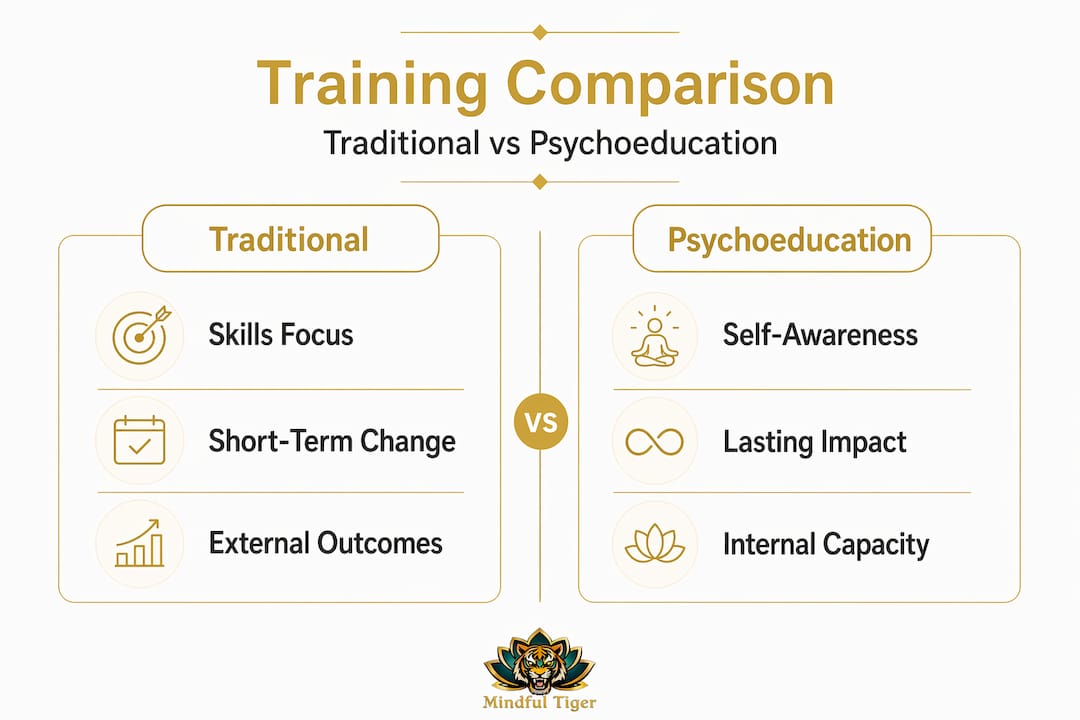
| Feature | Traditional leadership training | Psychoeducational leadership training |
|---|---|---|
| Primary focus | Operational skills, goal-setting, delegation | Emotional intelligence, relational safety, mental health literacy |
| Approach to emotions | Mostly absent or labeled as "soft skills" | Central to the curriculum and treated as measurable competencies |
| Behavior change mechanism | Knowledge transfer and frameworks | Experiential practice, reflection, and behavior translation |
| Mental health coverage | Rare, often limited to wellness perks | Explicit, structured, and destigmatizing |
| Measurement | Performance metrics and productivity | Mentalizing capacity, relational behaviors, psychological safety climate |
| Duration/format | Often one-day workshops or annual retreats | Structured multi-session models with reinforcement |
The gap in the middle column of that table is where most leadership programs lose their investment. You can teach a leader every framework in existence. If they cannot regulate their own emotional responses under pressure, or recognize when a team member is withdrawing due to psychological distress, no framework saves that situation.
Translating psychoeducational knowledge into observable behaviors, like practicing curiosity-driven inquiry or pausing before responding to conflict, is what separates programs that produce lasting culture change from those that produce good notes and forgotten slides.
Pro Tip: When building or selecting a leadership development program, look for explicit behavior translation exercises. Learning what mentalization means is not the same as practicing it under the conditions where it breaks down. The two are miles apart.
Putting psychoeducation into practice as a leader
You do not need a clinical background to apply these principles. You need structure, consistency, and the willingness to treat relational skills with the same rigor you bring to financial planning.
Here is a practical framework for integrating psychoeducational principles into your leadership practice:
-
Build in reflexive pauses. Before responding to a difficult email, a team conflict, or an unexpected setback, pause and ask yourself what assumptions you are operating from. This is not a productivity hack. It is mentalization in practice.
-
Adopt curiosity as a default stance. When a team member behaves in a way that frustrates you, your first move should be curiosity, not correction. What might they be experiencing that you are not seeing? This question alone changes the relational dynamic of the entire conversation.
-
Model non-defensive responses to mistakes. Psychological safety lives or dies by how a leader responds the first time someone admits an error. If your response closes the person down, that information will travel fast across your team.
-
Use structured learning formats. The WHO's Group PM+ model demonstrates that five-session psychoeducational programs with clear learning objectives produce measurable psychological skill acquisition. Apply that principle to your own development: short, structured, repeated practice beats long, sporadic workshops every time.
-
Combine psychoeducation with lived-experience sharing. Multimodal programs that pair structured learning with real personal narratives produce more lasting reductions in stigma and stronger behavior change than awareness talks alone. Create spaces, in team meetings or one-on-ones, where personal experience is welcomed, not just professional performance.
-
Measure the right things. Retention and productivity are downstream outcomes. The real indicators of progress are changes in mentalizing capacity, relational behaviors, and how psychologically safe your team reports feeling. Build those into your review process. A useful resource for mapping these skills is this trauma-informed self-leadership guide, which walks through how emotional regulation and self-awareness function as foundational leadership competencies.
My perspective on why this matters right now
I have worked with enough leaders to know what traditional training does and does not change. It changes vocabulary. It sharpens planning. It rarely changes how someone shows up in a hard moment with a struggling team member.
What I have observed is that leaders who engage with psychoeducational frameworks, even briefly, shift in a way that is qualitatively different from any other training I have seen. They stop solving people problems like operational problems. They start asking different questions. They become genuinely curious rather than subtly defensive.
The contrarian truth is this: most organizations are measuring the wrong outputs from their leadership development budgets. They track retention and engagement scores without ever measuring whether their leaders have the psychological skills to actually influence those numbers. Psychoeducation is not a wellness add-on. It is the infrastructure that everything else runs on.
What I have found, time and again, is that the leaders who resist this work the most are the ones who need it most. Not because they are broken, but because nobody ever gave them structured, credible space to develop the relational side of leadership. That is not a personal failure. It is a gap in how leadership development has historically been designed. Filling that gap is not soft work. It is the most strategic investment a senior leader can make in their own effectiveness. You can explore what building emotional clarity as a leadership practice actually looks like in real application.
— RachelMHarrison
How Rachel-m-harrison supports leaders through this work
The coaching and consultancy work at Rachel-m-harrison is built on exactly the kind of psychoeducational principles described in this article. Trauma-informed, psychologically grounded, and structured around the Sanctuary Symbolic Integration Method™, the approach goes beyond surface-level leadership advice.

If you are a leader or decision-maker who is ready to develop the emotional intelligence and relational skills that genuinely change how you lead, the coaching services at Rachel-m-harrison offer personalized, evidence-informed support. Whether you want to explore what this work involves or are ready to take a first step, the coaching guide lays out the structure clearly. For those who want to understand the full scope before committing, the start here page is the right place to begin.
FAQ
What is psychoeducation in a leadership context?
Psychoeducation in leadership is structured, evidence-based learning that builds psychological self-awareness, emotional regulation, and relational skills. It draws from clinical mental health practice and adapts those principles to help leaders create psychologically safer, more resilient workplaces.
How does psychoeducation differ from emotional intelligence training?
Emotional intelligence training often focuses on self-awareness and empathy as broad competencies. Psychoeducation is more structured and includes explicit skill-building in mentalization, stigma reduction, and self-management, with session-based formats and measurable behavioral outcomes.
Why do leaders specifically need psychoeducation?
Leaders set the relational tone for entire organizations. Research shows that health-impairing leadership increases adverse mental health outcomes for teams, while health-promoting leadership reduces stress and turnover. Psychoeducation is one of the few training approaches that directly develops these health-promoting leadership behaviors.
How long does it take to see results from psychoeducation programs?
Structured programs using five-session models, like the WHO Group PM+ framework, show measurable psychological skill gains within a focused training period. Stigma reduction effects have been sustained at six-month follow-up assessments.
Can psychoeducation principles be applied without formal training?
Yes, partially. Leaders can begin applying practices like reflexive pausing, curiosity-based inquiry, and modeling non-defensive responses immediately. However, sustained behavior change and measurable culture shifts are more reliably produced through structured, expert-facilitated programs with clear session objectives and reinforcement.